

The correct spelling is in fact, written as two separate words. “Infact” is not a real word in English. It’s simply a common spelling mistake that happens because people often say the phrase quickly, and it sounds like one word when spoken.
If you remember one thing from this guide, remember this: always write “in fact” with a space between “in” and “fact.” No dictionary, style guide, or grammar book recognizes “infact” as correct.
Examples
Here are a few quick examples to show the right and wrong way to write this phrase.
| Correct | Incorrect |
| In fact, she finished the project early. | Infact, she finished the project early. |
| I thought it would rain. In fact, it snowed. | I thought it would rain. Infact, it snowed. |
| He is, in fact, the best player on the team. | He is, infact, the best player on the team. |
What Does In Fact Mean?
“In fact” is a phrase used to add emphasis, correct a wrong idea, or give more detail about something you just said. It tells the reader or listener that what comes next is true, important, or worth paying closer attention to.
This phrase works like a bridge. It connects one idea to another, often showing that the second idea is stronger, more accurate, or more surprising than the first.
Example for Emphasis
Use “in fact” when you want to make a point stronger.
- “The movie was good. In fact, it was the best one I’ve seen all year.”
- “She works hard. In fact, she’s usually the first one in the office.”
For Correction
Use “in fact” when you want to fix a mistaken idea or replace it with the truth.
- “Many people think bats are blind. In fact, they can see quite well.”
- “He said the store was closed. In fact, it was open until nine.”
Example for Clarification
Use “in fact” when you want to explain something more clearly or add missing details.
- “The trip was short. In fact, it only lasted two days.”
- “The test wasn’t too hard. In fact, most students finished early.”
Grammar Rules Explained Clearly
Understanding why “in fact” is written as two words helps you avoid the mistake in the future. Let’s break down the grammar behind it.
In Fact Is a Fixed Phrase
“In fact” is what’s called a fixed phrase, or a prepositional phrase. It’s made of two separate words: the preposition “in” and the noun “fact.” These two words work together as one unit, but they still keep their own spelling and identity.
English has many phrases like this, such as “in time,” “in charge,” and “in order.” None of these get squeezed into a single word, and “in fact” follows the same pattern.
Sentence Placement
“In fact” can appear in different places within a sentence, and each position works a little differently:
- At the start of a sentence: “In fact, the meeting was moved to Monday.”
- In the middle of a sentence: “The plan, in fact, worked better than expected.”
- At the end of a sentence: “He was right, in fact.”
When “in fact” appears in the middle or at the end of a sentence, it’s usually set off with commas. When it starts a sentence, a comma follows it.
Why People Write Infact Instead of In Fact
This mistake is extremely common, even among native English speakers. Here’s why it happens so often.
Fast Pronunciation
When people speak quickly, “in fact” blends together and sounds like one word. Since writing often follows how we hear things in our heads, this leads to the incorrect spelling.
Typing Habits
Many people type fast without thinking carefully about spacing. Autocorrect tools don’t always catch this error because “infact” doesn’t trigger a spelling flag in every app.
Informal Messaging
Texting and chatting apps have made short, quick typing normal. In casual conversations, people often skip proper grammar rules altogether, which makes the “infact” habit stick.
Visual Confusion
Some people confuse “in fact” with other single-word phrases like “indeed” or “actually.” Since those words look like one unit, it’s easy to assume “in fact” should follow the same pattern.
Lack of Grammar Awareness
Not everyone learns the difference between fixed two-word phrases and single compound words. Without a clear grammar lesson, the mistake can go unnoticed for years.
In Fact in Real Life Usage

“In fact” shows up in many types of writing and speaking. Here’s how it’s commonly used across different settings.
In Conversation
In everyday talk, “in fact” adds weight to what someone is saying. It’s a natural way to strengthen a point or share a surprising detail.
- “I didn’t expect to enjoy the concert. In fact, it was amazing.”
Emails
In professional emails, “in fact” helps clarify information or correct a misunderstanding politely.
- “We had planned to delay the launch. In fact, we’re moving ahead as scheduled.”
In Academic Writing
Students and researchers use “in fact” to support arguments with strong evidence or to highlight important findings.
- “Critics assumed the theory was outdated. In fact, recent studies confirm its accuracy.”
In Professional Reports
Business reports use “in fact” to highlight key data points or unexpected results.
- “Sales were expected to drop. In fact, they increased by twelve percent.”
British and American English Usage
Good news here: “in fact” is spelled and used the same way in both British and American English. There’s no regional difference, no alternate spelling, and no exception based on country.
| Feature | British English | American English |
| Spelling | in fact | in fact |
| Meaning | Same | Same |
| Usage | Formal and informal | Formal and informal |
This makes “in fact” one of the easier phrases to get right once you know the basic rule, since you don’t need to worry about spelling variations like you might with words such as “colour” versus “color.”
Difference Between In Fact and Similar Phrases
English has several phrases that seem similar to “in fact,” but each one has small differences in tone and use.
In Fact vs Actually
“Actually” is a single word, while “in fact” is a two-word phrase. Both can show contrast or correction, but “actually” often feels more casual, while “in fact” can sound slightly more formal.
- “Actually, I already finished that.”
- “In fact, I finished that yesterday.”
In Fact vs Indeed
“Indeed” is also a single word and tends to agree with or confirm something already said. “In fact” often adds new information or a stronger point, not just agreement.
- “The results were good, indeed.” (confirms)
- “The results were good. In fact, they exceeded our goals.” (adds detail)
In Fact vs As a Matter of Fact
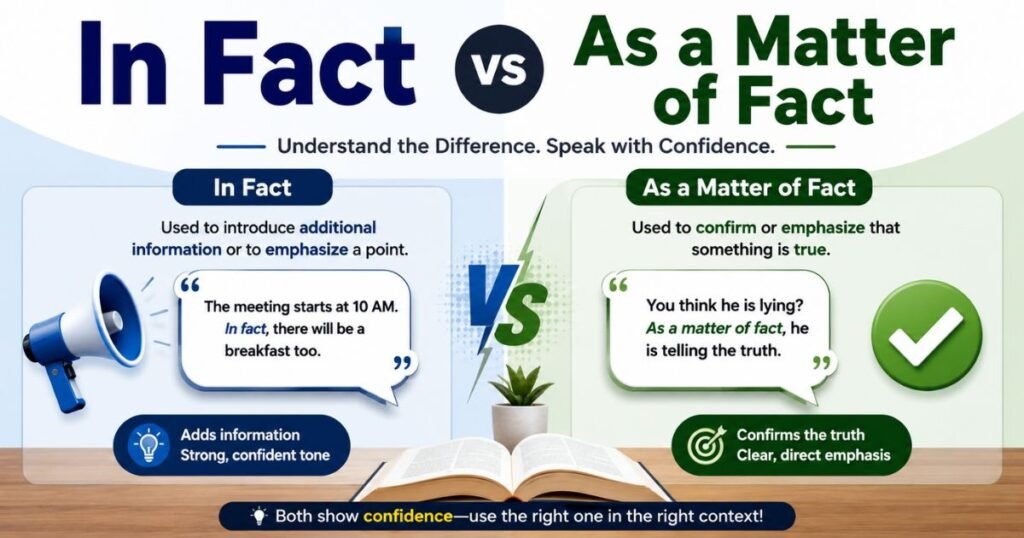
“As a matter of fact” means almost the same thing as “in fact,” but it’s longer and often used in spoken English. “In fact” is shorter and works well in both writing and speech.
- “As a matter of fact, I was just about to call you.”
- “In fact, I was just about to call you.”
Common Mistakes and Corrections
Here’s a quick table showing frequent errors and how to fix them.
| Mistake | Correction | Why |
| Infact, I agree with you. | In fact, I agree with you. | “Infact” is not a word. |
| She is infact very talented. | She is, in fact, very talented. | Needs a space and commas. |
| Infact he was late again. | In fact, he was late again. | Missing space and comma. |
| The results were, infact, surprising. | The results were, in fact, surprising. | Needs a space between words. |
A simple way to check your writing is to pause after typing “in fact” and make sure there’s a visible space between the two words before you move on.
Advanced Usage of In Fact
Once you’re comfortable with the basics, you can use “in fact” in more advanced and effective ways.
Strengthening Arguments
Writers use “in fact” to back up a claim with solid proof, making their argument more convincing.
- “The product isn’t just popular. In fact, it’s the top seller in its category.”
Academic Tone
In essays and research papers, “in fact” helps connect a general statement to specific evidence, giving the writing a more scholarly tone.
- “Climate change isn’t a future problem. In fact, its effects are already visible today.”
Persuasive Writing
In marketing or opinion pieces, “in fact” grabs attention and builds trust by presenting facts that support the writer’s message.
- “Our customers don’t just like the service. In fact, ninety percent return within a month.”
Related Confusing Word Pairs
“In fact” isn’t the only phrase people mix up. Here are a few similar pairs worth knowing.
- A lot vs Alot: “A lot” is correct; “alot” is not a word.
- All right vs Alright: “All right” is the traditional correct form, though “alright” is now widely accepted in casual writing.
- In spite of vs Inspite: “In spite of” is correct; “inspite” is incorrect.
- In order to vs Inorder: “In order to” is correct; “inorder” is not standard English.
Learning these patterns together can help you avoid similar spacing mistakes across your writing.
Practice Exercises
Test yourself with these quick exercises to lock in what you’ve learned.
Fill in the Blanks
- I thought the exam was hard. ___, most people passed easily.
- She seemed shy at first, but ___, she’s very outgoing.
- The company said sales dropped, but ___, they went up.
(Answer: “In fact” for all three.)
Correct the Sentence
- Infact, we should leave now.
- He was infact telling the truth.
- The weather was infact perfect for the trip.
(Corrected: “In fact, we should leave now.” / “He was, in fact, telling the truth.” / “The weather was, in fact, perfect for the trip.”)
Writing Tips to Avoid the Infact Mistake
A few small habits can help you avoid this error permanently.
- Always read your sentence aloud before finalizing it, since a pause naturally falls between “in” and “fact.”
- Use a grammar checker tool, but don’t rely on it completely, since some tools miss this error.
- Practice writing the phrase in different sentence positions until it feels natural.
- Remember that “in fact” behaves like other two-word phrases such as “in time” or “in order,” not like single compound words.
- Proofread your work a second time, focusing only on spacing and punctuation.
Final Thoughts
Getting “in fact” right is a small detail, but it makes a big difference in how polished your writing looks. Whether you’re writing a casual message, a school essay, or a business report, using the correct spelling shows attention to detail and builds trust with your reader. The rule is simple: it’s always two words, never one.
With a little practice, this mistake becomes easy to avoid. Read your sentences carefully, remember the comma rules, and treat “in fact” the same way you would treat other two-word phrases. Once the habit sticks, you’ll never have to second-guess this phrase again.

Mubeen is a passionate writer who shares simple and practical English grammar, vocabulary, and writing tips at ScoopVisly.