

“Of course” is the correct spelling. It is always written as two separate words. “Ofcourse” is not a real word in English. It is a common spelling mistake that happens when people type fast or say the phrase quickly in their head.
If you remember one thing from this article, remember this: “of” and “course” are always separate. There is no version of English, formal or casual, where joining them into one word is correct.
Here is a simple table to make it clear from the start:
| Form | Correct? | Used In |
| Of course | Yes | Formal and informal writing, speech |
| Ofcourse | No | Never correct, common typing error |
| Of-course | No | Never correct, incorrect hyphenation |
Of Course vs Ofcourse Meaning
“Of course” is a phrase used to show agreement, confirmation, or something that is obviously true. People use it to say yes in a warm, natural way. It can also mean “as expected” or “naturally.”
For example, if someone asks, “Can you help me move this weekend?” you might reply, “Of course, I’d be happy to.” Here, the phrase shows willingness and a friendly tone. It feels more personal than just saying “yes.”
“Ofcourse,” on the other hand, has no meaning at all. It is not listed in any dictionary, not in Oxford, not in Merriam-Webster, not in Cambridge. It is simply a misspelling that happens because the two words sound like one when spoken quickly. Our brains sometimes merge sounds in speech, and that habit slips into writing.
This mix-up is similar to other common English errors, like writing “alot” instead of “a lot,” or “infront” instead of “in front.” In each case, two words get squeezed into one by mistake.
Of Course vs Ofcourse Difference
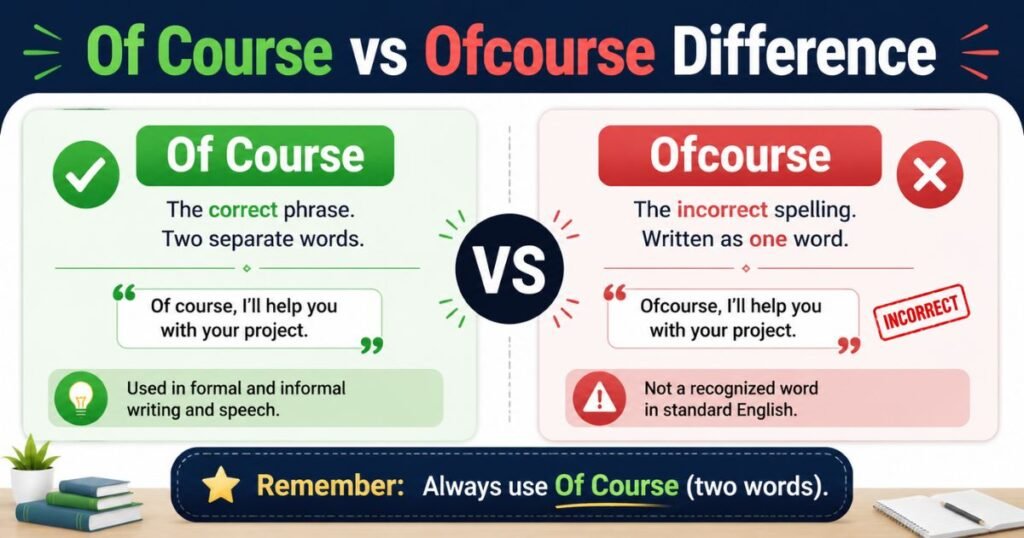
The core difference is simple: one is real English, and the other is not. But let’s break this down further so the difference is crystal clear.
Spelling difference “Of course” has a space between the two words. “Ofcourse” removes that space, which changes it from a proper phrase into an error.
Grammatical difference “Of” is a preposition. “Course” is a noun here, referring to a path or a natural direction of action. Together, they form a set phrase called an idiom. Idioms are made of separate words that carry meaning as a group, so removing the space breaks the grammar entirely.
Usage difference “Of course” fits in any sentence, spoken or written, formal or casual. “Ofcourse” does not fit anywhere because it is not a recognized word.
Here is a quick comparison table:
| Feature | Of Course | Ofcourse |
| Word count | 2 words | Incorrectly joined as 1 |
| Dictionary listed | Yes | No |
| Grammatically correct | Yes | No |
| Common in texting/typos | Sometimes misspelled | Frequently seen error |
| Acceptable in essays, emails, resumes | Yes | Never |
Grammar Rule Depth
To understand why “of course” stays as two words, it helps to look at how English idioms work. Many common phrases in English are built from small, simple words that combine to create a new meaning. Think of phrases like “in fact,” “at least,” or “by the way.” None of these are written as single words, even though we say them quickly in conversation.
“Of course” follows the same pattern. “Of” shows a relationship, and “course” refers to the natural or expected path of something. When combined, they mean something is expected, obvious, or agreed upon. Because this is a two-word idiom, English grammar rules require the space to stay.
There is no grammatical rule anywhere that allows merging a preposition with a noun into a single word, unless that combination has already become an accepted compound word over time, like “into” or “onto.” “Of course” has never gone through that shift. It has remained two words for centuries, and it is expected to stay that way.
A simple test you can use: if you can insert another word in between and it still makes some sense, it is very likely meant to remain two separate words. For example, you could technically say “of the course,” which shows the phrase is built from individual parts, not one solid unit.
The Origin of Of Course
The phrase “of course” has roots going back to Middle English and even earlier French influence. The word “course” originally meant a path, a route, or a natural progression of events, much like how we still use “course” in phrases like “the course of history” or “a river’s course.”
Over time, “of course” came to describe something that follows a natural or expected path. If something happens “of course,” it means it happens the way anyone would expect it to happen. This is why the phrase later became a natural way to say yes, because agreeing with something obvious felt like following its natural course.
Language historians note that phrases built with “course” appeared in English writing centuries ago, often in formal and literary contexts. Slowly, “of course” moved from formal writing into everyday speech, becoming one of the most common expressions in the English language today.
Because the phrase has such a long history as two separate words, there was never a point where merging them became standard. This is part of why “ofcourse” still looks so wrong to trained eyes, even though it sounds identical when spoken.
Why People Write Ofcourse Instead of Of Course
This mistake is more common than people think, and there are clear reasons behind it.
Reason 1: Speech merges the sound When we speak, “of course” often comes out sounding like one smooth word, “ofcorse.” Since writing often follows how we hear things in our heads, this leads to the merged spelling.
Reason 2: Fast typing habits On phones and keyboards, people type quickly and skip spaces without noticing, especially in casual chats or social media comments.
Reason 3: Autocorrect confusion Some phone keyboards do not always catch this error, especially if the user has typed it wrong before and the keyboard has learned the pattern.
Reason 4: Non-native English learners Many English learners come from languages where similar expressions are written as single words. This makes it natural to assume English works the same way.
Reason 5: Visual pattern matching People often see or type “become,” “however,” or “although,” which are single words with similar rhythm. This can create a false pattern in the brain that leads to merging “of course” too.
Here is a short list of similar common merging mistakes for comparison:
- “Alot” instead of “a lot”
- “Infact” instead of “in fact”
- “Aswell” instead of “as well”
- “Atleast” instead of “at least”
- “Incase” instead of “in case”
Real World Usage of Of Course
“Of course” appears constantly in daily conversations, business communication, customer service, and even academic writing. It is one of the most flexible and widely used expressions in English.
In workplaces, people use it to sound polite and cooperative. In customer support chats, agents use it to reassure customers. In casual conversations between friends, it adds warmth and confidence to a response.
Here are common real world settings where “of course” is used correctly:
| Setting | Example Sentence |
| Customer service | “Of course, I can help you with that today.” |
| Workplace email | “Of course, I’ll send the report by tomorrow.” |
| Casual conversation | “Of course I remember your birthday!” |
| Academic writing | “Of course, further research is needed to confirm this.” |
| Public speaking | “Of course, no plan is perfect, but we tried our best.” |
This shows how naturally the phrase fits into almost any tone, from formal writing to relaxed chatting.
Of Course in Everyday Examples
Seeing the phrase used in different situations helps make its meaning stick. Below are simple, everyday examples that show its flexibility.
Agreeing with someone “Can I borrow your charger?” “Of course, here you go.”
Confirming something obvious “Did you lock the door before leaving?” “Of course I did.”
Softening a response “I know this is a busy time for you, of course, but could you review this quickly?”
Expressing understanding “Of course, I understand why you’re upset.”
Making a polite offer “Of course, feel free to reach out anytime you need help.”
These examples show that “of course” is rarely just a simple yes. It often adds warmth, respect, or reassurance to the sentence.
Common Mistakes with Of Course vs Of Course
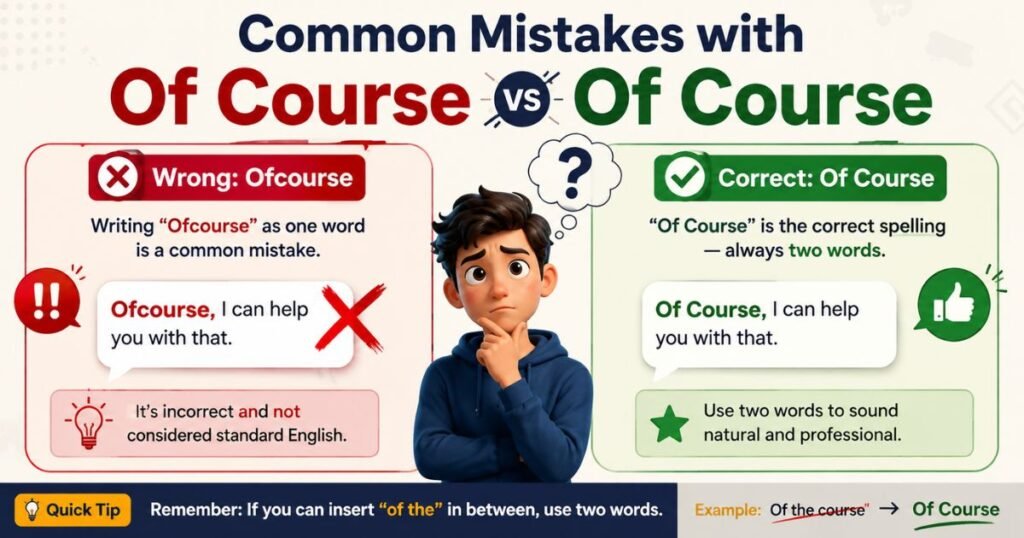
Even careful writers sometimes slip up with this phrase. Here are the most common mistakes people make.
- Writing “of course” as one word, especially in fast typing or texting
- Adding a hyphen, writing “of-course,” which is also incorrect
- Overusing the phrase so often that it loses its natural tone
- Using it in situations where it may sound dismissive, such as replying “of course” in a slightly sharp tone to a serious question
- Mixing it up with “off course,” which is a completely different phrase meaning to go in the wrong direction, especially for ships or planes
This last point deserves extra attention. “Off course” and “of course” sound close but mean very different things.
| Phrase | Meaning | Example |
| Of course | Yes, naturally, obviously | “Of course, I’ll be there.” |
| Off course | Moving away from the correct path | “The ship drifted off course during the storm.” |
Mixing these up can confuse readers, especially in writing where tone and precision matter.
Tone and Politeness with Of Course
“Of course” can carry different emotional tones depending on how it is used. This makes it a powerful phrase, but also one that needs a little care.
Used warmly, it signals friendliness and openness. For example, “Of course, I’d love to help” sounds kind and genuine. It shows the speaker is happy to assist, not just agreeing out of obligation.
However, “of course” can also sound blunt or slightly annoying if used in the wrong context. For example, replying “Of course” sharply to a question like “Did you finish the report?” might come across as impatient, as if the answer was obvious and the question was unnecessary.
To keep the tone polite, many people pair “of course” with softer words, such as:
- “Of course, no problem at all.”
- “Of course, happy to help.”
- “Of course, that makes sense.”
This small addition keeps the phrase warm rather than curt, especially in professional or customer facing communication.
Related Expressions
English has several phrases that carry a similar meaning to “of course.” Knowing these gives writers more variety and helps avoid repeating the same phrase too often.
| Expression | Meaning | Example |
| Naturally | Something expected | “Naturally, she agreed to help.” |
| Certainly | A confident yes | “Certainly, I can do that.” |
| Absolutely | Strong agreement | “Absolutely, let’s move forward.” |
| Sure thing | Casual agreement | “Sure thing, I’ll handle it.” |
| Without a doubt | Full confidence | “Without a doubt, this is the right choice.” |
Using a mix of these expressions, along with “of course,” keeps writing and speech sounding natural instead of repetitive.
Usage Trends
Language data shows that “of course” remains one of the most frequently used phrases in English, both in speech and writing. It appears heavily in spoken dialogue, interviews, customer service scripts, and everyday conversation.
At the same time, search engine data shows a steady number of people typing “ofcourse” into search bars, usually to check spelling or confirm which version is correct. This tells us the mistake is common enough that many people pause to double check it, which is a good habit.
Social media and texting have increased casual writing overall, which sometimes blurs spelling rules. Still, in professional writing, formal documents, and published content, “of course” remains the only accepted form. Style guides, grammar checkers, and editors consistently mark “ofcourse” as an error.
This shows a clear pattern: casual speech and quick typing create the mistake, but formal standards continue to protect the correct two word form.
Advanced Usage of Of Course

Beyond simple agreement, “of course” has some advanced and subtle uses that skilled writers and speakers use to add depth to their sentences.
As a transitional phrase “Of course, there are exceptions to every rule.” Here, it introduces a shift or a balancing point in an argument.
As a rhetorical softener Writers use it to acknowledge an obvious point before moving to a stronger one. “Of course, practice matters, but talent still plays a role.”
In persuasive writing “Of course, no solution is perfect, but this comes closest.” This builds trust with the reader by admitting limits before making a claim.
In storytelling “Of course, nothing ever goes according to plan.” This creates a reflective or slightly humorous tone in narrative writing.
These advanced uses show that “of course” is not just a simple filler phrase. It can shape tone, build trust, and guide the reader’s thinking when used thoughtfully.
Final Thoughts
“Of course” is a small phrase, but it carries a lot of weight in everyday English. It shows agreement, builds warmth, and helps conversations flow naturally. Understanding its correct spelling, its history, and its many uses helps writers sound clear, polished, and confident.
“Ofcourse” is simply a spelling slip, not a real alternative. Once you understand why space matters and how the phrase developed over time, it becomes easy to remember. With a bit of attention, this is one grammar mistake you can eliminate for good.
FAQ,s
Is “ofcourse” a real word?
No, “ofcourse” is not a real word. The correct spelling is always “of course,” written as two separate words.
What does “of course” mean?
“Of course” means yes, naturally, or obviously. It is used to confirm something or agree with someone in a friendly way.
Why do people write “ofcourse” instead of “of course”?
People often write “ofcourse” because the phrase sounds like one word when spoken quickly, leading to a common typing mistake.
Is “of course” formal or informal?
“Of course” works in both formal and informal writing. It fits naturally in business emails, casual chats, and academic writing.
What is the difference between “of course” and “off course”?
“Of course” means yes or obviously, while “off course” means moving away from the correct path or direction.
Can “of course” sound rude?
Yes, if said sharply, “of course” can sound impatient. Pairing it with warm words like “happy to help” keeps the tone polite.
What are some alternatives to “of course”?
Common alternatives include “certainly,” “absolutely,” “naturally,” and “sure thing,” which all express agreement in a similar way.
Conclusion
“Of course” is the only correct way to write this phrase, and “ofcourse” is simply a spelling error that happens due to fast speech or quick typing.
Now that you know the meaning, origin, and correct usage of “of course,” you can use it confidently in any type of writing, from casual texts to professional documents. A small correction like this can make your writing look more polished and trustworthy to readers.

Mubeen is a passionate writer who shares simple and practical English grammar, vocabulary, and writing tips at ScoopVisly.