

Have you ever typed “planing” when you meant “planning,” or wondered if they were even different words at all? You are not alone. These two words look almost identical, differing by just one letter, yet they describe completely different actions. One lives in your calendar and to-do list, while the other lives in a carpenter’s workshop.
In this guide, we will break down exactly what each word means, why people mix them up so often, and how to use them correctly in everyday writing, business communication, and technical fields. By the end, you will have a simple memory trick that makes choosing the right word effortless every time.
Quick Answer
“Planning” means preparing or organizing something before you do it. “Planing” means smoothing a wooden or metal surface with a tool called a plane. They sound almost the same, but they mean completely different things.
Examples
- She is planning her wedding for next spring.
- The carpenter is planing the wood to make it smooth.
- Our team spent all week planning the new product launch.
- He used an electric planer for planing the old door.
Planning vs Planing Meaning
Planning
Planning is the act of thinking ahead. It means setting goals, making decisions, and organizing steps to reach a result. People use this word every day, in homes, offices, schools, and even in casual chats about weekend trips.
Examples
- The city is planning a new park near the river.
- We are planning our budget for the next quarter.
- She spent the evening planning her study schedule.
Planing
Planing is a hands-on, physical action. It refers to using a tool, usually called a plane, to shave off thin layers from a wooden or metal surface. This makes the surface flat, smooth, and even. You will hear this word mostly in workshops, construction sites, and factories.
Examples
- The worker is planing the table top before painting it.
- Planing the door helped it close properly.
- He learned planing techniques during his carpentry course.
Planning vs Planing Difference
Key Point
The core difference comes down to this: planning is a mental process, while planing is a physical process. One happens in your head or on paper. The other happens with a tool in your hand.
| Feature | Planning | Planing |
| Meaning | Preparing or organizing ahead of time | Smoothing wood or metal with a plane tool |
| Type of action | Mental, strategic | Physical, hands-on |
| Common field | Business, life, education | Woodworking, carpentry, manufacturing |
| Spelling | Double N | Single N |
| Word root | Plan | Plane |
Grammar Rule Depth
The spelling rule here follows a simple pattern in English grammar. When a short word ends in a single vowel plus a single consonant, and you add “-ing,” you often double the last letter. “Plan” ends this way, so it becomes “planning.” But “plane” already ends in a silent “e.” You drop that “e” before adding “-ing,” which gives you “planing,” with just one N.
Planning
Think of “plan” as your base word. It has one syllable and ends with a single “n” after a vowel. Adding “-ing” doubles that final consonant, giving “planning.”
Examples
- Plan → Planning: We are planning the trip.
- She has been planning this event for months.
Planing
Think of “plane” as your base word. It ends with a silent “e.” You remove that “e” first, then add “-ing,” which gives “planing.”
Examples
- Plane → Planing: He is planing the wooden shelf.
- Planing removes rough spots from the surface.
Why People Confuse Planning and Planing
Similar Spelling
Both words look almost the same on paper. Only one letter separates them, so it is easy for the eye to skip right past the difference.
Similar Pronunciation
When spoken quickly, “planning” and “planing” can sound close to each other, especially in casual conversation or through audio content like podcasts and videos.
Lack of Awareness
Many people simply do not know that “planing” is a real word. Since “planning” is far more common, people assume any similar-looking word must be a typo.
Typing Errors
Autocorrect and fast typing often cause one letter to slip. A missing “n” can quietly change your sentence’s meaning without you noticing.
The Origin of Planning and Planing
Planning Origin
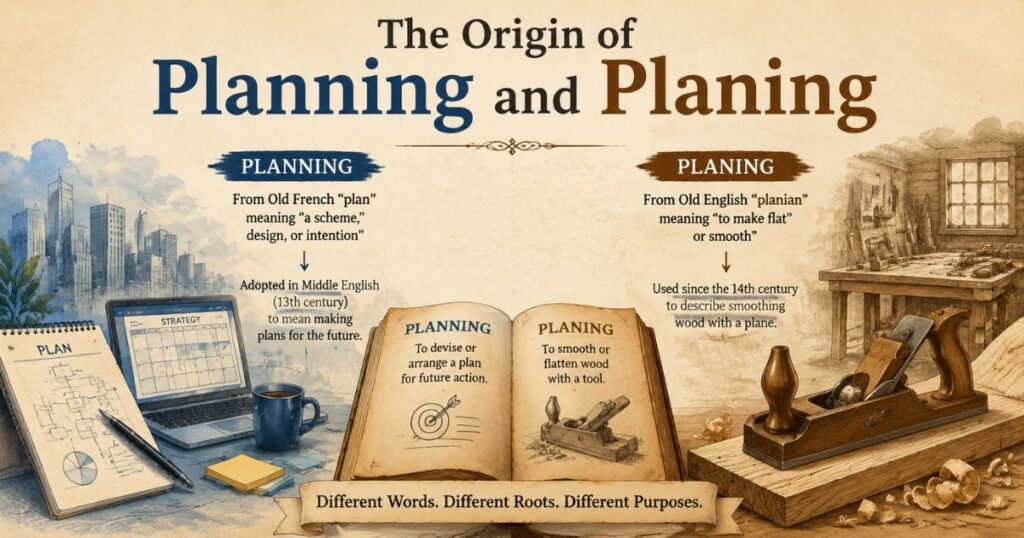
The word “plan” comes from the French word “plan,” which itself traces back to the Latin word “planus,” meaning flat or level. Over time, English speakers used “plan” to describe a drawing or a scheme, and eventually a mental scheme for future action. Adding “-ing” turned it into the ongoing action of making plans.
Planing Origin
The word “plane,” in the woodworking sense, also comes from Latin “planus,” meaning flat. A plane tool creates a flat surface, so the connection to flatness runs through both words. This shared root is actually part of why the two words look so similar today, even though their modern meanings have moved apart.
Planning in Everyday English
Personal Planning
People plan their daily routines, holidays, finances, and even small tasks like grocery shopping. Personal planning helps reduce stress and keeps life organized.
Examples
- I am planning my morning routine to save time.
- She is planning a surprise party for her mother.
Business Planning
Companies rely on planning to set goals, manage budgets, and prepare for growth. Without planning, businesses often struggle to stay on track.
Examples
- The company is planning to expand into new markets.
- Our manager is planning next year’s marketing strategy.
Academic Planning
Students and teachers use planning to organize lessons, assignments, and exam schedules. Good academic planning often leads to better results and less last-minute stress.
Examples
- The teacher is planning next week’s lessons.
- He is planning his study timetable for finals.
Planing in Technical Contexts
Woodworking
In woodworking, planing is one of the most basic and important skills. Carpenters use a plane to remove rough patches from wood, giving furniture a smooth, professional finish.
Examples
- The craftsman spent an hour planing the tabletop.
- Planing gave the wooden frame a clean edge.
Manufacturing
In manufacturing, machines called planers do large-scale planing work. These machines shape metal or wood parts quickly and accurately, which is important for factories that build furniture, tools, or vehicle parts.
Examples
- The factory uses automated planing machines for mass production.
- Planing helps create uniform metal panels.
Aviation Meaning
Interestingly, “planing” also shows up in aviation and boating. It describes when a boat or seaplane rises and skims across the surface of water instead of pushing through it.
Example
- The speedboat began planing once it reached top speed.
Planning vs Planing in Professional Writing
Incorrect Example
“The team is planing the quarterly budget review.”
Correct Version
“The team is planning the quarterly budget review.”
Why It Matters
In professional writing, a single wrong letter can confuse readers or make your work look careless. Business reports, emails, and presentations should always use “planning” when talking about organizing tasks or strategies. Save “planing” only for content about woodworking, carpentry, or similar physical trades.
Planning vs Planing in Emails
Correct Examples
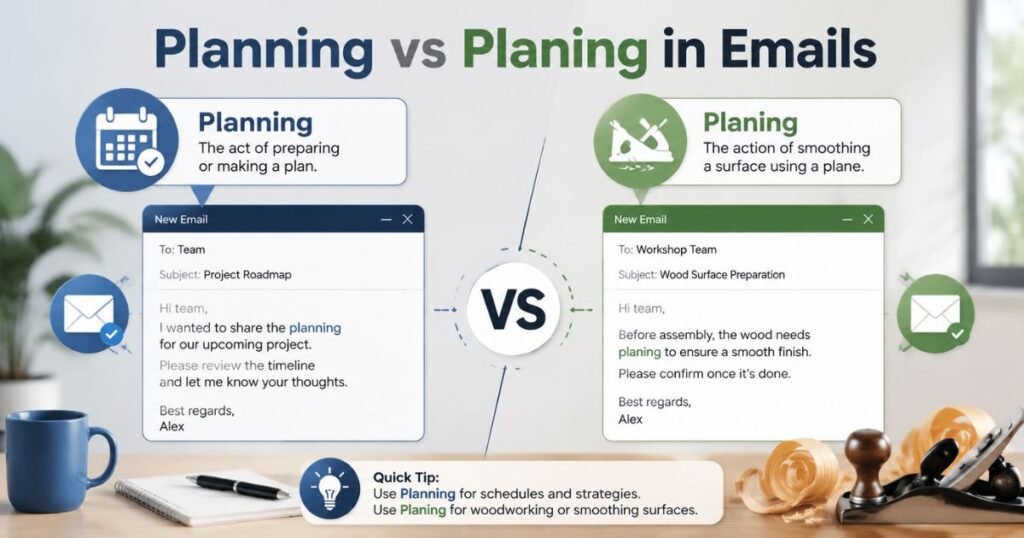
- I am planning to send the report by Friday.
- We are planning a meeting next week to discuss the budget.
Incorrect Examples
- I am planing to send the report by Friday. (wrong word)
- We are planing a meeting next week. (wrong word)
A quick proofread before hitting send can catch this simple mistake and keep your email looking polished.
Planning vs Planing in Social Media
Correct Usage
Most social media posts about events, trips, or goals should use “planning.”
- We’re planning our next big adventure.
- Planning my content calendar for next month.
Technical Usage
Woodworking and DIY content creators correctly use “planing” when showing hands-on work.
- Watch me planing this old table back to life.
- Planing tutorial: how to get a smooth wooden finish.
Planning vs Planing in News Writing
Examples
News articles about government decisions, business moves, or public events almost always use “planning.”
- City officials are planning new traffic rules for downtown.
- The company announced it is planning layoffs next quarter.
Example
Only trade-specific or niche articles, like furniture-making features, use “planing.”
- The article explained traditional planing methods used by furniture makers.
Common Mistakes with Planning vs Planing
Mistake 1: Using Planing Instead of Planning
This is the most frequent error. Writers often drop the extra “n” by accident, especially when typing fast.
Mistake 2: Forgetting the Double N
Some people remember “plan” needs “-ing” added but forget the spelling rule that doubles the final consonant.
Mistake 3: Confusing Technical and General Meaning
Some writers use “planing” in a general context, thinking it just means the same as “planning” with different spelling. This is incorrect, since the words describe two unrelated actions.
Related Words and Expressions
Planning Related Words
- Planner
- Plan
- Planned
- Strategy
- Scheduling
Planning Related Words
- Plane
- Planer
- Planed
- Surface
- Smoothing
Real World Examples of Planning
Business Example
A startup founder spends weeks planning her product launch, mapping out marketing, budgets, and timelines before the big release day.
Travel Example
A family sits down together, planning their summer road trip, picking cities to visit and booking hotels ahead of time.
Education Example
A university department is planning its course schedule for the next academic year, balancing teacher availability and student demand.
Event Example
An event planner is planning a wedding, coordinating vendors, decorations, and guest lists months in advance.
Real World Examples of Planing
Carpentry Example
A furniture maker is planing a rough wooden plank until it becomes smooth enough to varnish and sell.
Construction Example
A construction crew is planing wooden beams so they fit perfectly into the frame of a new house.
Manufacturing Example
A factory worker operates a planing machine to shape metal sheets used in car parts.
Which Word Should You Use
Use Planning When
- You are talking about organizing an event, task, or goal
- You are describing a business or personal strategy
- You are writing about future actions or decisions
Examples
- We are planning our vacation for August.
- The board is planning a new policy.
Use Planing When
- You are describing woodworking or metalworking
- You are talking about smoothing a rough surface
- You are describing a boat skimming across water
Examples
- He is planing the wooden door frame.
- The boat started planing across the lake.
Memory Trick for Planning vs Planing
Planning Has Double N
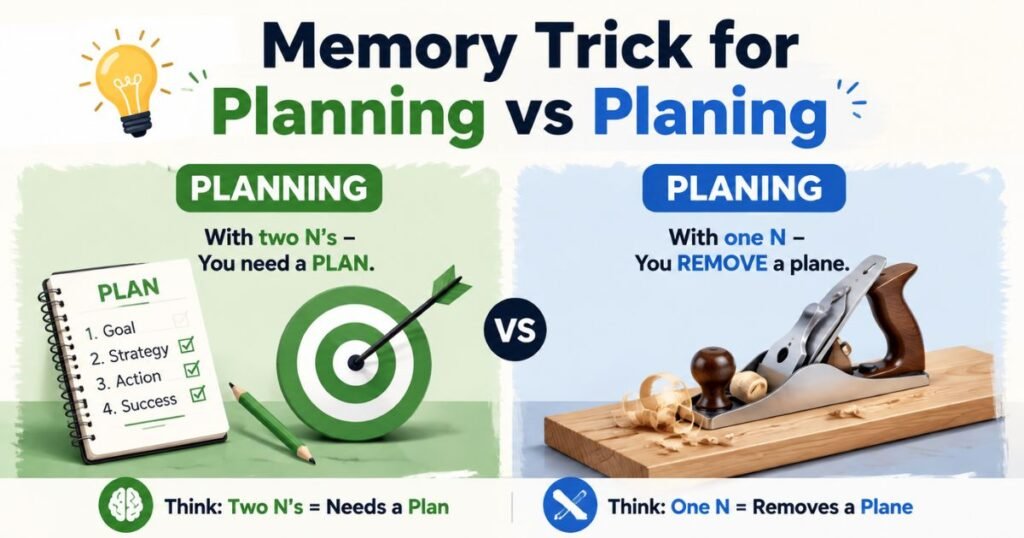
Think of “planning” as needing extra effort, just like the double “n” shows extra letters for a mental task that takes more thought and preparation.
Planing Has One N
Think of “planing” as simple and single, just like the single “n” matches a single physical action of smoothing a surface with one tool.
Planning vs Planing Usage Trends
Comparison Table
| Category | Planning Usage | Planing Usage |
| Everyday conversation | Very common | Rare |
| Business writing | Very common | Almost never |
| Woodworking content | Rare | Very common |
| Social media | Very common | Only in DIY niches |
| News articles | Very common | Only trade-specific pieces |
Planning appears far more often in daily English because it fits so many situations, from work to home life. Planing stays limited to specific trades, but it remains an essential word in those fields.
Planning Idioms and Expressions
Planning Ahead
This phrase means preparing early for future events. Example: “Planning ahead saved us a lot of stress during the move.”
Strategic Planning
This term is common in business, describing long-term goal setting. Example: “The company held a strategic planning session last week.”
Financial Planning
This phrase refers to organizing money matters, like savings, investments, and budgets. Example: “A financial planner can help with your retirement planning.”
Planing Tools and Equipment
Hand Plane
A hand plane is a simple tool with a blade, used by carpenters to shave wood by hand. It gives precise control for small jobs.
Electric Planer
An electric planer speeds up the planing process. It works well for larger wood pieces and saves time compared to manual tools.
Industrial Planing Machines
Factories use large planing machines to shape wood or metal at scale. These machines handle heavy, repetitive planing work with high accuracy.
Why Correct Spelling Matters
Using the wrong word, even by one letter, can confuse your reader or make your writing look unprofessional. In business emails, reports, or resumes, this small mistake can leave a poor impression. Getting it right shows attention to detail and builds trust with your audience.
Exercises
Exercise 1: Choose the Correct Word
- We are (planning/planning) a trip to the mountains.
- He is (planning/planing) the wooden table.
- The team is (planning/planning) next year’s budget.
- The carpenter is (planning/planing) the door frame.
Exercise 2: Correct the Sentence
- “I am planning my schedule for tomorrow.” → Correct: “I am planning my schedule for tomorrow.”
- “He is planning the rough wood surface.” → Correct: “He is planing the rough wood surface.”
Final Thoughts
Planning and planing may look similar, but they belong to two very different worlds. Planning is about thinking, organizing, and preparing for the future, whether that is a business goal, a family trip, or a school project. Planing, on the other hand, is a hands-on craft, tied closely to woodworking, carpentry, and manufacturing, where a tool smooths rough surfaces into something clean and usable.
Remembering the difference does not have to be hard. Just picture the double “n” in “planning” as extra thought and preparation, and the single “n” in “planing” as one simple physical action. With this small memory trick, you will never mix up these two words again, whether you are writing an email, a report, or a story about a carpenter’s workshop.
Conclusion
Planning and planing are two words that look alike but serve completely different purposes. Planning covers the mental work of preparing for the future, used across business, education, travel, and daily life. Planing describes the physical craft of smoothing wood or metal surfaces, common in carpentry and manufacturing.
By remembering the simple spelling rule, double N for the mental process, single N for the physical one, you can confidently use both words correctly. Whether you are writing a business report or describing a carpenter’s work, choosing the right word keeps your writing clear, accurate, and professional.

Mubeen is a passionate writer who shares simple and practical English grammar, vocabulary, and writing tips at ScoopVisly.