

Spelling mistakes can slip into our writing without warning, and “trainning” is one of the most common ones people search for online. It shows up in resumes, emails, school papers, and even business reports. Even confident writers pause for a second and wonder if it needs one “n” or two.
This article clears up the confusion once and for all. You will learn the correct spelling, the reason behind the rule, and how to spot this mistake before it appears in your own writing. By the end, you will never have to guess again.
Quick Answer
Many people search for “trainning” every day. It looks like it could be right. It sounds close to how we say the word. But it is not correct English. The right word is “training,” with only one “n” in the middle.
This guide explains why “training” is correct, why “trainning” is wrong, and how you can avoid this mistake forever. We will look at spelling rules, real examples, and common situations where this error shows up.
Quick Answer
The correct spelling is training. The word “trainning” is a spelling mistake and does not exist in standard English dictionaries.
Training comes from the verb “train.” When we add “-ing” to make it a noun or a continuous verb form, we do not double the letter “n.” This is because of a simple English spelling rule based on how the word sounds and how it is built.
Simple Examples
Here are a few quick examples to show the difference clearly:
| Correct | Incorrect |
| Training | Trainning |
| She is training for a marathon. | She is trainning for a marathon. |
| The company offers staff training. | The company offers staff trainning. |
| He completed his training last week. | He completed his trainning last week. |
Once you see them side by side, the correct spelling becomes easy to remember.
Why Training Is Correct and Trainning Is Wrong
Base Word
The word “training” starts with the base word “train.” Train is a simple verb that means to teach someone a skill or to prepare for something through practice. When we want to turn this verb into its “-ing” form, we simply add “-ing” at the end.
So the word becomes: train + ing = training. There is no reason to add an extra “n” anywhere in this process.
Why We Do Not Double the N
In English, we sometimes double the last letter of a word before adding “-ing.” But this only happens under certain conditions. The word “train” does not meet those conditions, so the final “n” stays as it is.
This is the main reason “trainning” is wrong. People assume doubling happens everywhere, but it does not. English spelling rules are specific, and once you learn them, this mistake becomes easy to avoid.
Deep Spelling Rule Explanation
When Do We Double the Final Consonant?
English has a rule that helps us know when to double the last letter of a word. It usually applies when:
- The word has one syllable, or the stress falls on the last syllable
- The word ends with a single vowel followed by a single consonant
- Adding “-ing” or “-ed” would normally follow this pattern
For example, “run” becomes “running” because it ends in a single vowel and a single consonant, and the stress is on that syllable.
Why Train Does Not Double
The word “train” ends with two vowels together (“ai”) before the “n.” Because of this, it does not follow the doubling rule. The rule only applies when a single vowel comes right before the final consonant.
Since “train” has “ai” before the “n,” English spelling treats it differently. This is why we simply add “-ing” without doubling anything. The result is “training,” not “trainning.”
Why People Make This Mistake
Confusion With Similar Words
Some English words do double their final consonant, like “running,” “swimming,” and “planning.” Because these words are common, people sometimes apply the same pattern to every “-ing” word without checking the spelling rule first.
Visual Assumption
Many learners assume that longer or more “important-sounding” words need extra letters to look complete. Since “training” is used often in formal writing, some people feel it needs a stronger, doubled spelling. This assumption is simply incorrect.
Lack of Spelling Rule Knowledge
Not everyone learns the exact rule about single vowels and single consonants before adding “-ing.” Without this rule, it is easy to guess wrong, especially for non-native English speakers.
Typing Errors
Sometimes “trainning” is not a spelling mistake at all. It is just a typing slip. Fast typing on a phone or keyboard can lead to an extra letter appearing by accident.
Resume and Professional Writing Pressure
People often write about “training” in resumes, cover letters, and reports. Under pressure to sound professional, they may rush and misspell the word without noticing. This is one of the most common places where “trainning” appears by mistake.
Training in Real World Usage

Workplace Usage
In offices and companies, “training” refers to programs that help employees learn new skills. HR departments often use phrases like “employee training,” “training session,” or “training manual.” Getting this word right matters a lot in workplace documents.
Academic Usage
Schools, colleges, and universities use the word “training” for skill-building programs, internships, and practical courses. Students may write about “teacher training” or “vocational training” in assignments and applications.
Fitness and Sports
Athletes and gym-goers use “training” constantly. Terms like “strength training,” “training schedule,” and “personal training” are part of everyday fitness language. This is one of the most searched contexts for this word online.
Online Learning
E-learning platforms use “training” for courses, modules, and certifications. Words like “online training,” “training video,” and “training platform” are extremely common in this space.
British and American English Usage
The good news is that “training” is spelled the same way in both British and American English. There is no regional difference here, unlike words such as “colour” and “color.”
| Region | Correct Spelling |
| British English | Training |
| American English | Training |
| Australian English | Training |
| Canadian English | Training |
No matter where you are writing from, “training” with one “n” is always the correct choice.
Common Mistakes and Corrections
Here is a simple table showing frequent errors and their corrections:
| Mistake | Correction |
| Trainning program | Training program |
| Staff trainning | Staff training |
| Trainning session | Training session |
| I am trainning today | I am training today |
| Trainning manual | Training manual |
Keep this table handy if you often write reports, emails, or resumes that mention training programs.
Related Words That Follow the Same Rule
Words That Do Not Double
These words behave just like “train” because they contain two vowels before the final consonant:
- Explain → explaining
- Maintain → maintaining
- Contain → containing
- Remain → remaining
- Sustain → sustaining
Words That Do Double
These words double their final letter because they have a single vowel before a single consonant, with stress on the last syllable:
- Run → running
- Swim → swimming
- Plan → planning
- Stop → stopping
- Begin → beginning
Comparing these two groups helps you understand the pattern better and avoid future spelling mistakes.
Advanced Grammar Insight

The rule about doubling consonants connects to something called “syllable stress.” In English, stress patterns affect spelling more than most people realize. Words where the stress falls clearly on the final syllable, and that syllable has a short vowel sound, tend to double the last letter.
Also Read This:Infact or In Fact
“Train” has only one syllable, but its vowel sound is a long “ai” sound, not a short one. This long vowel sound is the real reason doubling does not happen here. Understanding this small detail can help you spell many similar words correctly in the future.
Training vs Trainning in Professional Writing
In business documents, resumes, and official reports, correct spelling matters a lot. A small mistake like “trainning” can make a document look careless, even if the content is strong. Recruiters and managers often notice spelling errors quickly, especially in important documents.
Using spell-check tools, proofreading carefully, and knowing this simple rule can protect your professional image. Since “training” appears so often in job-related writing, getting it right every time is a small but valuable habit.
Training vs Trainning in Sentences
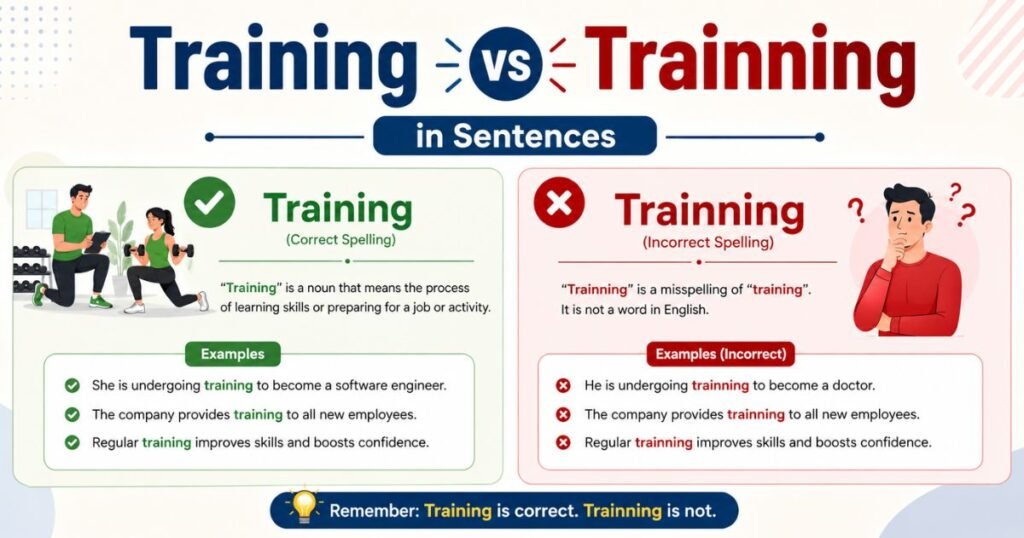
Simple Sentences
- I go for training every morning.
- The training was short but useful.
- She finished her training early.
Medium Sentences
- Our company provides training for all new employees.
- He is currently attending a training session in another city.
- The training program covers both theory and practical skills.
Formal Sentences
- The organization has designed a structured training framework for its staff members.
- Employees are required to complete mandatory training before starting their assigned roles.
- The training initiative aims to improve overall workplace productivity and safety standards.
Practice Exercises
Fill in the Blanks
- She is _______ (train) for the upcoming race.
- The company offers online _______ (train) for new staff.
- He completed his _______ (train) last month.
- We need better _______ (train) materials for the team.
- The manager scheduled a _______ (train) session for Friday.
Choose the Correct Word
- training / trainning
- training program / trainning program
- staff training / staff trainning
- training video / trainning video
- training schedule / trainning schedule
The correct answer in every case above is the version with one “n,” which is “training.”
Conclusion
The correct word is “training,” and “trainning” is simply a common spelling mistake. This error usually happens due to confusion with other doubling rules, typing speed, or a lack of clarity about English spelling patterns. Once you understand why “train” does not double its final letter, this mistake becomes very easy to avoid.
Use this guide as a quick reference whenever you write about workplace training, fitness training, academic training, or online courses. With a little practice, correct spelling will become second nature, and you will always write “training” with confidence.

Mubeen is a passionate writer who shares simple and practical English grammar, vocabulary, and writing tips at ScoopVisly.