

English spelling can trip up even careful writers. One common mix-up is “trys” versus “tries.” Even people who speak English every day sometimes pause and wonder which one is correct. This confusion is understandable, since English spelling rules are not always obvious at first glance.
This guide clears up the confusion in plain, simple language. You will learn the correct spelling, the grammar rule behind it, real examples, common mistakes, and simple tips to remember it for good. By the end, you will never have to second guess this word again.
Trys or Tries Quick Answer
The correct spelling is tries, not “trys.” This is the form of the verb “try” used with he, she, or it in the present tense. “Trys” is a common misspelling and it is never correct in standard English.
Here is a fast reference table:
| Word | Correct? | Used With |
| Tries | Yes | he, she, it, singular nouns |
| Trys | No | Not a real word |
| Try | Yes | I, you, we, they |
If you remember one thing from this article, remember this: always write “tries.”
Trys or Tries Meaning
“Tries” means to make an attempt at something. It comes from the verb “try,” which means to attempt, test, or make an effort to do something. When you add an “s” for the third person singular form, the spelling changes because of a simple English rule.
For example, “She tries her best every day” means she makes an effort every day. The word carries the same meaning as “try” but is used in a specific grammar situation.
Why Tries Is Correct
English has a spelling rule for verbs that end in a consonant plus “y.” When you add an “s” to these verbs, you drop the “y” and add “ies” instead. “Try” ends in a consonant (“r”) followed by “y,” so it follows this exact pattern.
This is why “cry” becomes “cries,” “fly” becomes “flies,” and “try” becomes “tries.” Writing “trys” breaks this rule and looks unfamiliar to native English speakers.
Trys vs Tries Difference
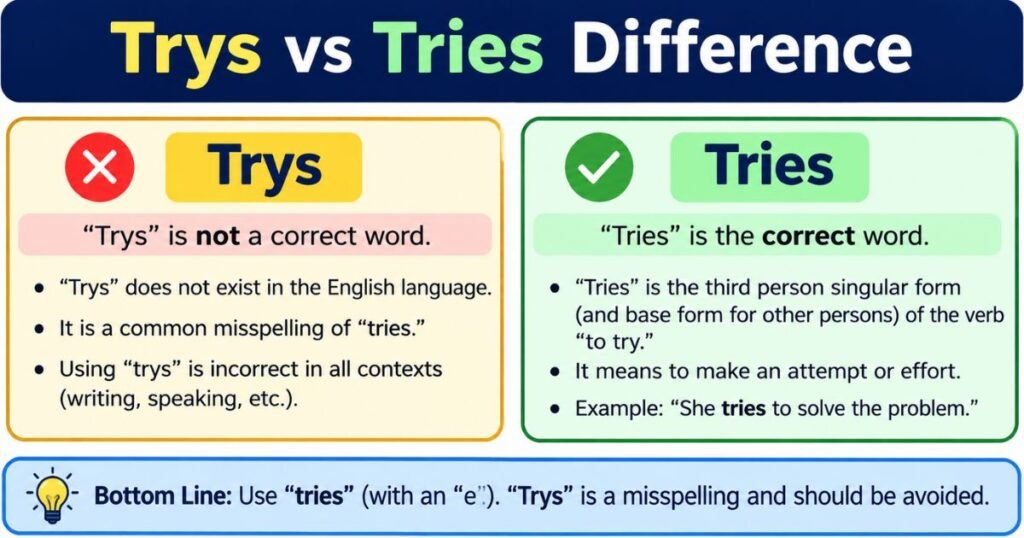
The difference is simple: one is a real word, and the other is not. “Tries” is grammatically correct and appears in dictionaries. “Trys” is a spelling error that some people make by mistake.
- Tries: correct spelling, follows English grammar rules
- Trys: incorrect spelling, not found in any standard dictionary
- Try: the base form, used for I, you, we, and they
There is no situation where “trys” is the right choice. Always use “tries” when you need the third person singular form.
Grammar Rule Depth
The rule behind this spelling change applies to many English verbs, not just “try.” When a verb ends in a consonant followed by “y,” the “y” changes to “ie” before adding “s” for the present tense third person form.
Here are more examples that follow the same pattern:
| Base Verb | Third Person Form |
| Carry | Carries |
| Study | Studies |
| Worry | Worries |
| Deny | Denies |
| Reply | Replies |
Notice that verbs ending in a vowel plus “y,” like “play” or “stay,” do not follow this rule. They simply add an “s” (“plays,” “stays”). This is why some people get confused, since not every “y” verb changes the same way.
The Origin of the Word Try
The word “try” comes from Old French “trier,” which meant to pick out or sift. Over time, English speakers adapted the word to mean testing or attempting something. By the 14th century, “try” had settled into the meaning we use today.
The spelling rules for adding “s,” “ed,” or “ing” to English verbs developed over centuries as the language absorbed influences from French, Latin, and Old English. The “y to ies” pattern became a standard part of English grammar and has stayed consistent ever since.
Why People Write Trys Instead of Tries
Many people write “trys” simply out of habit or a quick typing mistake. Some assume that adding an “s” is always the simplest way to form a plural or verb ending, without thinking about the “y” rule.
Common reasons for this mistake include:
- Typing too fast and skipping the spelling check
- Following the pattern of regular verbs like “plays” or “stays”
- Not learning the “y to ies” rule clearly in school
- Autocorrect not catching the error every time
This mistake is common, especially among people still learning English or writing quickly on phones and social media.
Real World Usage of Tries
“Tries” shows up often in daily conversation, writing, and even sports commentary. In rugby, a “try” is also a scoring move, and the plural “tries” refers to multiple scores. This adds another layer to how the word gets used.
In general writing, “tries” is used constantly in sentences describing effort, attempts, or repeated actions. News articles, books, emails, and casual chats all rely on this word regularly.
Tries in Everyday Examples
Here are some everyday sentences using “tries” correctly:
- My brother tries to wake up early every morning.
- The team tries a new strategy each game.
- She tries not to eat sugar during the week.
- He always tries his hardest in class.
- The company tries to respond within 24 hours.
These examples show how natural and common the word is in daily speech and writing.
Verb Forms of Try
The verb “try” changes form depending on the subject and the tense. Here is a simple breakdown:
| Tense | Form | Example |
| Present (I, you, we, they) | Try | I try my best. |
| Present (he, she, it) | Tries | She tries her best. |
| Past | Tried | He tried yesterday. |
| Future | Will try | They will try tomorrow. |
| Present participle | Trying | We are trying now. |
H3: Example Sentences
- I try to exercise every day.
- She tries to finish her work early.
- They tried a new recipe last night.
- He is trying to fix his car right now.
- We will try again next week.
Common Mistakes With Trys or Tries
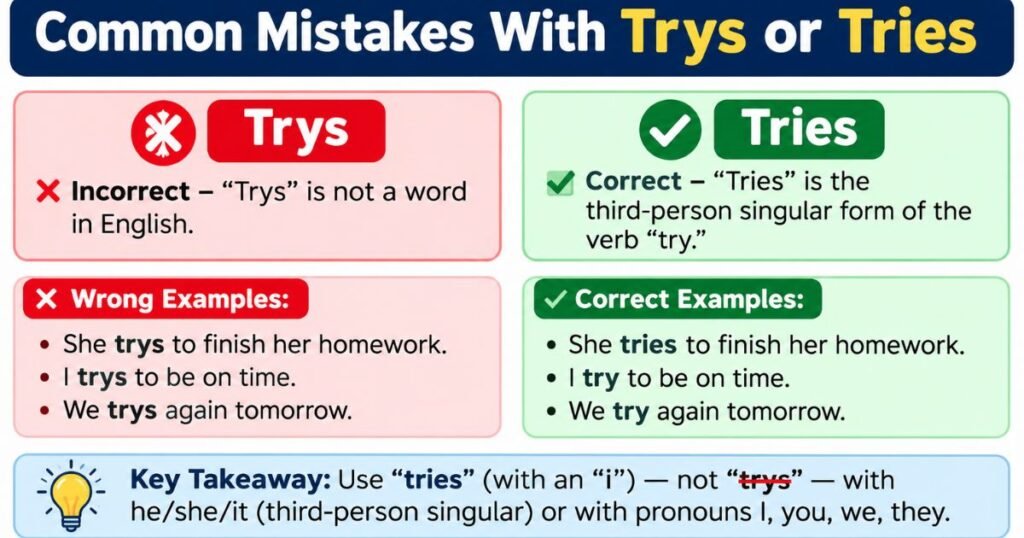
The most common mistake is writing “trys” instead of “tries.” Another mistake is using “try” when the sentence needs “tries,” especially with third person singular subjects like “he,” “she,” or “it.”
Common errors to avoid:
- Writing “He trys hard” instead of “He tries hard”
- Writing “She try every day” instead of “She tries every day”
- Confusing “tries” with “tries” as a rugby term without context
- Forgetting the rule applies to similar words like “flies” and “cries”
Fixing these small errors makes your writing look more polished and professional.
Try vs Tries
“Try” and “tries” are both forms of the same verb, but they fit different subjects. “Try” works with I, you, we, and they. “Tries” works only with he, she, it, or a singular noun.
| Subject | Correct Form |
| I | Try |
| You | Try |
| He/She/It | Tries |
| We | Try |
| They | Try |
| Singular noun (the dog) | Tries |
Getting this pairing right is a small but important part of speaking and writing correct English.
Related Grammar Words
Several other verbs follow the same spelling pattern as “try.” Learning these together can help the rule stick in your memory.
- Cry becomes cries
- Fly becomes flies
- Dry becomes dries
- Apply becomes applies
- Multiply becomes multiplies
All of these end in a consonant plus “y,” so they all change the “y” to “ies” in the third person singular form.
Tips to Remember Tries
Here are simple tips to help you remember the correct spelling every time:
- Remember the rule: consonant plus “y” becomes “ies.”
- Think of similar words like “cries” and “flies” to check the pattern.
- Read your sentence out loud. “He tries” sounds odd once you know the rule.
- Use spelling and grammar tools, but do not rely on them completely.
- Practice writing a few sentences with “tries” until it feels natural.
With a little practice, this spelling becomes automatic.
British English vs American English Usage
The good news is that “tries” is spelled the same way in both British and American English. There is no regional difference for this particular word, unlike words such as “color” and “colour.”
The only difference in usage comes from context. In British English, “tries” is also used in rugby to describe scoring plays, a usage that is less common in American English since rugby is less popular there.
Why Correct Spelling Matters
Correct spelling builds trust with your reader. Small mistakes like “trys” can make writing look rushed or careless, even if the ideas behind it are strong. This matters more in professional emails, resumes, school papers, and business content.
Good spelling also helps with clear communication. A misspelled word can slow down the reader or cause confusion, especially for people learning English as a second language.
Tries in Spoken English
In spoken English, “tries” sounds natural and blends smoothly into sentences. Native speakers use it constantly without thinking about the spelling rule behind it. Since spelling does not affect pronunciation here, most speaking mistakes with this word are rare.
The real challenge shows up in writing, texting, and typing, where the “trys” mistake tends to appear more often than in speech.
Usage Trends and Popularity

“Tries” is a common word used across books, news, social media, and everyday conversation. Its usage has stayed steady over time since it is a basic verb form that appears in countless everyday sentences.
Also Read This: Ect or Etc
Online searches for “trys or tries” show that many people actively look for clarity on this topic, which proves the confusion is widespread and worth addressing clearly.
Common Expressions With Try
English has several popular phrases and idioms built around the word “try.” Learning these can improve your everyday vocabulary.
- Third time’s the charm, so keep trying
- Nothing ventured, nothing tried
- Give it a try
- Try your luck
- Try your hand at something
These expressions all connect back to the core meaning of attempting or testing something new.
Real Life Sentence Examples
Here are more natural, everyday examples showing correct usage:
- The chef tries a new dish every weekend.
- My teacher always tries to explain things clearly.
- The app tries to load faster after an update.
- Every athlete tries to beat their personal best.
- The store tries to restock popular items quickly.
Exercise 1 Choose the Correct Word
Choose “try” or “tries” for each sentence:
- She ______ her best every single day.
- I ______ to wake up early on weekdays.
- He ______ a new coffee shop every month.
- They ______ to finish the project on time.
- The cat ______ to catch the toy every time.
Answers: 1. tries, 2. try, 3. tries, 4. try, 5. tries
Exercise 2 Correct the Sentence
Fix the spelling mistakes in these sentences:
- He always trys to help his friends.
- She trys not to be late for work.
- My dad trys new recipes on Sundays.
Corrected: 1. He always tries to help his friends. 2. She tries not to be late for work. 3. My dad tries new recipes on Sundays.
Advanced Grammar Explanation
The “y to ies” rule is part of a broader pattern in English morphology called consonant plus y pluralization or verb conjugation. This rule applies not only to verbs but also to nouns, such as “baby” becoming “babies” and “city” becoming “cities.”
Understanding this pattern helps with more than just “try.” It builds a foundation for spelling dozens of other English words correctly, which strengthens both reading and writing skills over time.
Trys or Tries in Formal Writing
In formal writing such as essays, reports, and business documents, correct spelling is essential. “Tries” should always be used instead of “trys” to maintain a professional tone and avoid distracting the reader.
Editors, teachers, and employers often view small spelling errors as a sign of weak attention to detail, so getting this right supports a stronger overall impression in any formal document.
Related Words From Try
Several words are built from the root “try” and follow similar or related grammar patterns.
| Word | Meaning |
| Trying | Present participle form, ongoing effort |
| Tried | Past tense form |
| Tries | Third person singular present tense |
| Trial | A noun form, meaning a test or attempt |
| Tryout | A test or audition for a role or team |
Knowing these related words helps build a fuller understanding of how “try” works across different situations.
Conclusion
“Tries” is the correct spelling, and “trys” is simply a common mistake. The rule is easy once you understand it: verbs ending in a consonant plus “y” change the “y” to “ies” when used with he, she, or it.
Practicing a few examples and remembering similar words like “cries” and “flies” will help this rule stick for good. With this guide, you now have everything you need to use “tries” correctly and confidently in any sentence.

Mubeen is a passionate writer who shares simple and practical English grammar, vocabulary, and writing tips at ScoopVisly.