

If you have ever paused mid-sentence and wondered whether to write “ect” or “etc,” you are not alone. This is one of the most common spelling mix-ups in English. The good news is that the answer is simple once you understand where the word comes from and how it works.
In this guide, we will break down the correct spelling, the grammar rules behind it, real examples, and the mistakes people make most often. By the end, you will never second-guess yourself again.
Ect or Etc Quick Answer
The correct spelling is etc, not “ect.” There is no such word as “ect” in standard English. People write “ect” by mistake because it is easier to say out loud, even though it is grammatically wrong.
“Etc” is short for the Latin phrase et cetera, which means “and other things” or “and so on.” It is always used at the end of a list to show that more items could be added but are left out for the sake of space.
Here is a quick way to remember it:
| Term | Correct? | Meaning |
| Etc | Yes | Short for “et cetera” (and so on) |
| Ect | No | Not a real word, common typo |
| Ect. | No | Still incorrect, even with a period |
| Etc. | Yes | Correct with a period at the end |
So the next time you are unsure, just remember: etc is right, ect is wrong. It is that simple.
Grammar Rules Explained
Now that we know “etc” is correct, let’s look at how to use it properly in a sentence. Getting the spelling right is only half the job. You also need to know where it goes and how to punctuate it.
Rule 1: Always use a period after “etc.” Since “etc” is an abbreviation of “et cetera,” it needs a period at the end, just like other short forms such as “e.g.” or “i.e.”
Rule 2: Place a comma before “etc.” When “etc” ends a list of items, a comma usually comes right before it.
- Example: We bought apples, bananas, grapes, etc.
Rule 3: Do not use “and” before “etc.” Since “etc” already means “and so on,” writing “and etc.” is repetitive. The word “and” is already built into the meaning of “etc,” so adding it again is incorrect.
- Wrong: We need pens, pencils, and etc.
- Right: We need pens, pencils, etc.
Rule 4: Avoid using “etc” after “such as” or “for example.” Phrases like “such as” or “for example” already tell the reader that the list is incomplete. Adding “etc” at the end becomes unnecessary and repetitive.
- Wrong: I like fruits such as apples, oranges, etc.
- Right: I like fruits such as apples and oranges.
Rule 5: Use “etc” only for things, not people. “Etc” is meant for objects, items, or ideas, not for people. When talking about a list of people, it is better to use phrases like “and others” or “and more.”
- Wrong: The meeting included John, Sarah, etc.
- Right: The meeting included John, Sarah, and others.
These small rules make a big difference in how professional your writing looks.
Why People Make Mistakes With Ect or Etc
Most people who write “ect” instead of “etc” are not careless. They are simply following how the word sounds when spoken quickly. Understanding why this mistake happens can help you avoid it for good.
Here are the main reasons behind the confusion:
- Pronunciation habits: Many people say “eck-cetera” or “ex-etra” instead of “et-cetera,” which leads to swapping the letters when writing.
- Letter reversal: Since “e,” “c,” and “t” are close together, it is easy to accidentally flip the “t” and “c” while typing fast.
- Lack of Latin background: Since “etc” comes from Latin, many English speakers never learned its origin, so the spelling feels random rather than logical.
- Autocorrect gaps: Some spellcheck tools do not always catch “ect” because it looks like a real word fragment, especially in casual writing or messaging apps.
- Muscle memory from typing fast: People who type quickly on phones or keyboards often make small letter-order mistakes without noticing.
Knowing these reasons can help you slow down and double-check your spelling, especially in professional emails or documents where small errors can affect credibility.
Ect or Etc in Real-Life Usage
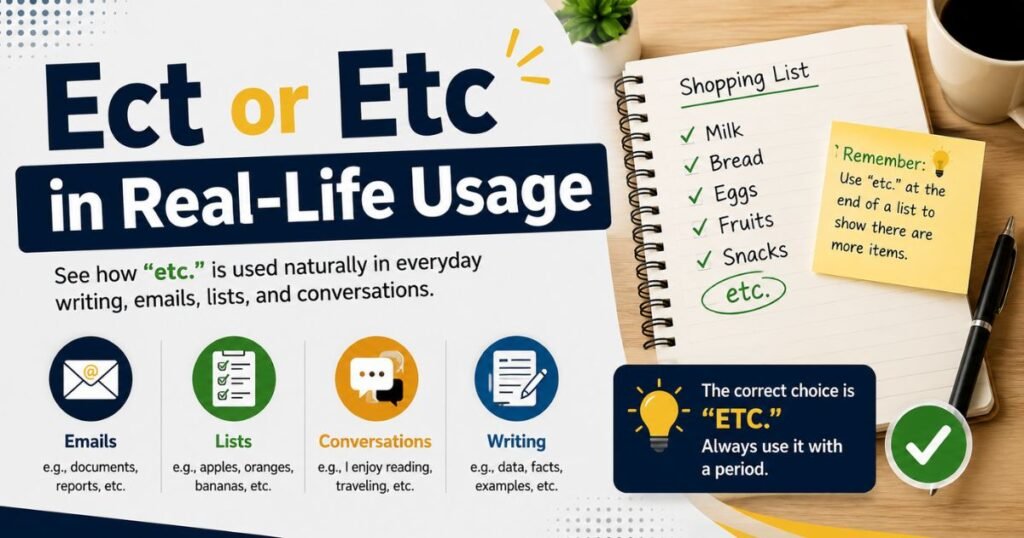
Understanding grammar rules is helpful, but seeing the word in action makes it stick. Let’s look at how “etc” is used correctly in everyday writing and speech.
Ect or etc grammar
In real sentences, “etc” almost always appears at the end of a list. It signals that the list continues but does not need to be fully written out. Here are a few natural examples:
- The store sells shoes, bags, belts, etc.
- Please bring your ID, ticket, boarding pass, etc.
- The recipe needs sugar, butter, flour, etc.
Notice that “etc” always comes after a comma and ends with a period, unless it falls at the end of a sentence, in which case only one period is needed.
- Example: Pack your clothes, shoes, chargers, etc.
You will also see “etc” used in business writing, academic papers, and casual conversations. It works the same way in all these settings, as long as the basic grammar rules are followed.
Common Mistakes and Corrections
Even careful writers slip up sometimes. Below is a simple table showing the most common errors people make with “etc” and how to fix them.
| Mistake | Why It’s Wrong | Correction |
| Ect. | Misspelled word | Etc. |
| and etc. | Repeats the meaning of “and” | etc. |
| etc,. | Wrong punctuation order | etc. |
| Etc used for people | “Etc” is for things, not people | Use “and others” instead |
| ecetera | Misspelled full form | et cetera |
| No period after etc | Missing required punctuation | Add a period: etc. |
A few extra tips to avoid these mistakes:
- Always read your sentence out loud before finishing it. If it sounds repetitive, like “and etc,” fix it right away.
- Use spellcheck tools, but do not rely on them completely, since some do not flag “ect” as wrong.
- When writing formal documents, double-check every abbreviation, including “etc,” for correct punctuation.
Small fixes like these can make your writing look much more polished and professional.
Also Read This: Privilege vs Priviledge
Ect or Etc in More Sentences
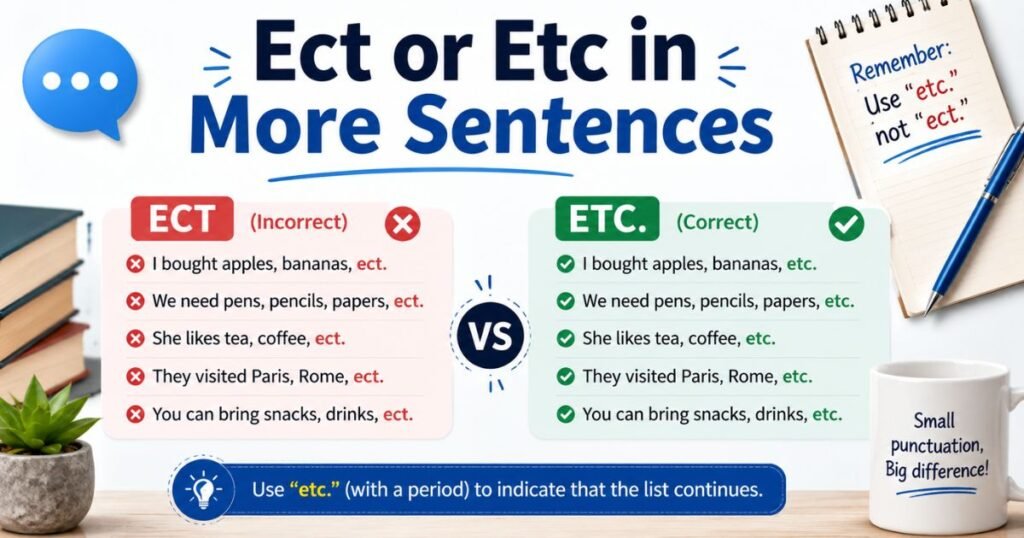
Let’s look at a wider range of examples so you can see how flexible and common this word really is across different types of writing.
Etc meaning in text
In texting and casual writing, “etc” is often used without a period, especially in quick messages. While this is common in informal chats, it is still better to keep the period in formal writing.
Here are more sentence examples across different contexts:
Everyday Conversation
- I need to clean the house, do laundry, cook dinner, etc.
- We talked about work, family, plans for the weekend, etc.
Business Writing
- The report should include sales data, customer feedback, market trends, etc.
- Please update your contact details, billing information, etc.
Academic Writing
- The study covered topics like memory, attention, learning, etc.
- Researchers analyzed age, gender, income level, etc.
Shopping Lists
- Buy milk, eggs, bread, etc.
- Pick up detergent, soap, tissues, etc.
As you can see, “etc” fits naturally into almost any type of list, no matter the setting. The key is always the same: keep it short, keep it correct, and place it at the end of the list.
Related Mistakes and Variations
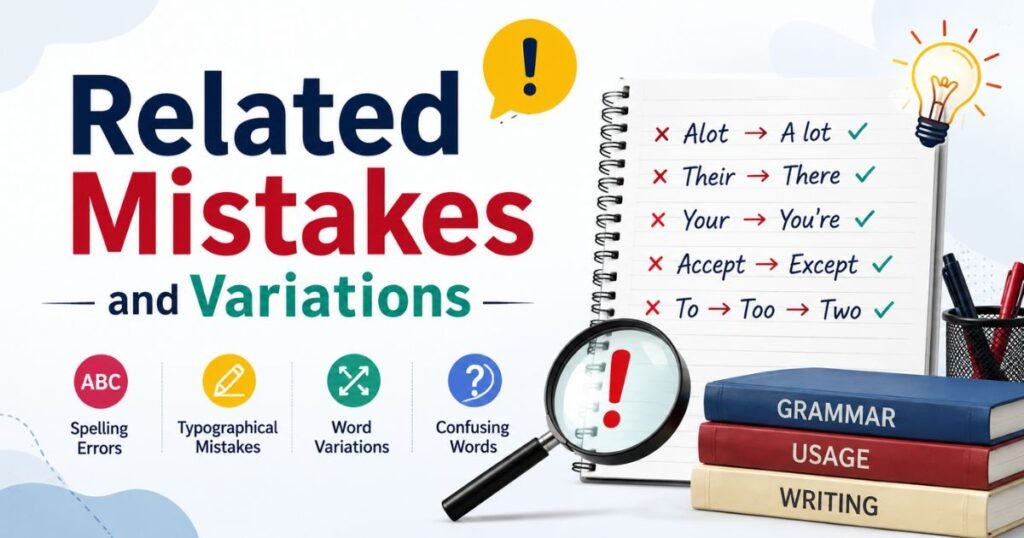
“Etc” is not the only abbreviation that confuses writers. A few related terms are often mixed up too, so it helps to know the difference.
| Term | Meaning | Example |
| Etc. | And so on | Books, pens, etc. |
| E.g. | For example | Fruits, e.g., apples and oranges |
| I.e. | That is | The main point, i.e., saving time |
| Et al. | And others (used for people) | Smith et al. wrote the paper |
| Vs. | Against or compared to | Cats vs. dogs |
Some other common spelling variations of “etc” that are incorrect include:
- Excetera
- Ectcetera
- Ekcetera
- Ect cetera
None of these are correct. The only accepted short forms are etc or etc., and the full written form is et cetera.
Learning these small differences helps you write with more confidence, whether you are writing an email, a school paper, or a quick text message.
Practice Exercises
Testing yourself is one of the best ways to remember grammar rules. Try filling in the blanks below with either “etc” or the correct fix.
- I bought apples, bananas, grapes, ___.
- The bag has pens, notebooks, and ___. (Fix the mistake)
- Bring your laptop, charger, mouse, ___.
- The team includes John, Mia, ___. (Fix this for people)
- She studies math, science, history, ___.
Answers:
- etc.
- etc. (remove “and”)
- etc.
- and others
- etc.
If you got most of these right, you already understand the rule better than a lot of native speakers. Practice a little every day, and it will become second nature.
Final Thoughts
Getting “etc” right is a small detail, but it says a lot about how careful and polished your writing is. Once you remember that “etc” comes from “ET terrace” and means “and so on,” the spelling starts to make sense on its own.
Keep the simple rules in mind: no “and” before it, always a comma before and a period after, and never use it for people. With a little practice, this common mistake will disappear from your writing for good.

Mubeen is a passionate writer who shares simple and practical English grammar, vocabulary, and writing tips at ScoopVisly.