

Ever typed “partys” and wondered why your screen flagged it? You’re not alone, and the fix takes about ten seconds.Parties is the correct plural of party. “Partys” is an incorrect spelling in standard English.
Stick around and you’ll learn the rule, the common traps, and a few easy memory tricks. We’ll also sort out party’s and parties’, since those two trip up plenty of writers.
Quick Answer
Use parties when you mean more than one party.
Skip “partys” every single time.
The spelling rule is short.
Change y to i and add -es.
Here’s how it looks in real life.
“We planned three birthday parties this month.”
What Is the Correct Plural of Party?
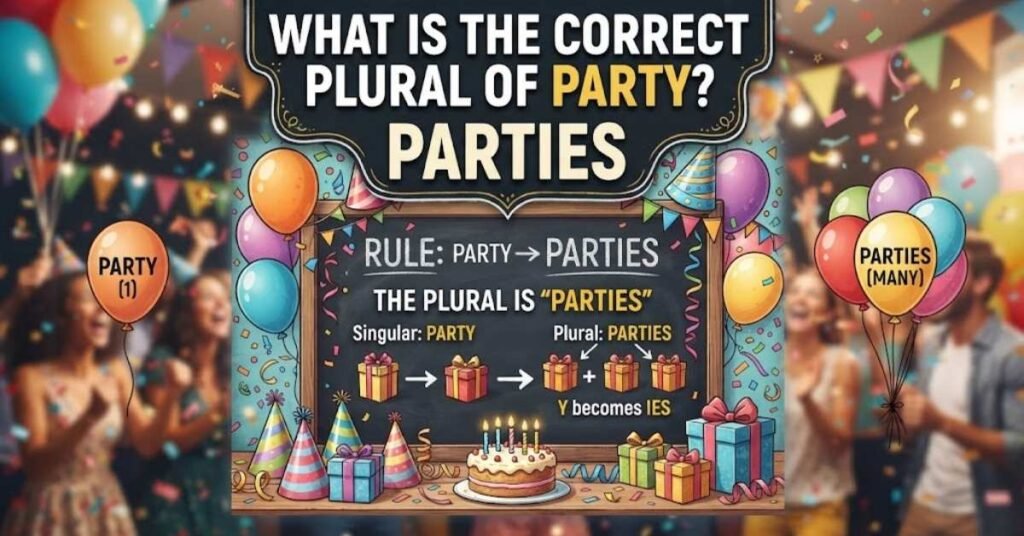
The plural of party is parties.
It follows a pluralization pattern that hundreds of English words share.
Think of baby → babies or city → cities.
Party belongs to the same crowd.
When to Use Parties vs. Party?
Use party for one event or one group.
Use parties when you’re counting two or more.
“The party starts at eight.”
“Three parties are happening on our street tonight.”
How Do You Spell Two Parties?
You spell it P-A-R-T-I-E-S.
Two parties, five parties, or fifty parties all use the same spelling.
The number doesn’t change the rule.
Only the difference between one and many matters.
Is “Parties” a Word?
Yes, it’s a real word, and people use it daily.
Dictionaries list it as a plural noun and as a verb form.
You’ll see it in birthday parties, political parties, and legal documents.
“Partys” shows up in none of them.
Why People Confuse Them
Most English plurals just need an s.
So “partys” feels logical, like day → days or key → keys.
Fast typing makes it worse.
Your brain grabs the easy pattern and skips the check.
Key Differences At A Glance
Here’s a side-by-side look at every form you’ll meet.
It saves you from guessing later.
| Form | Type | Meaning | Correct? |
| Party | Singular noun | One event or group | Yes |
| Parties | Plural noun | More than one | Yes |
| Partys | None | Nothing | No |
| Party’s | Singular possessive | Belongs to one party | Yes |
| Parties’ | Plural possessive | Belongs to many parties | Yes |
Notice that only one row is wrong.
That row is the one people type most.
Meaning And Usage Difference
Parties carries real meaning, while “partys” carries none.
One is a word, and the other is a spelling mistake.
Let’s look at each one closely.
The gap becomes obvious fast.
What Does Parties Mean?
It can mean social gatherings like celebrations, receptions, or festivities.
It can also mean people or sides in a legal or political setting.
As a verb, it means someone celebrates.
“He parties every Friday” is a good example.
What Does Partys Mean?
Nothing in standard English.
It’s simply a typo that slipped through.
The only exception is a brand or personal name that spells it this way on purpose.
Even then, it’s a proper noun, not a plural.
The Plural Rule For Words Ending In Y
Look at the letter right before the final y.
If it’s a consonant, change y to i and add -es.
If it’s a vowel, keep the y and add -s.
That covers the consonant plus y rule and the vowel plus y rule in one breath.
Party has an R before the Y, so it becomes parties.
Here are more word endings that follow the same logic:
- Consonant plus y: story → stories, country → countries, family → families
- Vowel plus y: day → days, boy → boys, toy → toys, valley → valleys
- Verbs too: play → plays, but party → parties
Tone, Context, And Formality
The spelling never changes with tone.
Formal writing, informal writing, and texts to friends all use parties.
What changes is the meaning around the word.
A contract says “the parties agree,” while a group chat says “the parties were wild.”
In academic writing and business writing, you’ll mostly see the legal sense.
In everyday English, it usually means fun.
Which One Should You Use?
Always pick parties for the plural.
Skip “partys” in every setting.
Need one event or group?
Use party.
Need to show ownership?
Add an apostrophe, and read the next section carefully.
Parties, Party’s, And Parties’
These three sound almost identical when you speak.
On paper, they mean very different things.
The apostrophe does the heavy lifting.
Learn where it sits and you’re done.
Parties: More Than One
There’s no apostrophe here.
It’s a plain plural form.
“Two parties are on Saturday.”
“Both parties want the same date.”
Party’s: Belonging To One Party
The apostrophe s shows that one party owns something.
That’s the singular possessive form.
“The party’s theme was pirates.”
“The political party’s candidate spoke first.”
It can also be a contraction of “party is.”
“The party’s tonight” means the party is tonight.
Parties’: Belonging To Multiple Parties
The apostrophe comes after the s.
That’s the plural possessive form.
“The parties’ attorneys met on Monday.”
“Each party’s responsibilities appear on page two.”
When One Choice Sounds Wrong
Read the sentence out loud.
If it sounds off, check the count and the ownership.
“Both party is late” sounds wrong because “both” needs a plural.
“Both parties are late” fixes it.
Here’s the trick.
Ask “one or many?” first, then “does it own something?”
A Simple Memory Trick
Picture the y as a tiny flag that falls over.
When a consonant stands before it, the flag drops and an i takes its place.
Then add es, like a closing bell.
Party becomes parties, and the trick works for baby, city, and story too.
Common Mistakes And Quick Fixes
These six errors show up constantly.
Each one has a fast fix.
Go through them one by one.
Keep this list nearby when you edit.
Mistake: Adding S Directly To Party
Writing “partys” is the classic slip.
It skips the change y to i step.
The fix is simple.
Swap the y for “ies” and you’re done.
Mistake: Using An Apostrophe For A Plural
“We planned three party’s this year” is wrong.
An apostrophe doesn’t make a plural.
Drop it.
Write “three parties.”
Mistake: Confusing Singular And Plural Possession
People mix up party’s and parties’ all the time.
The apostrophe position tells you how many owners exist.
One owner takes party’s.
Many owners take parties’.
Mistake: Using Parties For One Event
“We’re hosting parties on Sunday” suggests several events.
If you mean one, say party.
Count the events first.
One event gets one party.
Mistake: Forgetting Subject-Verb Agreement
Subject-verb agreement matters here.
“The parties is ready” is wrong.
Say “The parties are ready” or “The party is ready.”
Match the verb to the noun.
Mistake: Misreading The Verb Form
Party can also be a verb, so “parties” isn’t always a plural noun.
“She parties hard” uses the third-person singular verb form.
Check who’s doing the action.
If one person does it, you’re looking at the verb.
Everyday Examples
Real sentences beat abstract rules.
Here are examples from four different settings.
Notice how the spelling stays put.
Only the meaning shifts.
Social Events
“We’re planning two birthday parties and one graduation party.”
“Holiday parties fill our calendar in December.”
“Corporate parties usually end by ten.”
“Private parties need a reservation.”
Political Groups
“Both political parties released their election platforms.”
“Opposition parties challenged the bill during the debate.”
“Each party picks its candidates before elections.”
This kind of government-related context always uses the same spelling.
Legal And Business Contexts
“Both parties signed the agreement.”
“The parties to a contract must follow the contract terms.”
“Interested parties received written notice.”
“Third parties weren’t part of the settlement.”
“Mediation helped both sides end the dispute.”
“The lawyers reviewed every legal document with the parties’ approval.”
Direct Comparisons
Here’s a quick cheat sheet.
Save it for your next edit.
- Party vs parties: one versus many
- Parties vs partys: correct versus incorrect
- Parties vs party’s: plural versus possessive
- Parties vs parties’: plural versus plural possessive
- Noun vs verb: “The party ends” versus “She parties”
Dictionary-Style Word Details
Want the word broken down like a dictionary entry?
This section covers type, synonyms, history, and phrases.
It’s short and useful.
Skim what you need.
Verb
To party means to celebrate or attend a social event.
The forms are party, parties, partied, and partying.
“She parties on weekends.”
“They partied until midnight.”
Noun
As a noun, party means a social gathering or a group with shared goals.
It also means a person or side in a legal matter.
A party can be one person in a lawsuit.
The plural is still parties.
Synonyms
For social events, try celebrations, gatherings, receptions, events, or festivities.
These swap in nicely when you want variety.
For legal or business groups, try participants, sides, signers, individuals, or organizations.
True antonyms are rare, though “outsiders” contrasts with parties to a deal.
Example Sentences
“The reception went well, so we booked two more parties.”
“Both sides sent their attorneys to review the terms.”
“Every party in the deal has clear responsibilities.”
“Three participants left the gathering early.”
Word History
The word has a French origin.
It comes from the Old French partie, meaning a part, side, or share.
Over time, meaning expansion stretched it to groups and later to social gatherings.
That’s why one word covers both a lawsuit side and a birthday bash.
Phrases Containing
Party pops up in plenty of set phrases.
Common ones include third parties, both parties, all parties, and parties involved.
You’ll also see “party line” and “party crasher.”
In law, look for parties to the agreement and parties to a lawsuit.
Quick Self-Check Before You Publish
Spellcheck can miss the apostrophe problem.
“Party’s” and “parties” are both real words, so no red line appears.
Run three checks.
Count the nouns, spot the owners, and match your verbs.
Conclusion
Parties is the only correct plural. “Partys” is a common spelling mistake you can leave behind.Watch the apostrophe. Use party’s for one owner and parties’ for many.
Got a tricky sentence you’re unsure about? Drop it in the comments, and share this guide with a friend who types “partys.”We’ll keep refreshing this guide as new questions come in. Check back anytime you need a quick grammar refresher.
FAQs
Is parties or partys correct?
Parties is correct. “Partys” is an incorrect spelling.The consonant plus y rule explains why.Change y to i, then add es.
What is the plural of party?
The plural is parties. Use it for two or more events, groups, or sides.”Both parties arrived early.” “Three parties are planned for June.”
Why does party become parties?
Party ends in a consonant plus y. English changes the y to i and adds es in that case.The rule keeps the word easy to say. “Partys” would feel clumsy out loud.
What is the difference between parties and party’s?
Parties is plural, with no ownership. Party’s shows that one party owns something.”Two parties met.” “The party’s location changed.”
What does parties’ mean?
Parties’ is the plural possessive form. It shows that several parties share or own something.”The parties’ lawyers agreed on a date.” “Both parties’ responsibilities are listed below.”
Can parties be a verb?

Mubeen is a passionate writer who shares simple and practical English grammar, vocabulary, and writing tips at ScoopVisly.