

Spelling mistakes happen to almost everyone, and “privilege” is one of the most commonly misspelled words in English. Many people write it as “priviledge,” thinking it looks or sounds right, when in fact only one version is correct. This small mix-up can appear in emails, school assignments, social media posts, and even professional documents.
This guide breaks down everything you need to know about “privilege” and “priviledge.” You will learn the correct spelling, the real meaning of the word, its origin, and why the mistake happens so often. By the end, you will be able to use this word correctly and explain the difference to others with confidence.
Quick Answer
The correct spelling is privilege. The word “priviledge” is not a real word. It is simply a misspelling that many people write by mistake.
This mistake happens because of how the word sounds when spoken. The “g” sound before “e” can trick the brain into adding an extra “d” that does not belong there.
| Word | Correct? | Notes |
| Privilege | Yes | Standard English spelling |
| Priviledge | No | Common misspelling |
Privilege vs Priviledge Meaning
“Privilege” refers to a special right, benefit, or advantage that is given to a person or a group. It is not something everyone has access to. It can be earned, inherited, or granted by a system, a job, or a social position.
For example, having free healthcare in some countries is a privilege that not every citizen in the world enjoys. Being allowed to skip a long queue because of a VIP pass is also a privilege.
“Priviledge” has no meaning at all. It does not appear in any English dictionary. It is simply an incorrect way of writing “privilege.”
Privilege vs Priviledge Difference
The only real difference between these two words is spelling. One is correct, and one is wrong. There is no version where “priviledge” becomes acceptable, even in casual writing.
Here is a simple breakdown:
- Privilege: correct spelling, used in formal and informal writing
- Priviledge: incorrect spelling, should be avoided completely
People often assume there might be a British versus American English difference, similar to “color” and “colour.” That is not the case here. Both British and American English use “privilege” as the only accepted spelling.
Grammar Rule Depth
English has many silent rules that guide spelling, and “privilege” follows a pattern common in French-based English words. It comes from a structure where “vi” is followed directly by “lege,” with no “d” sound in between.
Words that end in “-lege” or “-ledge” often confuse writers. “Knowledge” has a “d” before “ge,” but “privilege” does not. This inconsistency in English spelling is one of the biggest reasons people misspell “privilege.”
A simple grammar rule to remember is this: not every word that sounds like it has a “d” actually contains one. Pronunciation in English does not always match spelling.
Verb Form of Privilege
“Privilege” can also work as a verb, though this use is less common than the noun form. As a verb, it means to give someone a special right or honor.
Example sentence: The company privileges long-term employees with extra vacation days.
Here are common forms of the word:
| Form | Example |
| Noun | She has the privilege of speaking first. |
| Verb | The rule privileges senior staff over new hires. |
| Adjective | He comes from a privileged background. |
The Origin of Privilege
The word “privilege” comes from Latin. It combines two Latin words: “privus,” meaning private or individual, and “lex,” meaning law. Together, they originally referred to a law made for a single person or a small group.
Over time, this Latin idea moved into Old French as “privilege,” and English later borrowed the word directly from French. This is why the spelling looks slightly different from typical English patterns.
Understanding this history helps explain why there is no “d” in the word. The Latin root “lex” never included a “d” sound, so the English version stayed true to that root.
Why People Write Priviledge Instead of Privilege
Most spelling mistakes happen because of sound, not meaning. When people say “privilege” quickly, the ending can sound like “ledge,” which naturally makes some writers think of a “d” sound.
Common reasons for this mistake include:
- Confusing it with words like “knowledge” or “acknowledge”
- Typing too fast without checking spelling
- Learning the word by ear before learning it by sight
- Relying on autocorrect that sometimes fails to catch it
This mistake is extremely common, even among native English speakers, so there is no need to feel embarrassed if it has happened before.
Influence of Similar Words
English has several words that end in “-ledge,” and this creates confusion for “privilege,” which does not follow the same ending. The brain often groups similar-sounding words together, which increases spelling errors.
Some examples of words that may cause confusion:
- Knowledge
- Acknowledge
- Ledge
None of these words share the same root as “privilege,” even though they sound similar. This is a case where visual memory becomes more useful than sound-based memory.
Real World Usage of Privilege

“Privilege” appears often in daily conversations, news articles, and workplace discussions. It is used to describe access, rights, or advantages that are not available to everyone.
Examples of real-world usage:
- “Voting is both a right and a privilege in many democracies.”
- “Growing up with a stable home was a privilege many people do not have.”
- “Employees who work overtime may receive the privilege of flexible hours.”
This word is common in legal writing, social discussions, education, and business communication.
Types of Privilege
Privilege can appear in many different areas of life. Understanding the different types helps clarify how broad this word really is.
| Type of Privilege | Example |
| Social privilege | Being treated fairly because of background or status |
| Economic privilege | Having financial stability or family wealth |
| Educational privilege | Access to quality schools and learning resources |
| Legal privilege | Special rights granted under the law, such as attorney-client privilege |
| Workplace privilege | Extra benefits like bonuses, flexible hours, or promotions |
Each type shows how privilege is not a single idea. It changes depending on the situation and the environment.
Privilege in Professional Context
In professional settings, “privilege” often relates to permissions, access levels, or special rights within a company or system. This use is common in offices, legal firms, and even software systems.
For example, in workplaces, “privilege” may refer to decision-making authority given to senior staff. In legal contexts, “attorney-client privilege” protects private conversations between a lawyer and their client.
Also Read This: Sitted or Seated
In technology, the word appears in IT systems as “user privileges,” which control what actions a person can perform on a computer network. This shows how flexible and widely used the word truly is.
Common Mistakes with Privilege vs Priviledge
Many mistakes happen not just with spelling but also with usage. Below are some frequent errors people make.
- Writing “priviledge” instead of “privilege”
- Using “privilege” when the correct word should be “right”
- Confusing “privileged” with “entitled,” which has a different meaning
- Misplacing the word in a sentence, making it sound awkward
A quick way to avoid these mistakes is to slow down and read the sentence aloud before finalizing it.
Related Words and Forms
Understanding related words can help reinforce the correct spelling and meaning of “privilege.”
| Related Word | Meaning |
| Privileged | Having special rights or advantages |
| Underprivileged | Lacking basic advantages or resources |
| Privileging | The act of giving special treatment |
| Unprivileged | Not having a certain privilege |
These forms show how the root word changes shape depending on grammar needs, but the core spelling of “privilege” stays the same.
Tips to Remember Privilege Spelling
A few simple tricks can help lock in the correct spelling for good.
- Remember there is no “d” sound before “ge”
- Break the word into parts: “privi” and “lege”
- Compare it to “college,” which also ends in “-lege”
- Practice writing the word slowly a few times
- Read it out loud while spelling each letter
These small habits can train your memory so the mistake becomes less likely over time.
Privilege vs Privilege in Modern Usage
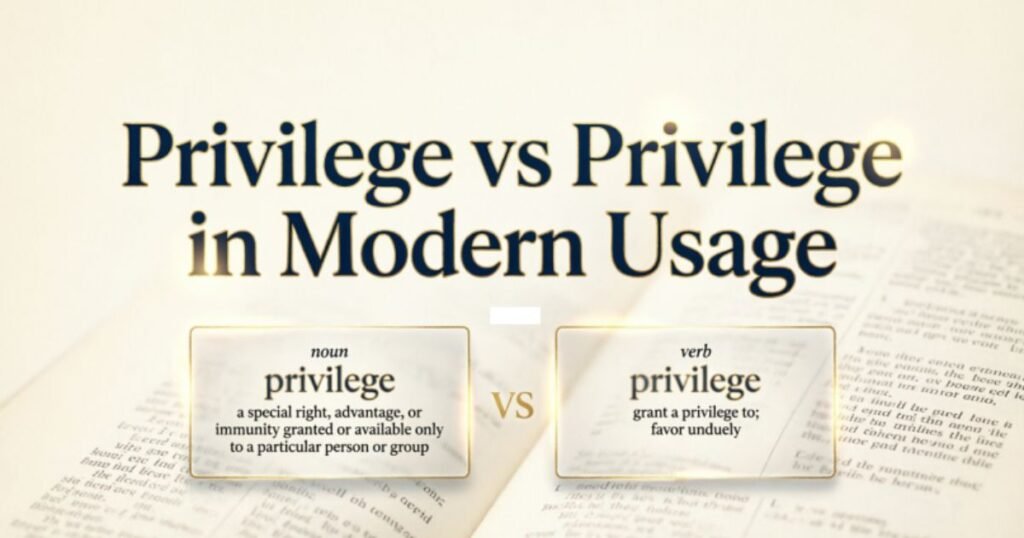
In today’s world, “privilege” is used heavily in social conversations, especially around fairness, equality, and access to opportunities. It is a word that carries emotional and social weight beyond simple grammar.
“Priviledge,” on the other hand, is almost always seen only as an error. Autocorrect tools, grammar checkers, and search engines now flag it instantly, which has slightly reduced how often it appears in professional writing.
Despite this, the mistake is still common in casual texting, social media posts, and quick emails where people do not double-check spelling.
Usage Trends
Language data shows that “privilege” is used far more often in written English than most similar words. It appears frequently in academic papers, legal documents, news reports, and workplace policies.
Search engine trends also show that many people search for the correct spelling online, which proves this confusion is widespread and ongoing. This makes it one of the more commonly searched spelling questions in the English language today.
As education around digital writing tools increases, spelling mistakes like “privilege” are expected to slowly decrease, though they are unlikely to disappear completely.
Exercises
Try these short exercises to test your understanding.
- Choose the correct spelling: “She felt (privilege / priviledge) to be part of the team.”
- Identify the verb form: “The system (privileges / privileges) verified users only.”
- Fill in the blank: “Growing up in a stable home is a form of ______.”
- Correct the sentence: “He was privileged to attend the event.”
- Write one sentence using “privilege” as a noun and one using it as an adjective.
Answers can be checked by comparing them with the correct definitions and examples shared earlier in this article.
Conclusion
Understanding the difference between “privilege” and “priviledge” comes down to one simple fact: only “privilege” is correct. This word carries deep meaning across social, legal, and professional contexts, making correct spelling even more important. Once you know the root of the word and the small grammar rule behind it, the mistake becomes much easier to catch and correct.
With the tips, examples, and explanations shared in this guide, you now have everything needed to use this word confidently and correctly every time. Keep practising the exercises, review the tricks whenever you feel unsure, and soon writing “privilege” correctly will become second nature.

Mubeen is a passionate writer who shares simple and practical English grammar, vocabulary, and writing tips at ScoopVisly.