

Have you ever paused mid-sentence, unsure whether to write “sitted” or “seated”? You are not alone. This simple word choice trips up students, professionals, and even native speakers who type quickly without checking the grammar behind it. The confusion usually starts with a natural assumption that every verb follows the same “-ed” pattern, but English does not always play by that rule.
This guide breaks down everything you need to know about “sitted” and “seated” in one place. You will learn which word is actually correct, why the mistake happens so often, and how to use “seated” properly in emails, business writing, and everyday conversation. By the end, you will never second guess this word again.
Quick Answer
“Seated” is the correct word to use. “Sitted” is not a real word in standard English grammar.
The verb “sit” does not become “sitted” in the past tense. Instead, its past tense and past participle form is “sat.” The word “seated” comes from a different root and works as both an adjective and a verb form with its own specific uses.
| Word | Correct? | Common Use |
| Sitted | No | Not standard English |
| Sat | Yes | Past tense of “sit” |
| Seated | Yes | Adjective, formal verb form |
Sitted or Seated Difference
The main difference is simple. “Sitted” does not exist in proper English grammar, while “seated” is a real and useful word.
People often mix these two because “sit” feels like a regular verb that should follow the normal “-ed” pattern, similar to “walked” or “talked.” But “sit” is an irregular verb. Its forms are sit, sat, and sat, not sit, sitted, and sitted.
“Seated,” on the other hand, comes from the verb “seat,” which means to place someone in a chair or a specific spot. This word follows regular grammar rules perfectly. That is why it looks and sounds correct, while “sitted” does not.
What Does Seated Mean
“Seated” means being placed in a sitting position, usually in a chair, bench, or any specific spot meant for sitting. It can describe a person, a group, or even furniture arrangement.
This word works in two main ways:
- As an adjective: “The guests were already seated when we arrived.”
- As part of a formal verb phrase: “Please be seated.”
“Seated” often shows up in polite or professional language. It gives a more formal tone than simply saying “sitting” or “sat down.”
What Does Sitted Mean
“Sitted” does not carry any real meaning in standard English. It is a common mistake, not an actual word found in dictionaries or grammar books.
Some non-native speakers create “sitted” by applying the regular past tense rule to the verb “sit.” This logic makes sense on the surface, but English grammar has many exceptions, and “sit” is one of them.
If you ever come across “sitted” in writing, it should be corrected to either “sat” or “seated,” depending on the context and tone needed.
How to Pronounce Seated
“Seated” is pronounced as SEE-tid. The stress falls on the first syllable, and the ending sounds soft, almost like “tid.”
Here is a simple breakdown:
- First sound: “See” (like the verb “to see”)
- Second sound: “tid” (soft, quick sound)
Practicing this word out loud a few times can help you remember both the pronunciation and the spelling, since the “ea” in the middle is often where people slow down or hesitate.
Why People Confuse Sitted and Seated
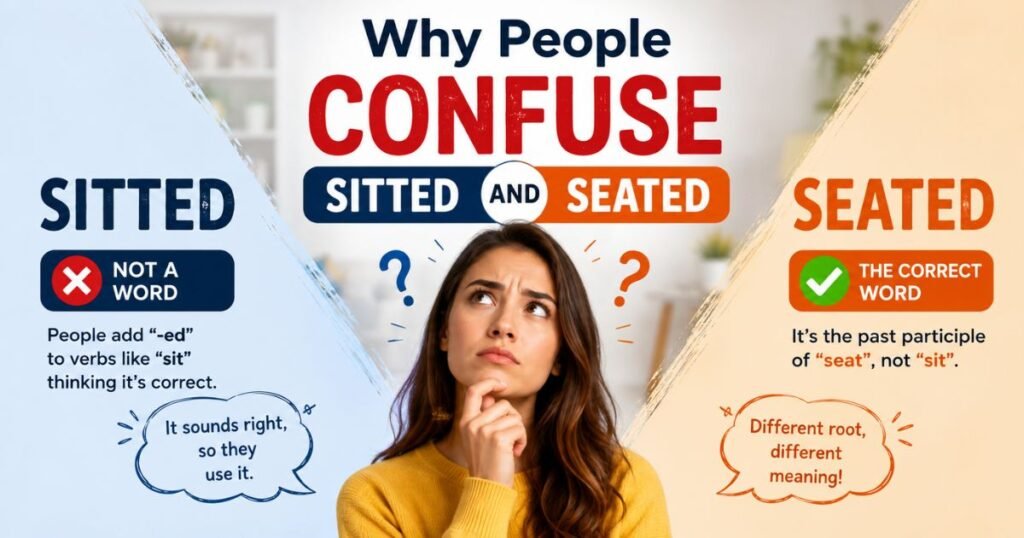
Confusion between these two words happens for a few clear reasons.
- English learners assume all verbs follow the “-ed” pattern.
- “Sit” and “seat” sound and look similar, which blurs the line between them.
- Many irregular verbs are taught early, but “sit” is sometimes overlooked in casual learning.
- Autocorrect tools do not always catch “sitted” because it looks like a plausible word.
Because of these reasons, even fluent speakers occasionally slip and write “sitted” without noticing the error.
Grammar Rule Depth
To fully understand this topic, it helps to look at how English handles irregular verbs like “sit.”
Regular verbs follow a simple pattern. You add “-ed” to form the past tense, such as “walk” becoming “walked.” Irregular verbs break this pattern, and their forms must be memorized rather than created through a rule.
“Sit” belongs to a group of irregular verbs that change their spelling completely in the past tense. Instead of adding “-ed,” the vowel inside the word shifts.
| Base Form | Past Tense | Past Participle |
| Sit | Sat | Sat |
| Seat | Seated | Seated |
This table shows why “seat” and “sit” behave differently, even though they look related. “Seat” is regular, while “sit” is irregular.
Why Seated Is More Common
“Seated” appears more often than “sitted” because it is grammatically correct and widely accepted in both spoken and written English.
It also has a slightly more polished tone. People use “seated” in restaurants, offices, events, and formal announcements because it sounds respectful and clear.
Since “sitted” is not a recognized word, it naturally appears far less in books, articles, and professional communication. Search engines and grammar checkers also flag “sitted” as incorrect, which reduces its use online.
Is Sitted Ever Correct
No, “sitted” is not correct in standard English under any common grammar rule.
There is no dialect, formal style, or accepted exception where “sitted” replaces “sat” or “seated.” Some casual online slang may use it playfully, but this does not make it grammatically valid.
If accuracy matters, whether in school, work, or professional writing, always avoid “sitted” and choose “sat” or “seated” instead.
The Origin of Sit and Seated
The words “sit” and “seat” both come from very old English roots, but they developed into separate word families over time.
“Sit” traces back to Old English “sittan,” which already had irregular forms even in its earliest use. This is why the irregular pattern has stayed consistent for centuries.
“Seat” comes from Old Norse “sæti,” meaning a place to sit. Over time, English speakers turned this noun into a verb, “to seat,” which follows regular grammar rules. That is how “seated” became a proper and accepted word form.
Different Forms Related to Sit
The verb “sit” has several related forms that are useful to know.
- Sit: base form, present tense (“I sit here every day.”)
- Sits: third person singular (“She sits near the window.”)
- Sitting: present participle (“They are sitting outside.”)
- Sat: past tense and past participle (“He sat down quickly.”)
Knowing these forms helps prevent confusion and makes it easier to avoid incorrect words like “sitted” in everyday writing.
Seated in Emails
“Seated” is a useful word in professional email writing, especially when discussing events, meetings, or seating arrangements.
Examples include:
- “All attendees will be seated by 9 a.m.”
- “Please let us know if you would like to be seated near the entrance.”
- “Guests were seated according to the provided list.”
Using “seated” instead of “sitting” in emails adds a formal and organized tone, which fits well in business communication.
Seated in Business Writing
In business documents, reports, and announcements, “seated” often replaces more casual phrasing.
For example, instead of writing “everyone sat down,” a formal report might say “attendees were seated according to schedule.” This small change improves clarity and professionalism.
Also Read This: Hustle vs Hussle
Business writing values precision, and “seated” delivers that precision better than casual alternatives. It also avoids any risk of grammar mistakes like “sitted,” which could hurt credibility in official documents.
Seated in Social Media
Social media posts are often casual, but “seated” still appears frequently in event promotions, restaurant updates, and announcements.
Common examples include:
- “Doors open at 7, guests will be seated by 7:30.”
- “Limited seated tickets available for this event.”
- “Come early, seating is first come, first served.”
Even in short, informal posts, “seated” keeps the message clear and avoids confusion, unlike “sitted,” which can make a brand or writer look less credible.
Common Mistakes With Sitted or Seated
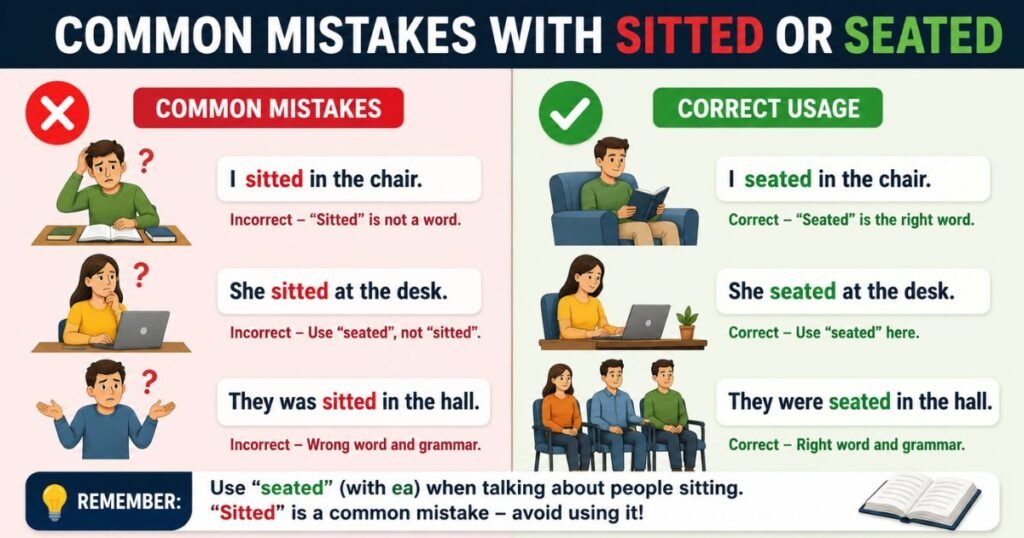
Several common mistakes happen around these words, especially among learners and fast typists.
- Writing “sitted” instead of “sat” in past tense sentences.
- Using “seated” when simple “sitting” would sound more natural in casual speech.
- Confusing “seated” with “sat” in formal writing, even though both are correct depending on context.
- Overusing “seated” in very casual conversations where it can sound stiff.
Understanding the right context for each word helps avoid sounding either incorrect or overly formal.
Related Words People Confuse With Sitted
Along with “sitted,” a few other related words often cause confusion.
| Word | Correct Form | Meaning |
| Sitted | Incorrect | Not a real word |
| Setted | Incorrect | Should be “set” |
| Seated | Correct | Placed in a sitting position |
| Sat | Correct | Past tense of “sit” |
These mix-ups usually happen because English learners try to apply the same “-ed” rule across different irregular verbs.
How Common Is the Mistake Sitted
The mistake “sitted” is fairly common, especially among non-native English speakers and casual writers online.
It often appears in social media comments, quick text messages, or early drafts of writing. Most grammar checking tools now catch this error and suggest “sat” or “seated” as corrections.
Even though the mistake is common, it rarely appears in published books, professional articles, or edited content, since editors quickly catch and correct it.
Memory Tricks to Remember Seated

A few simple memory tricks can help you remember when to use “seated” correctly.
- Think of “seat” as a noun (a chair) and “seated” as being placed on that chair.
- Remember that “sit” changes completely to “sat,” it does not simply add “-ed.”
- Picture a formal event where guests are “seated,” which naturally sounds more polished than “sitted.”
Repeating correct examples out loud can also help train your memory over time.
Sitted or Seated Summary
To summarize, “sitted” is not a correct English word, while “seated” and “sat” are both valid, depending on the sentence.
Use “sat” for simple past tense actions, such as “I sat on the bench.” Use “seated” for formal situations, adjectives, or polite verb phrases, such as “Please be seated” or “The guests were seated quickly.”
Keeping this distinction clear will improve both your spoken and written English, especially in professional settings.
Conclusion
The confusion between “sitted” and “seated” comes from a simple grammar gap, not a lack of language skill. Once you remember that “sit” is irregular and becomes “sat,” while “seat” is regular and becomes “seated,” the confusion disappears completely.
Using the right word, whether in emails, business writing, or casual conversation, shows attention to detail and strengthens your overall communication. With a bit of practice, avoiding “sitted” and choosing the correct form will become second nature.

Mubeen is a passionate writer who shares simple and practical English grammar, vocabulary, and writing tips at ScoopVisly.