

Have you ever typed a sentence and paused, unsure if it should be “thier” or “their”? You are not alone. This is one of the most common spelling mix-ups in English. Many people type fast and swap the letters without noticing.
The good news is that this mistake has a simple fix. Once you understand the rule, you will never get confused again. In this guide, we will break down the correct spelling, explain why the mistake happens, and show you how to use the word correctly in real sentences.
Thier or Their Quick Answer
The correct spelling is their. The word “thier” is not a real word in English. It is simply a common misspelling.
“Their” is a possessive pronoun. It shows that something belongs to a group of people or things. Here are quick examples to make it clear:
- Their house is near the park.
- The students forgot their books.
- Their dog ran across the yard.
If you remember one thing from this article, remember this: thier is always wrong, and there is always right.
Grammar Rules Explained
English spelling has a well-known rule called “i before e, except after c.” This rule helps with many words, but it also causes confusion with words like “their.” Some people wrongly apply the rule and write “thier” instead of “their.”
The truth is, “their” does not fully follow the classic i-before-e pattern. It is one of the exceptions you simply need to memorize. Here is a simple table to help you understand the rule better:
| Rule | Example | Correct Spelling |
| I before E | Believe, Chief | believe, chief |
| Except after C | Receive, Ceiling | receive, ceiling |
| Exception words | Their, Weird | their, weird |
“Their” is a possessive pronoun. It always comes before a noun to show ownership. For example:
- Their car is parked outside.
- I saw their new office yesterday.
Since “their” does not follow the usual pattern, the best way to remember it is through practice and repetition, not just rules.
Why People Make Mistakes With Thier or Their
There are a few clear reasons why people write “thier” instead of “their.” Understanding these reasons can help you avoid the mistake in the future.
Typing speed is one major reason. When people type quickly, their fingers sometimes move faster than their brain. This causes letters to get swapped, especially with words that have similar-looking letter pairs like “ie” and “ei.”
Muscle memory from other words also plays a role. Since many English words follow the “i before e” pattern, your brain may automatically apply that pattern to “their” as well, even though it is an exception.
Here are the most common reasons for this mistake:
- Typing too fast without checking
- Relying on habit instead of rule
- Confusing “their” with “believe” or “chief” pattern
- Not proofreading before sending a message or email
- Learning English as a second language and mixing spelling patterns
Once you know why the mistake happens, it becomes much easier to catch and correct it.
Thier or Their in Real Life Usage

You will see the word “their” everywhere, from text messages to business emails to books. It is one of the most frequently used words in English. Let’s look at how it appears in daily communication.
In casual conversation, people often write:
- “Did you see their new car?”
- “I love their sense of style.”
- “They left their umbrella at my place.”
In professional writing, the word appears just as often:
- “The company updated their policy last month.”
- “Employees must submit their reports by Friday.”
- “The team celebrated their success together.”
Because “their” is used so often, even a small mistake like writing “thier” can stand out in an email, resume, or article. This is why it matters to get it right, especially in professional or academic writing where first impressions count.
British and American English Usage
One good thing about the word “their” is that it does not change between British and American English. Unlike words such as “colour” and “color,” or “favourite” and “favorite,” this word stays exactly the same in both versions of English.
Here is a simple comparison table:
| Word Type | British English | American English |
| Their (possessive) | their | their |
| Colour vs Color | colour | color |
| Favourite vs Favorite | favourite | favorite |
| Organise vs Organize | organise | organize |
So no matter where you are writing from, whether the UK, the US, Canada, Australia, or anywhere else, the spelling rule for “their” is the same everywhere. This makes it a little easier to remember since you do not need to adjust based on region.
Which One Should You Use

The answer is simple: always use their, never “thier.” There is no situation, context, or type of writing where “thier” is the correct choice. It is a spelling error, not an alternate form of the word.
To help you choose the right word every time, keep these points in mind:
- “Their” shows possession or ownership.
- “Their” is always followed by a noun.
- “Thier” is never correct in any English dictionary.
If you are ever unsure while writing, a quick trick is to pause and mentally spell the word as “th-e-i-r.” Saying it slowly in your head can help your brain lock in the correct order of letters.
Also Read This: Preform or Perform
Common Mistakes and Corrections
Besides mixing up the letters, people often confuse “their” with two other similar-sounding words: “there” and “they’re.” All three words sound the same when spoken, but they mean completely different things.
Here is a helpful breakdown:
| Word | Meaning | Example |
| Their | Shows possession | Their bags are heavy. |
| There | Refers to a place | Put the box over there. |
| They’re | Short for “they are” | They’re coming to the party. |
| Thier | Incorrect spelling | Not a real word |
Some common mistakes to watch out for:
- Writing “Are you going to their house?” instead of “their house.”
- Writing “Thier plans changed” instead of “Their plans changed.”
- Writing “They’re going to the market” instead of “They’re going to the market.”
A simple way to check your sentence is to replace the word with “they are.” If the sentence still makes sense, then “they’re” is correct. If it does not, then you likely need “their” or “there,” depending on the meaning.
Thier or Their in More Sentences
Practice makes the rule stick in your memory. Below are more example sentences using “their” correctly in different situations, so you can see how flexible and common this word really is.
Everyday sentences:
- Their kids play in the same school.
- I borrowed their ladder for the weekend.
- Their flight got delayed by two hours.
Workplace sentences:
- Managers reviewed their team’s performance.
- The company shared their quarterly results.
- Their client meeting was rescheduled to Monday.
Academic sentences:
- Students submitted their assignments online.
- The researchers published their findings last week.
- Their professor gave detailed feedback on the essay.
Notice how in every example, “their” is followed by a noun and shows that something belongs to a group of people. This pattern stays consistent across every type of writing.
Related Confusing Words
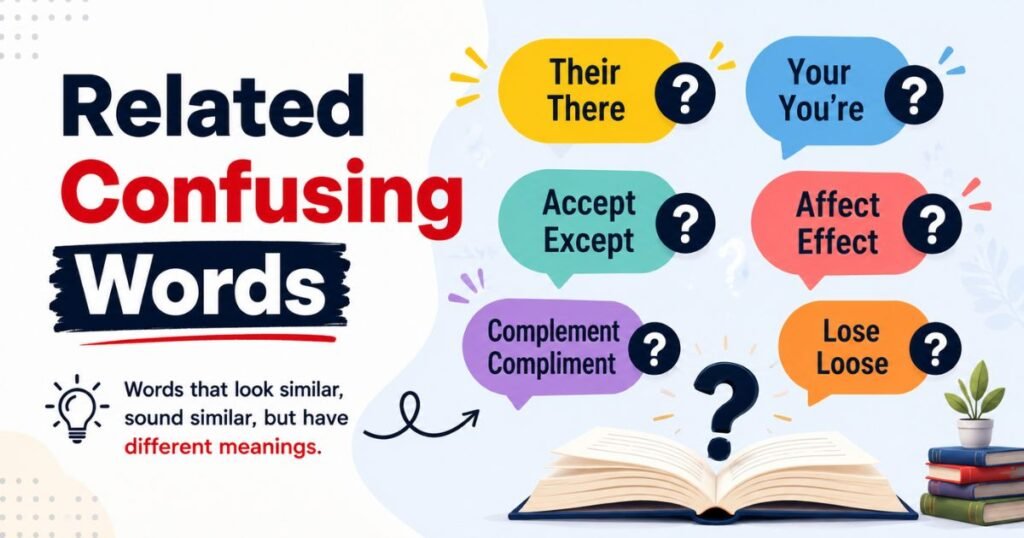
English has many word pairs that sound alike but are spelled and used differently. Learning these alongside “their” can improve your overall writing accuracy.
Here are a few common ones:
| Confusing Pair | Meaning | Example |
| Its / It’s | Possession vs “it is” | Its color is blue. / It’s raining today. |
| Your / You’re | Possession vs “you are” | Your bag is here. / You’re welcome. |
| Whose / Who’s | Possession vs “who is” | Whose phone is this? / Who’s calling? |
| Loose / Lose | Not tight vs to misplace | The knot is loose. / Don’t lose your keys. |
Just like with “their,” the best way to master these pairs is through regular reading and writing practice. The more you see the correct forms, the more natural they will feel.
Practice Exercises
Now it’s time to test what you have learned. Try filling in the blanks below with the correct word: their, there, or they’re.
- _______ car broke down on the highway.
- Please put the books over _______.
- _______ going to visit us next weekend.
- The children left _______ toys on the floor.
- Is that _______ new house on the corner?
- _______ not ready to leave yet.
- I think _______ are more chairs in the other room.
Answer Key:
- Their
- There
- They’re
- their
- their
- They’re
- there
If you got most of these right, you already have a strong grasp of the difference. If you missed a few, go back and review the sections above, especially the comparison table.
Conclusion
The spelling confusion between “thier” and “their” is common, but it is also easy to fix once you understand the rule. Remember that “thier” is simply incorrect, and “their” is the only correct form used to show possession.
By practicing with real sentences, understanding the difference between “their,” “there,” and “they’re,” and paying attention while writing, you can avoid this mistake for good. Good spelling builds trust in your writing, whether it is a text message, an email, or a school assignment, so a little extra care always pays off.

Mubeen is a passionate writer who shares simple and practical English grammar, vocabulary, and writing tips at ScoopVisly.