

Words that sound alike often cause spelling trouble, and “hustle” is one of the best examples. Whether you are writing a resume, a business caption, or a quick text to a friend, spelling this word correctly matters more than you might think. A small mistake can make your writing look careless, even if the rest of your message is clear and well written.
This article breaks down everything you need to know about “hustle” and the common misspelling “hussle.” You will learn the correct meaning, the grammar behind the silent letter, real world examples, and how the word is used across work, sports, and modern culture. By the end, you will never second guess which spelling to use again.
Many people get confused between “hustle” and “hussle.” They sound almost the same when spoken. But only one of these words is correct in standard English. This guide breaks down the meaning, the difference, and the right way to use “hustle” in daily life, work, and writing.
Quick Answer
“Hustle” is the correct spelling. “Hussle” is not a real English word. It is a common misspelling that happens because of how “hustle” sounds when people say it out loud.
If you are ever unsure which one to use, always go with “hustle.” It is the version found in dictionaries, books, business writing, and everyday conversation. “Hussle” only shows up as a last name for some people or as a typo, never as a standard word with its own meaning.
Hustle vs Hussle Meaning
“Hustle” has a few different meanings depending on how it is used. As a verb, it means to work hard and move quickly to get something done. As a noun, it can describe hard work, energy, or even a dishonest scheme to trick someone out of money.
Here is a simple breakdown of what “hustle” means in different situations:
| Use of Hustle | Meaning |
| Verb (work related) | To work hard and fast |
| Verb (movement related) | To move quickly or push forward |
| Noun (positive) | Energy, drive, and strong effort |
| Noun (negative) | A scam or a dishonest trick |
| Slang (modern) | A side job or extra way to earn money |
“Hussle” does not carry any of these meanings on its own. It has no dictionary definition. The only common use of “Hussle” is as a surname, most famously linked to the late rapper Nipsey Hussle, who chose that spelling as his stage name.
Hustle vs Hussle Difference
The biggest difference between these two words is simple: one is real, and one is not. “Hustle” is a proper English word with a long history and many everyday uses. “Hussle” is not found in any major dictionary as a standalone word.
People often mix them up because the sound is nearly identical. When you say “hustle” out loud, it can sound like it has two S sounds instead of a “t” sound. This leads to the common spelling mistake.
Here is a quick side-by-side comparison:
- Hustle: Real word, verb and noun, used in business, sports, and daily life
- Hussle: Not a standard word, mostly seen as a proper noun or a spelling error
- Hustle: Found in dictionaries like Merriam-Webster and Oxford
- Hussle: Not found in standard dictionaries
If you remember one thing from this section, remember this: use “hustle” for anything related to hard work, effort, or moving fast. Save “Hussle” only for names, like Nipsey Hussle.
Grammar Rule Depth
English spelling rules can explain why “hustle” looks the way it does. The word contains a silent “t” before “le,” which is common in English. Think of words like “castle,” “wrestle,” and “whistle.” All of these have a silent “t” sound.
This pattern helps explain the confusion. Since the “t” is silent, the word sounds like “huss-ul” when spoken fast. That is exactly why so many people accidentally write “hussle” instead of “hustle.”
A simple grammar tip can help you remember the correct spelling. Just connect “hustle” with other silent-t words you already know, like “castle” or “wrestle.” If you spell those correctly, you can use the same pattern for “hustle.”
The Origin of Hustle
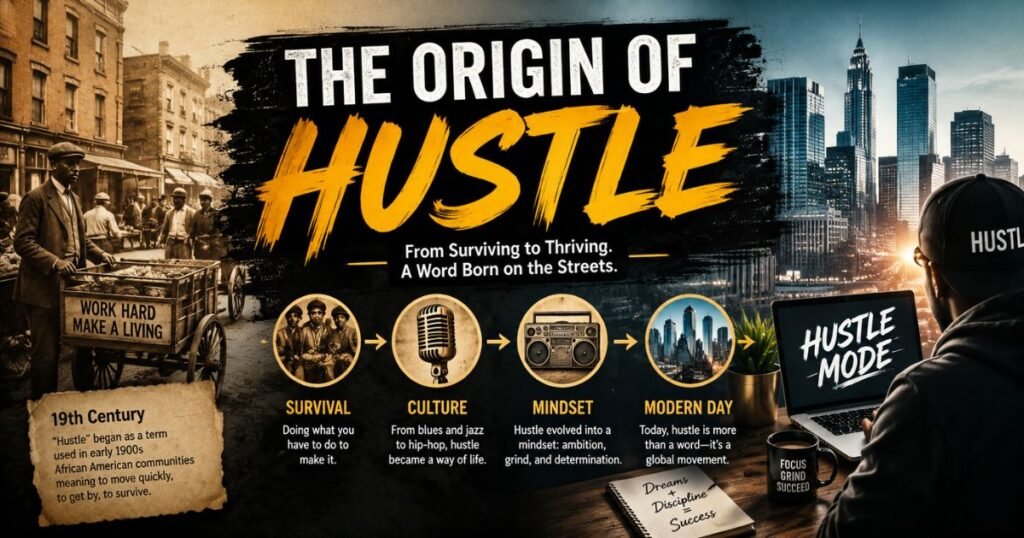
The word “hustle” has roots in the Dutch language. It comes from “husselen,” which meant to shake or toss something around. Over time, English speakers picked up the word and gave it new meaning.
By the 1600s and 1700s, “hustle” started to mean pushing or shoving someone in a rough way. Later, during the 1800s in America, the word shifted to describe hard work and quick action, especially in business and street life.
Today, the word has grown even further. It now covers everything from sports effort to modern side hustles that people run outside their regular jobs. The meaning has changed over centuries, but the spelling has stayed the same.
Why People Write Hussle Instead of Hustle
There are a few clear reasons why this mistake happens so often. Understanding these reasons can help you avoid making the same error in your own writing.
- Silent letters confuse spelling: The silent “t” makes the word sound different from how it looks.
- Autocorrect and typing speed: Fast typing on phones often causes small letter swaps.
- Celebrity influence: The name Nipsey Hussle made many people think “Hussle” was a valid spelling.
- Learning English as a second language: Non-native speakers may spell words based on sound rather than standard rules.
- Lack of proofreading: Quick messages and social media posts are rarely checked for spelling errors.
Knowing these reasons makes it easier to catch the mistake before it happens. A quick double check before hitting send or publish can save you from this common error.
Real World Usage of Hustle
“Hustle” appears in many parts of daily life, from casual talk to formal writing. It fits naturally into conversations about work, sports, money, and personal growth.
People use “hustle” to describe someone who works hard without giving up. A student can hustle to finish an assignment. A worker can hustle to meet a deadline. An athlete can hustle across the field to make a play.
Businesses also use the word often. Marketing content, motivational posts, and job descriptions frequently include “hustle” to describe energy and drive. This makes the word part of everyday professional language, not just casual slang.
Hustle in Different Contexts
The meaning of “hustle” can shift slightly depending on where it is used. Here is how the word changes across different settings.
| Context | Example Meaning |
| Workplace | Working with energy and speed to finish tasks |
| Sports | Giving full effort and quick movement on the field |
| Business | Running a side project or extra income source |
| Street slang | A clever or sometimes dishonest way to make money |
| Personal growth | Staying driven and motivated toward goals |
Each context adds a slightly different shade of meaning, but the core idea stays the same: hard work, speed, and strong effort.
Hustle in Everyday Examples
Seeing the word in real sentences makes it easier to understand and remember. Here are some simple examples you can use as a guide.
- “She had to hustle to catch the last train.”
- “His hustle on the basketball court impressed the coach.”
- “I started a small hustle selling handmade candles online.”
- “You can tell he has real hustle; he never stops working.”
- “Don’t fall for that hustle; it sounds like a scam.”
These examples show how flexible the word is. It works as a verb, a noun, and even part of a warning about dishonest behavior.
Hustle in Modern Culture

Over the past decade, “hustle” has become a major part of modern culture, especially online. Social media is full of posts about “hustle mode,” “hustle harder,” and daily hustle routines.
Music, movies, and business influencers have all helped push the word into mainstream use. Songs about grinding for success, films about entrepreneurs, and online creators sharing their daily routines all use “hustle” as a core theme.
Also Read This: Really Mean
This cultural shift has turned “hustle” into more than just a word. It now represents a lifestyle built around ambition, side income, and constant self-improvement.
Hustle Culture Explained

“Hustle culture” refers to the modern mindset that values nonstop work and constant productivity. People who follow this mindset often believe that rest is optional and success only comes through nonstop effort.
This idea has both supporters and critics. Some people find it motivating and helpful for reaching big goals. Others warn that it can lead to burnout, stress, and poor mental health if taken too far.
A balanced approach is often the healthiest way to view hustle culture. Working hard is valuable, but rest and balance matter just as much for long term success.
Common Mistakes with Hustle vs Hussle
Even careful writers slip up sometimes. Knowing the most common mistakes can help you avoid them in your own writing.
- Writing “hussle” in emails, resumes, or business documents
- Assuming “Hussle” is a real word because of the rapper’s name
- Mixing up “hustle” with unrelated words like “hassle”
- Using autocorrect without double checking the final spelling
- Copying spelling from social media captions without checking accuracy
A simple rule to remember: if you are talking about hard work, speed, or effort, the correct word is always “hustle.”
Related Words and Expressions
“Hustle” connects to several other English words that share similar meanings. Knowing these related words can help expand your vocabulary and improve your writing.
H3: Related Expressions
- Grind: Similar meaning to hustle, often used for hard, repeated effort
- Hassle: A different word meaning trouble or annoyance, easy to confuse with hustle
- Side hustle: A popular phrase for extra work done outside a main job
- Go-getter: A person with strong hustle and ambition
- Work ethic: A broader term related to how hard someone works
Learning these related terms helps you use “hustle” more naturally in conversation and writing.
Usage Trends
Online search data and social media activity show that interest in “hustle” has grown steadily over the years. The rise of side jobs, remote work, and online business has pushed the word into daily use.
Here is a simple summary of usage trends:
| Trend | Description |
| Side hustle searches | Rising steadily due to gig economy growth |
| Social media hashtags | Millions of posts under hustle-related tags |
| Business content | Common word in career and startup advice |
| Music and pop culture | Frequently used in song lyrics and interviews |
These trends show that “hustle” is not a passing phrase. It has become a lasting part of modern language, especially around careers and personal goals.
Exercise 1 Choose the Correct Word
Test your understanding with this short exercise. Choose “hustle” or “hussle” for each sentence.
- She has a lot of ______ when it comes to her business.
- He had to ______ to make it to the meeting on time.
- That online offer sounds like a ______.
- My cousin started a small ______ selling art online.
- The coach praised her ______ during the game.
(Answer: All five blanks should be filled with “hustle.”)
Exercise 2 Correct the Sentence
Read each sentence below and fix the spelling mistake.
- He really has a strong hussle when it comes to work.
- I need to hussle to finish this project on time.
- Her side hussle is baking cakes for local events.
- That deal sounds like a total hussle.
- The team showed great hussle in the final minutes.
(Correct answer: Replace every “hussle” with “hustle” in each sentence.)
Final Thoughts
“Hustle” is the correct word for hard work, speed, and drive, while “hussle” is simply a common spelling mistake. Once you understand the silent “t” pattern and the word’s background, it becomes much easier to remember the right spelling every time.
Whether you are writing a resume, a business post, or a casual message, using “hustle” correctly shows attention to detail. Small habits like double checking spelling can make a big difference in how clear and professional your writing looks.

Mubeen is a passionate writer who shares simple and practical English grammar, vocabulary, and writing tips at ScoopVisly.