

Small grammar mix-ups can make even confident writers pause mid-sentence. One of the most common ones involves the verb “lend.” Should you say “she lended me a book” or “she lent me a book”? At first glance, both can seem correct, especially since “-ed” endings work for most English verbs. But English has a set of verbs that break this rule on purpose, and “lend” is one of them.
This guide clears up the confusion once and for all. You will learn the exact meaning of “lend,” “lent,” and why “lended” does not belong in standard English. Along the way, you will see real examples, simple tables, common mistakes, and practice exercises that make the rule easy to remember. By the end, choosing between “lended” and “lent” will feel completely natural.
Lended vs Lent Quick Answer
The short answer is this: “lent” is correct, and “lended” is not a real word. “Lend” is an irregular verb. That means it does not follow the normal “add -ed” pattern that most English verbs use. Instead, it changes its spelling in the past tense.
So no matter how the sentence is built, past tense or past participle, the correct form is always “lent.”
Lended vs Lent Quick Answer
The short answer is this: “lent” is correct, and “lended” is not a real word. “Lend” is an irregular verb. That means it does not follow the normal “add -ed” pattern that most English verbs use. Instead, it changes its spelling in the past tense.
So no matter how the sentence is built, past tense or past participle, the correct form is always “lent.”
Examples
| Sentence | Correct? |
| She lent me her umbrella yesterday. | Correct |
| She lended me her umbrella yesterday. | Incorrect |
| He has lent his car to his brother. | Correct |
| He has lended his car to his brother. | Incorrect |
Lended vs Lent Meaning
To understand why “lent” wins, it helps to look at each word on its own.
Lend
“Lend” is the base form, or the present tense form, of the verb. It means to give something to someone for a short time, with the expectation that it will be returned. For example, “I lend my books to friends often.”
Lent
“Lent” is the past tense and past participle form of “lend.” It describes an action that already happened. For example, “I lent my book to Sara last week.” It is also used with helping verbs like “has,” “have,” or “had.”
Lended
“Lended” is simply not a standard English word. It looks like it should work because many verbs form their past tense by adding “-ed.” But “lend” does not follow that rule. Using “lended” is a common grammar mistake, not an accepted alternative.
Lended vs Lent Difference
The core difference is grammatical, not about meaning. Both words are meant to describe the same action, giving something temporarily. But only one of them is grammatically correct in standard English.
Here is a simple way to remember it:
- Present tense: lend
- Past tense: lent
- Past participle: lent
- Incorrect form: lended
Unlike regular verbs such as “walk” (walked) or “play” (played), “lend” skips the “-ed” pattern completely and shifts to “lent” instead.
Grammar Rule Depth
To really understand this, it helps to look at how English verbs are grouped.
Lend Is an Irregular Verb
English verbs fall into two main groups: regular and irregular. Regular verbs follow a predictable pattern. You just add “-ed” to the base form, and that becomes both the past tense and the past participle. Irregular verbs do not follow this pattern. They often change their internal spelling instead. “Lend” belongs to this second group.
Verb Forms
Here is a quick table showing how “lend” behaves compared to a regular verb like “walk.”
| Verb Type | Base Form | Past Tense | Past Participle |
| Regular | walk | walked | walked |
| Irregular | lend | lent | lent |
| Irregular | send | sent | sent |
| Irregular | spend | spent | spent |
Notice something interesting? “Lend,” “send,” and “spend” all follow the same irregular pattern. This is a helpful clue for remembering the rule.
Examples
- Present: I lend my notes to classmates.
- Past: I lent my notes to a classmate last week.
- Past Participle: I have lent my notes many times this semester.
Why Lended Is Wrong
“Lended” is wrong simply because English grammar rules do not support it. “Lend” never changes into “lended” in any accepted form of standard English, whether spoken or written. It does not appear in dictionaries as a correct form, and most grammar checkers will flag it as an error.
Some words feel like they should work because they look logical. But English has hundreds of irregular verbs that break the normal rules on purpose, simply because that is how the language developed over time. “Lend” is one of them.
The Origin of Lend and Lent

The word “lend” comes from Old English “laenan,” which meant to grant the use of something. Over centuries, English absorbed many verbs from Old English and Germanic roots that kept irregular past tense patterns. That is why verbs like “lend,” “send,” and “spend” all share a similar shift from “-nd” to “-nt” in their past forms.
This pattern was not created randomly. It reflects how the language evolved through sound changes over hundreds of years. Even though modern English speakers do not think about this history in daily conversation, it explains why “lent” feels natural to native speakers, even without formal grammar training.
Why People Say Lended Instead of Lent
Even though “lent” is correct, many people still say or write “lended” by mistake. There are a few clear reasons behind this.
1. Regular Verb Habit
Most English verbs are regular. Because “-ed” works for so many words, people naturally apply that same pattern to “lend” without thinking twice. This is a very common habit, especially among new learners.
2. Spoken Language Influence
In fast, casual speech, small grammar mistakes often go unnoticed. If someone hears “lended” used once, they might repeat it, assuming it sounds correct because it feels familiar.
3. Lack of Irregular Verb Knowledge
Irregular verbs are not always taught in depth, especially outside of formal English classes. Without clear exposure to the “lend, lent, lent” pattern, many people simply guess based on the rules they already know.
Real World Usage of Lent
“Lent” shows up constantly in daily life, business, education, and finance. Seeing it used correctly in different settings can help make the rule stick.
Everyday Conversation
People use “lent” naturally when talking about small favors. For example, “My neighbor lent me his ladder last weekend.” This kind of sentence comes up often in casual talk between friends and family.
Business Communication
In professional settings, “lent” often appears in emails or reports about resources, equipment, or support. For example, “Our marketing team lent extra staff to help with the product launch.”
Academic Writing
Students and researchers also use “lent” when describing past actions in essays or reports. For example, “The professor lent several rare books to the library for the exhibit.”
Financial Context
In banking and finance, “lent” is used constantly to describe loans and credit. For example, “The bank lent the company two million dollars for expansion.”
Lent in Everyday Examples

Seeing “lent” in different formats helps show just how common and natural it is.
Emails
“Hi Sam, thank you for the equipment you lent us last month. We really appreciated it.”
News
“The government lent financial support to small businesses during the recent economic slowdown.”
Social Media
“My best friend lent me her car for the weekend trip. Such a lifesaver!”
Formal Writing
“The museum lent several historical artifacts to the traveling exhibition this year.”
Common Mistakes with Lended vs Lent
Even careful writers slip up sometimes. Here are the most common mistakes people make.
Mistake 1 Using Lended
This is the most frequent error. Writers add “-ed” out of habit, forgetting that “lend” is irregular. The fix is simple: always replace “lended” with “lent.”
Mistake 2 Mixing Verb Forms
Some people mix tenses in the same sentence, such as writing “I lend him money yesterday” instead of “I lent him money yesterday.” Staying consistent with tense is important for clear writing.
Mistake 3 Confusing With Borrow
Many people mix up “lend” and “borrow” because both describe temporary transfers of something, just from opposite directions. This confusion often leads to sentences that sound off, even if the grammar is technically correct.
Lend vs Borrow Clarification
This is one of the most common points of confusion in English, so it deserves its own clear explanation.
Lend
“Lend” means to give something to someone else temporarily. The person doing the lending is the owner of the item. Example: “I lent my pen to Alex.”
Also Read This: Training vs Trainning
Borrow
“Borrow” means to receive something from someone else temporarily. The person doing the borrowing does not own the item. Example: “Alex borrowed my pen.”
Here is a simple table to make the difference crystal clear:
| Word | Who Does the Action | Direction |
| Lend | The owner of the item | Giving something out |
| Borrow | The person receiving the item | Taking something in |
| Lent | Past tense of lend | Already given |
| Borrowed | Past tense of borrow | Already received |
Lended vs Lent in Different Contexts
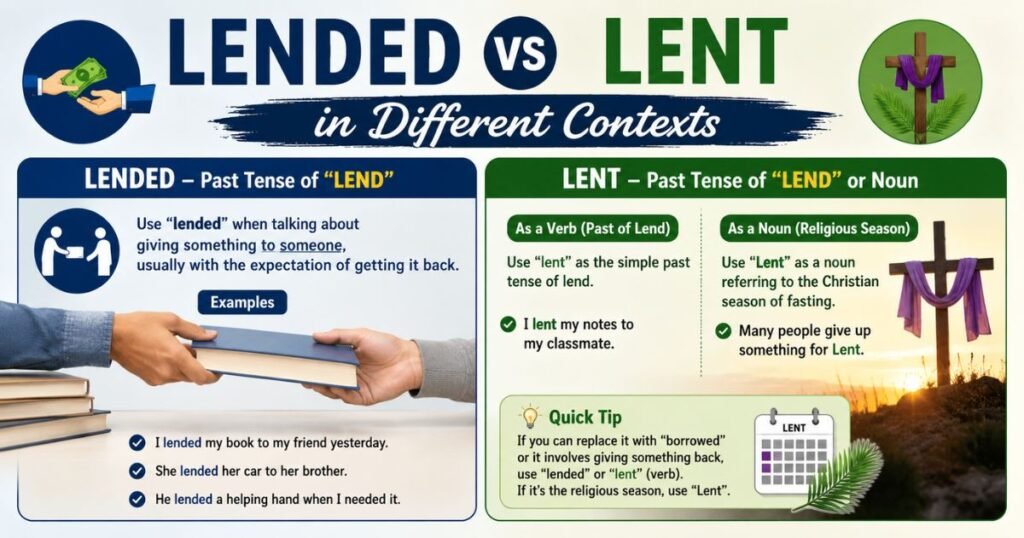
Understanding how “lent” fits into different sentence types can help avoid mistakes in real writing.
Instructions
In instructional writing, “lend” is often used in its base form. For example, “Lend your tools carefully and always ask for them back.”
Past Actions
When describing something that already happened, “lent” is the only correct choice. For example, “She lent her jacket to a friend during the concert.”
Descriptions
“Lent” also works well in descriptive writing about someone’s character or habits. For example, “He was known as a generous man who often lent money to those in need.”
Related Words and Similar Patterns
Learning “lend” and “lent” becomes easier once you notice similar verbs that follow the same pattern.
Similar Irregular Verbs
| Base Form | Past Tense | Past Participle |
| Lend | Lent | Lent |
| Send | Sent | Sent |
| Spend | Spent | Spent |
| Bend | Bent | Bent |
| Build | Built | Built |
Key Insight
Most of these verbs end in “-nd” in their base form and shift to “-nt” in the past tense. Recognizing this small pattern can help you remember many irregular verbs at once, not just “lend.”
Usage Trends
Language data shows that “lent” is used far more often than “lended” in published writing, news articles, and formal documents. Search trends also show that many people actively search “lended vs lent” because they are unsure which one is correct, which confirms that this is a widespread point of confusion, especially among English learners and casual writers.
Despite this, “lended” still appears occasionally in informal speech and low-quality online content. This shows that while the mistake is common, it has never become an accepted or standard form.
Exercise 1 Choose the Correct Word
Pick the correct option for each sentence.
- She (lent / lended) me her charger this morning.
- The library has (lent / lended) hundreds of books this year.
- He always (lend / lends) his tools to neighbors.
- They (lent / lended) their car for the wedding.
- I have never (lent / lended) money to strangers.
Exercise 2 Correct the Sentence
Fix the grammar mistake in each sentence below.
- My uncle lended his truck to us last summer.
- The bank has lended millions to small businesses.
- She lended her notes to the whole class.
- We lended our garden tools to the new neighbors.
- He lended his umbrella without even thinking twice.
Final Thoughts
Grammar mistakes like “lended” are easy to make and just as easy to fix once you understand the pattern behind them. English has many irregular verbs, and “lend” is one of the clearest examples of how these words break from the usual “-ed” rule. Keeping a short list of similar verbs, like send, spend, and bend, in mind can make future writing much smoother.
Whether you are writing a business email, a school essay, or a casual text message, using “lent” correctly shows attention to detail and builds trust with your reader. A small fix like this can make your writing sound more polished and professional overall.

Mubeen is a passionate writer who shares simple and practical English grammar, vocabulary, and writing tips at ScoopVisly.