

You’re typing a client email and you freeze. Is it seamless or seemless?
Seamless is the correct spelling. Seemless is a common misspelling that no standard dictionary accepts. Here’s why, with examples you can use today.
Seamless vs. Seemless: The Quick Answer
Use seamless every time. It comes from the noun seam plus the -less suffix, so it literally means without seams.
Seemless is a common typo that sneaks in from the verb seem. It fails every dictionary spelling check and looks careless in professional writing.
| Word | Status | Why |
| Seamless | Correct | Seam + less = without seams |
| Seemless | Incorrect | Mixes up seem (to appear) with seam |
What Does “Seamless” Mean?
Seamless describes something smooth, continuous, and without interruptions. Think of a bridge with no gaps or an app that never asks you to log in twice.
The word works in two ways: a literal meaning and a figurative meaning. Both stay tied to one idea, which is no visible joins.
Simple Definition of Seamless
The seamless definition in plain English: having no seams, gaps, or breaks. It’s perfectly connected and easy and effortless to use.
If you can’t spot where one part ends and the next begins, it’s seamless.
Literal Meaning of Seamless
Literally, seamless means without seams. A sock, pipe, or tile made as one piece has no stitched joining line.
This is the older sense of the word. You’ll find it in textile terminology and fabric construction.
Examples
- Seamless leggings are knitted as one piece, so there are no visible seams.
- Seamless socks skip the ridge across the toes, which means less skin irritation.
- Seamless sportswear adds comfort and flexibility during workouts.
- A seamless steel pipe has no welded joint.
Literal Example Sentence
“She bought seamless running socks because her old pair rubbed her toes raw.”
The word describes a real, physical thing with no seam.
Figurative Meaning of Seamless
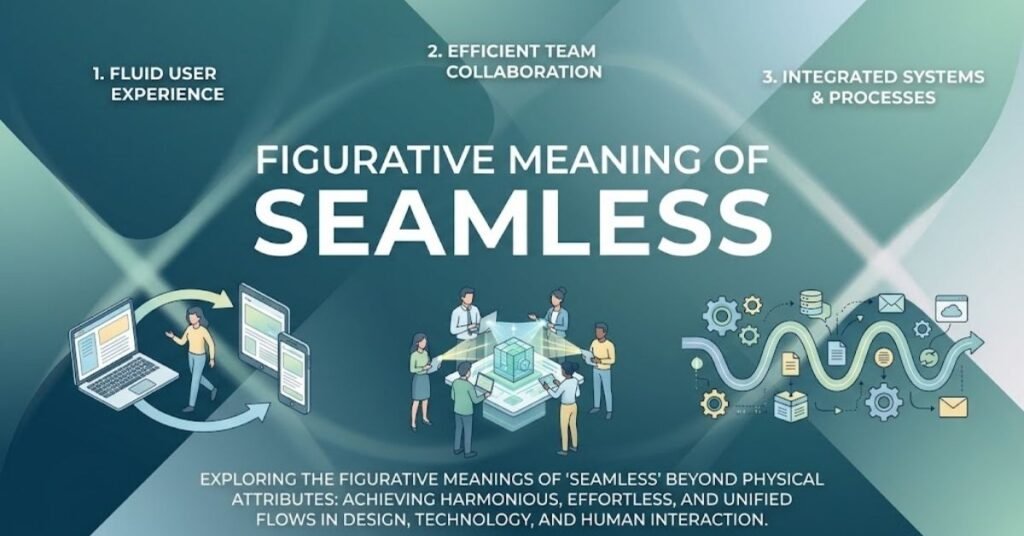
Over time, semantic evolution gave the word a second job. It now describes an uninterrupted experience, like a friction-free checkout or a smooth handoff between teams.
This modern figurative definition is the one you’ll see most in business English and tech. No fabric required.
Figurative Example Sentence
“The team handled the seamless transition between departments without missing a single deadline.”
Nothing here has a seam. The process simply feels smooth.
Why People Spell Seamless as Seemless
Mostly because of sound. English spelling doesn’t announce itself, so the brain grabs the spelling it knows best. That’s a classic sound-based spelling slip.
Add fast typing and skimming, and the error slides through. It’s a common spelling confusion, not a sign of weak English.
Pronunciation Causes Confusion
In spoken English, seam and seem are true homophones. So the full words seamless and seemless are identical-sounding words when said aloud.
Different English accents barely change that. Your ear can’t help you here.
The Word “Seem” Already Exists
Seem is a very familiar verb. You use it daily, as in “It seems fine.”
That word familiarity makes the wrong spelling feel natural. But seem means “to appear,” which has nothing to do with joining fabric.
The Real Origin of the Word “Seamless”
The word origin is simple. Seam is an old English word with Germanic languages roots, and it names the line where two pieces of cloth are joined by stitching.
The -less suffix also comes from Old English and means “without.” Put them together and you get the original meaning: without a stitched joining line.
Memory Trick
Picture a seam on a jacket sleeve. Now remove it. What’s left is seamless, and the word keeps its root word.
Seamless vs. Seemless Pronunciation
Seamless pronunciation sounds like SEEM-liss. The stress lands on the first syllable.
Seemless pronunciation would sound identical, and that’s exactly the trap. Since seemless isn’t a real word, the only difference lives on the page.
Seamless vs. Seemless at a Glance
Here’s a quick word comparison you can screenshot.
| Feature | Seamless | Seemless |
| Dictionary recognition | Yes | No |
| Root word | Seam | Seem (wrong) |
| Meaning | Without seams, smooth | None |
| Use in writing | Always correct | Always a spelling error |
How Seamless Is Used in Business English
Business communication loves this word. It signals smooth business operations and a tidy business workflow.
Used well, it adds clarity. Used loosely, it turns into one of those tired business buzzwords.
Common Business Phrases
- Seamless onboarding
- Seamless communication
- Seamless collaboration
- Seamless integration
- Seamless payment processing
- Seamless workflow
- Seamless transition
Example
“Our new hire got a seamless onboarding: laptop, logins, and a buddy on day one.”
Specific details make the claim believable.
Seamless in Technology
Technology companies use the word for connected systems that work without manual steps. Think of your phone and laptop sharing the same files.
It points to an efficient process with no surprise errors along the way.
Examples in Technology
- Seamless synchronization across mobile and desktop devices
- Seamless login experience with a single account
- Seamless streaming with no buffering
- Cloud integration and app integration between tools
- Automatic data updates after software updates
Example Sentence
“The project management software offers seamless integration with our calendar, so deadlines update on their own.”
Seamless in Customer Experience
In customer experience, seamless means a customer journey with no bumps. You find a product, pay, and track it without stopping to wonder what’s happening.
That links straight to customer satisfaction, customer trust, and customer retention.
Areas Where Companies Use the Word
- Online shopping and the online checkout process
- Mobile banking
- Airline booking
- Food delivery apps with real-time delivery tracking
- Streaming platforms
- Customer support
Real-World Example
Picture ordering dinner. You tap once, your payment information is already saved, and a map shows the driver’s route.
No retyping, no phone call. That’s a seamless customer experience.
Why “Seamless” Became a Popular Marketing Word
It’s short, positive, and packs convenience, speed, simplicity, efficiency, and reliability into one word. Marketing teams love that.
It also sounds technical without needing a technical explanation, which helps consumer perception.
However, Overuse Creates Problems
When every product claims to be seamless, the word loses impact. Repetitive marketing copy sounds like generic writing and vague wording.
Worse, if a real technical issue shows up, the promise backfires and hurts brand trust.
Better Alternatives to Seamless
Sometimes a sharper word works better. Try smooth, effortless, continuous, unified, integrated, streamlined, or frictionless.
Better still, show the result. “Checkout takes 20 seconds” beats any adjective.
Example Comparison
| Vague wording | Stronger wording |
| Seamless checkout | Pay in two taps, no account needed |
| Seamless integration | Connects to Google Calendar in one click |
| Seamless support | Replies within five minutes |
Correct Usage Examples of Seamless
Here are three quick sets for your own writing. Each shows correct usage in a natural sentence.
Business Examples
- “We want a seamless transition for clients moving to the new plan.”
- “Good team coordination keeps handoffs seamless for remote teams.”
Technology Examples
- “The app gives you seamless device synchronization across your phone and tablet.”
- “Her seamless streaming setup never drops during the big game.”
Everyday Examples
- “The planner arranged seamless travel arrangements for every guest.”
- “His seamless presentation flowed from one slide to the next.”
- “These seamless leggings don’t dig in at the waist.”
Incorrect Usage Examples of Seemless
Wherever you see seemless, it’s incorrect word usage. No dictionary lists it as a variant, and standard English doesn’t recognize it.
Incorrect Sentences
- “We offer a seemless checkout.”
- “Her seemless leggings arrived today.”
- “The seemless integration saved hours.”
Corrected Versions
- “We offer a seamless checkout.”
- “Her seamless leggings arrived today.”
- “The seamless integration saved hours.”
How Spell Checkers Handle “Seemless”
Most spell check tools flag seemless with a red underline and suggest seamless. It’s an easy catch for automatic spelling correction.
But tools aren’t perfect, and they can’t judge your word choice.
Popular Tools That Detect the Error
Grammarly, Microsoft Word, Google Docs, and browser spell check all flag the error. Hemingway Editor focuses on readability, so it helps with awkward phrasing and repeated words rather than spelling.
Use a mix of proofreading tools for the best coverage.
Why Human Proofreading Still Matters
Contextual errors can slip past software. A tool might accept a real word used in the wrong place.
Human proofreading also catches tone and overused buzzwords. Read your draft slowly, or out loud.
Why English Learners Struggle With Words Like Seamless
English spelling doesn’t follow tidy sound rules. The language borrowed from Germanic languages, Latin, French, and Greek, so English spelling inconsistencies are everywhere.
For English learners, one sound can have several spellings. That’s a language acquisition hurdle, not a lack of talent.
Similar Confusing Words
- Their vs. There and Affect vs. Effect
- Stationary vs. Stationery and Brake vs. Break
- Alot should be a lot, and Definately should be definitely
- Recieve should be receive, and Stich should be stitch
- Irregardless is nonstandard, so use regardless
- Theater vs. Theatre is a US vs. UK choice
The Psychology Behind Spelling Errors
Cognitive processing loves shortcuts. When reading quickly or typing quickly, your brain fills in the familiar form instead of checking every letter.
That’s why word recognition by shape often beats spelling accuracy. Visual recognition says “looks fine” and moves on.
Why Correct Spelling Matters in Professional Writing
Readers judge fast. One typo in a headline can color how they see everything after it.
It can signal low attention to detail, which affects professional credibility, reader trust, and brand authority.
Spelling Affects First Impressions
On a resume, LinkedIn profile, or client emails, the first line sets the tone. A spelling slip in resume writing can cost you a call-back.
Marketing emails and website headlines carry the same risk.
Example
Two companies pitch the same service.
Business A
The headline reads: “Seamless payroll for small teams.” It’s clean and confident.
Business B
The headline reads: “Seemless payroll for small teams.” The service is identical, but the typo makes readers wonder what else was missed.
How to Remember the Correct Spelling Forever
Link the word to its meaning, and you’ll lock in the spelling memory. Once seamless connects to seam, you won’t forget.
Try these three memory tricks.
Connect the Word to “Seam”
No seams = seamless. A seam is a stitch line, and less means without.
Visual Association Trick
Picture a shirt without visible stitching. Your mind keeps the seam and drops the stitches, and the spelling follows.
Quick Reminder Formula
Seam + less = seamless. Can’t say “without seams”? Then you’ve got the wrong word.
Common Contexts Where You Should Use “Seamless”
Use it when something genuinely flows without breaks. That’s correct word usage and it keeps your claim honest.
Appropriate Uses
- Physical items made without a seam
- Processes with no manual handoffs
- Systems that sync on their own
Example Situations
- A hotel check-in with no front desk line
- A data move with zero downtime
- A seamless presentation that flows from slide to slide
When You Should Avoid Using “Seamless”
Skip it when you can’t back it up. If users still hit errors, readers will notice.
Also skip it when a more specific word does the job.
Avoid Repetition
Using the word five times on one page is overuse of seamless. It dulls your writing clarity fast.
Example of Weak Writing
“Our seamless platform delivers a seamless experience with seamless integration.”
Better Version
“Our platform connects to your tools in one click and keeps your data in sync.”
Seamless as a Brand Name
Many people know Seamless as a US food delivery service. That brand recognition drives plenty of searches for the word.
It also means a typo in a review or email can look doubly sloppy. If you write about the brand, spell it seamless too.
Case Study: How One Word Changes Brand Perception
This is a made-up scenario, but the lesson is real. Two landing page headlines promote the same travel app.
Landing Page A
“Seemless booking for busy travelers.”
Most readers would pause at the typo. That pause chips away at brand credibility.
Landing Page B
“Seamless booking for busy travelers. Pick a seat, pay, and board in minutes.”
It’s correct and specific. That builds brand trust and a more professional image.
Quick Tips to Improve Spelling Accuracy
Read your work out loud, since you’ll hear awkward spots. Keep a short list of words you often miss.
Run a spell check first, then do manual proofreading after a short break. A fresh eye catches what a tired one skips.
Conclusion
Seamless is the only correct spelling. Seemless is a common misspelling that comes from the verb seem.
Remember the formula: seam + less = seamless. Got a spelling mix-up that trips you up? Share it in the comments, and pass this guide to a friend who writes a lot.
FAQs
Is Seemless ever correct in English?
No. Seemless isn’t recognized by any standard dictionary, so always use seamless.
Why do people confuse Seamless vs. Seemless so often?
The two words sound the same, and seem is a very familiar word. That makes sound-based spelling errors easy.
What does Seamless actually mean?
It means smooth, continuous, and without seams or gaps. It works for fabric and for experiences.
Can spelling mistakes affect professional credibility?
Yes. Typos can weaken first impressions and make readers doubt your attention to detail.
What is the easiest way to remember the correct spelling?
Use the formula seam + less = seamless. If you can picture a seam, you can spell the word.

Mubeen is a passionate writer who shares simple and practical English grammar, vocabulary, and writing tips at ScoopVisly.