

You saw a poison tree tattoo somewhere, maybe on Pinterest, maybe on someone’s forearm at a coffee shop. And now you can’t stop thinking about it.
Here’s the short answer before we go deep: a poison tree tattoo meaning usually points to suppressed anger, hidden resentment, or emotions someone kept quiet for way too long. It’s not about wishing harm on anyone. It’s about what happens inside a person when they swallow their feelings instead of saying them out loud.
Let’s unpack why this design has quietly become one of the most requested pieces in dark, symbolic tattoo work.
What Does a Poison Tree Tattoo Mean?
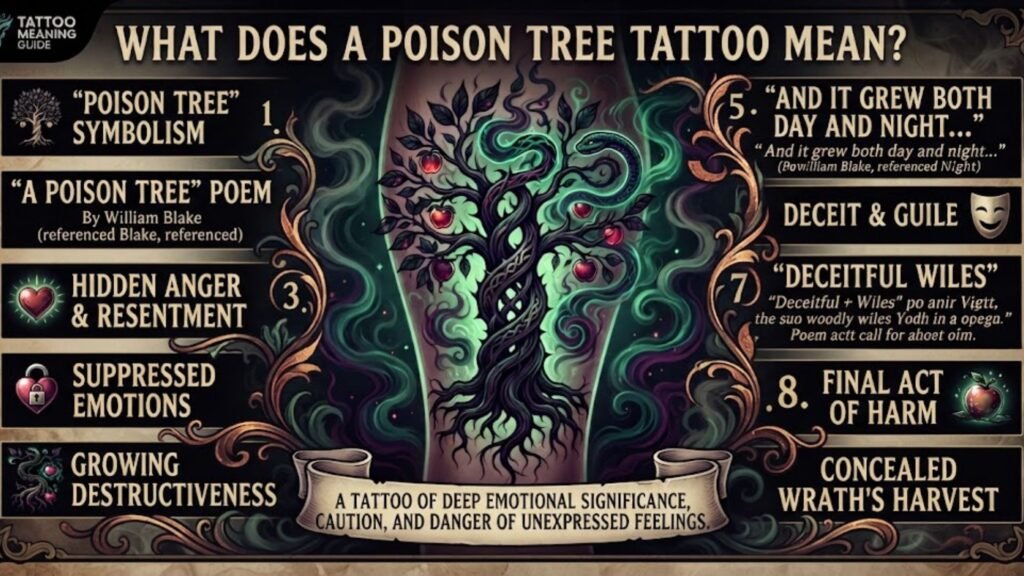
At its core, this tattoo represents emotional suppression. Picture someone smiling at a person who hurt them, while underneath, something ugly keeps growing.
That’s the whole idea. The tree isn’t literally poisonous. It’s a stand in for bottled up feelings that never got a voice. The longer you ignore anger, the deeper the roots go.
Most people who choose this design aren’t celebrating darkness for the sake of it. They’re marking a chapter where they stayed silent, and it cost them something.
Where Does the Poison Tree Symbol Come From?
The phrase traces back to William Blake, the English poet and artist known for mixing beauty with unsettling truth. His short poem simply called A Poison Tree gave this image its shape.
Before Blake, though, poisoned or forbidden trees already lived in myth and scripture. Cultures have used trees as stand ins for hidden danger, temptation, and consequence for centuries.
So the tattoo pulls from two wells at once: a specific 18th century poem and a much older, broader well of poisoned tree mythology.
The William Blake Poem: A Quick Breakdown
Blake published A Poison Tree in 1794, inside his collection Songs of Experience. The poem is short, but it hits hard.
The narrator talks about being angry with a friend. He tells the friend, and the anger fades. Then he’s angry with an enemy, stays quiet, and that silent resentment grows like a plant he waters daily with fake smiles and buried rage.
By the end, the enemy eats the poisonous apple the anger produced and dies. It’s a cautionary tale about what unspoken anger can turn into if you let it sit long enough.
Biblical and Historical Roots of the Poison Tree
If the apple and tree combo felt familiar, that’s not an accident. It echoes the Tree of Knowledge from the Garden of Eden, where forbidden fruit led to consequences nobody could undo.
That story gave Western culture a template: something beautiful on the outside, but carrying hidden corruption underneath. Blake basically borrowed that emotional architecture and pointed it inward, at a person’s own mind instead of a shared paradise.
Beyond the Bible, other traditions carry similar themes. Norse mythology has Yggdrasil, the world tree connecting realms, sometimes shown with dark serpents gnawing at its roots. The pattern repeats because it’s just how people process corruption beneath the surface.
What Emotions Does a Poison Tree Tattoo Represent?
This is where the tattoo gets personal. People wear this design to carry a piece of their own story, not just Blake’s.
Common emotions tied to it include bitterness, secret hatred, deep resentment, and sometimes even quiet thoughts of revenge that never got acted on. It can also represent emotional pain from a friendship or relationship that soured slowly instead of all at once.
But here’s the flip side. Plenty of wearers say the tattoo isn’t about staying stuck in anger. It’s a marker of the moment they finally recognized their own toxic thought patterns, which is often the first real step toward emotional healing.
Poison Tree Tattoo Designs: What the Visual Elements Mean
Every piece of this tattoo carries its own weight. Nothing on it is just decoration, at least not in the well thought out versions.
Bare branches or a cracked trunk usually point to internal damage, the kind that doesn’t show on the outside. Deep roots suggest how long the feeling has been growing, sometimes since childhood. A glowing apple hanging off a dead looking branch creates that beauty and danger contrast the whole concept is built on.
Some designs add a snake in branches, echoing serpent symbolism from Eden. Others include a full moon, which adds a layer of mystery and quiet watching, like the anger only comes alive at night when nobody’s looking.
Who Gets Poison Tree Tattoos and Why?
You’ll find this tattoo on a pretty wide mix of people. Survivors of emotional abuse often get it as a private nod to what they walked through. Writers, poets, and other creative types are drawn to it for the literary weight it carries.
William Blake fans get it simply because they love the poem and want it on their skin permanently. Then there are the reflective people, the ones who think deeply about their own patterns and want a permanent reminder not to bottle things up again.
None of these groups are wrong. The tattoo flexes to fit whoever’s wearing it, which is part of why it’s stuck around.
Poison Tree Tattoo vs. Other Dark Tree Tattoos: Key Differences
It helps to know what makes this design different from its cousins, since dark tree tattoos aren’t all telling the same story.
A Tree of Life Tattoo usually leans positive, focused on growth, family roots, and connection. A Weeping Willow Tattoo speaks to grief, mourning, and loss, often chosen as a memorial piece. A Twisted Tree Tattoo without the apple can simply represent struggle or resilience, no specific poem attached.
The poison tree stands apart because of that one detail, the fruit. Without the apple, you’ve just got a dark tree tattoo. With it, you’ve got a direct nod to Blake and everything his poem represents.
Placement Ideas and What They Add to the Meaning
Where you put this tattoo changes how it feels, even if the design stays identical.
A forearm tattoo or inner wrist tattoo puts it front and center, a constant visual reminder you’ll see daily. A ribcage tattoo or sternum tattoo sits close to the heart, literally, which fits the emotional weight of the piece nicely.
For something more private, a back tattoo near the spine or a thigh tattoo keeps the meaning tucked away, visible only when you choose to show it. That’s not a lesser choice. Some people want their healing story kept just for themselves.
Common Mistakes People Make With This Tattoo
A few missteps show up again and again with this design, and they’re worth knowing before you sit in the chair.
- Going too literal, adding a full skull or blood dripping off the apple, which tips the piece into cliché horror territory instead of subtle symbolism
- Overcrowding the design with too many extra elements at once, burying the tree under thorns, snakes, moons, and ravens until nothing reads clearly
- Skipping artist research, picking whoever’s available instead of a fine line specialist who actually understands intricate branches and root detail
- Choosing this tattoo purely because it looks edgy, without understanding the poem meaning or what it’ll represent to you years down the line
Take your time here. This isn’t a design you want to rush.
Does the Poison Tree Tattoo Have a Positive Meaning?
Yes, and honestly, this side of the meaning gets overlooked way too often. For a lot of people, this tattoo isn’t about staying angry. It’s proof they got through it.
Choosing to ink this symbol can represent self-awareness, the moment someone stopped pretending everything was fine. It can mark personal growth, resilience, and the decision to stop releasing bitterness onto everyone around them.
Think of it less like a warning sign and more like a scar that healed. The tree grew, sure, but the person wearing the tattoo chose to grow past it too.
How to Talk to Your Tattoo Artist About This Design
This heading isn’t in most guides, but it probably should be. Walking into a studio and just saying “poison tree” leaves way too much open to interpretation.
Bring reference images, sure, but also bring your reasoning. Tell your artist whether you want the piece to feel heavy and gothic, or softer and more like a quiet personal note. That changes line weight, shading, and even where the apple sits on the branch.
A good tattoo consultation should feel like a conversation, not an order. If your artist isn’t asking questions about what the piece means to you, that’s worth noticing.
Poison Tree Tattoo Trends and Fresh Style Directions
Fine line blackwork tattoo styles have taken over a lot of dark botanical work lately, and the poison tree fits right into that shift. Instead of heavy shading everywhere, artists are leaning into negative space, letting a single cracked trunk or a lone apple carry the whole message.
Minimalist versions are also gaining ground, a small tree with one apple, no extra symbols attached. It’s quieter, but the meaning doesn’t shrink just because the design does.
Pairing the tree with supporting imagery like a raven tattoo or roses with thorns is still popular too, especially for people who want the piece to say more without adding words.
Related Keywords Worth Knowing
If you’re researching this tattoo, a few related terms keep popping up, and it helps to know what they mean.
Dark botanical tattoo refers to the broader style category this piece belongs to. Literary tattoo covers any design pulled from a book or poem, not just Blake’s work. Symbolic tree tattoo is the umbrella term for any tree design carrying a deeper meaning beyond decoration.
Knowing these terms helps when you’re scrolling through portfolios or explaining your idea to an artist who might not know the poem by name.
Frequently Asked Questions
Is a poison tree tattoo considered negative or bad luck?
Not inherently. It represents an emotional state, not a curse. Plenty of wearers see it as a healing symbol rather than a dark omen.
Do I need to know the William Blake poem to get this tattoo?
No, but it helps. Knowing the poem gives the tattoo extra depth, though plenty of people connect with the imagery on its own.
Can this tattoo be combined with other symbols?
Yes. Snakes, ravens, moons, and thorned roses are common pairings. Just avoid overcrowding the design so the core meaning stays clear.
Final Thought
A poison tree tattoo isn’t really about poison at all. It’s about what quiet anger does when nobody deals with it, and what it looks like when someone finally does.
Whether you’re drawn to Blake’s poem, the biblical echoes, or just your own story of staying silent too long, this design gives that experience a permanent, visible shape. That’s rare for a tattoo to pull off this well.

Mubeen is a passionate writer who shares simple and practical English grammar, vocabulary, and writing tips at ScoopVisly.