

Have you ever typed the word “nosy” and then stopped to wonder if it should have an “e” in it? You are not alone. This is one of the most common spelling mix ups in English. People search for it every day, and even confident writers pause before they hit send.
This guide will clear up the confusion once and for all. You will learn the correct spelling, the grammar rules behind it, real examples, and how the word is used in both British and American English. By the end, you will never second guess this word again.
Quick Answer
Both “nosy” and “nosey” are technically correct. However, “nosy” is the standard and most widely accepted spelling, especially in American English. “Nosey” is an older variant that still shows up in British English and casual writing.
If you are writing for school, work, or any formal document, stick with “nosy”. It is the safer and more modern choice. Save “nosey” for casual chats or if you are writing for a British audience that prefers the older style.
| Spelling | Status | Best Used For |
| Nosy | Preferred, modern standard | Formal writing, American English, most style guides |
| Nosey | Accepted variant | Casual writing, older British texts |
Simple Examples
Seeing the word in real sentences makes it much easier to remember how to use it correctly. Here are some simple examples that show the word in everyday situations.
- My neighbor is so nosy that she checks who visits my house every single day.
- Stop being nosy and mind your own business.
- The nosy reporter kept asking questions that had nothing to do with the story.
- He gave me a nosy look when I opened my mail in front of him.
- Kids can be nosy, especially when adults are having a private conversation.
Notice how “nosy” fits naturally into casual talk, workplace chat, and even storytelling. The word almost always describes a person, an action, or a tone that shows too much curiosity about someone else’s life.
Nosey or nosy pronunciation
Here is some good news. No matter which spelling you choose, the pronunciation stays exactly the same. Both versions are said as NOH-zee, with the stress on the first part of the word.
The “s” in the middle sounds like a “z”, not a soft “s” sound. So it rhymes with words like “cozy” and “rosy”. Since the sound never changes, spelling confusion has nothing to do with how the word is spoken. It is purely a written English issue.
Quick pronunciation breakdown:
- Sound: NOH-zee
- Rhymes with: cozy, rosy, dozy
- Stress: on the first syllable
Quick Tip
Here is a simple trick to remember the correct spelling. Just think of the word “nose”. Since the word “nosy” comes directly from “nose” plus the suffix “-y”, you do not need an extra “e” in between.
Think of similar words that follow the same pattern, such as “icy” from “ice” or “spicy” from “spice”. None of these words keep the extra “e” before adding “-y”. Using this pattern in your head will help you avoid the mistake almost every time.
Grammar Rules Explained
Understanding the grammar behind “nosy” makes the spelling question much easier to answer. The word is an adjective formed from the noun “nose” with the suffix “-y” added at the end. This suffix is commonly used in English to turn a noun into a descriptive word, showing that something has the quality of that noun.
When a word ends in a silent “e” and you add a suffix that starts with a vowel, English spelling rules usually say to drop the “e”. Since “nose” already ends in a silent “e”, and “-y” starts with a vowel, the correct process is to drop the “e” and simply add “y”. This is exactly how we get “nosy” and not “nosey”.
Here is how the word changes across different grammar forms:
| Form | Word | Example Sentence |
| Base adjective | Nosy | She is a nosy coworker. |
| Comparative | Nosier | He is even nosier than his sister. |
| Superlative | Nosiest | That is the nosiest question I have ever heard. |
| Adverb | Nosily | She nosily peeked through the window. |
| Noun form | Nosiness | His nosiness annoys everyone at work. |
You will notice that every one of these forms keeps the “nosy” spelling as its base, not “nosey”. This consistency is one more reason why “nosy” is considered the standard, rule-following spelling.
Nosy or nosey synonyms
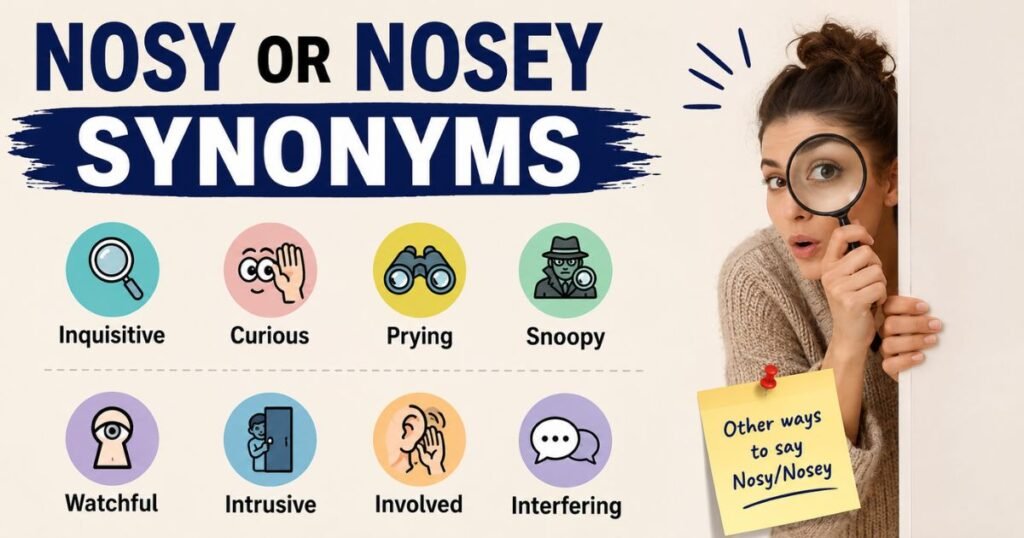
If you want to avoid repeating the same word too often in your writing, there are plenty of synonyms you can use instead. Choosing the right synonym also helps you match the tone of your sentence, whether it is playful, serious, or formal.
Common synonyms for nosy include:
- Curious
- Prying
- Inquisitive
- Snoopy
- Meddlesome
- Intrusive
- Interfering
Each synonym carries a slightly different shade of meaning. “Curious” sounds neutral and even positive in some cases. “Prying” and “intrusive” sound more negative and suggest someone is crossing a line. “Snoopy” feels playful and is often used to describe pets, kids, or gossiping friends.
| Synonym | Tone | Example |
| Curious | Neutral | She was curious about the new project. |
| Prying | Negative | Stop prying into my personal matters. |
| Inquisitive | Neutral to positive | The inquisitive student asked many questions. |
| Snoopy | Playful | The snoopy dog sniffed through every bag. |
| Meddlesome | Negative | His meddlesome nature caused problems at home. |
Why People Make Mistakes With Nosy or Nosey
Spelling mistakes with this word happen for a few clear reasons. First, English has many words where an “e” is added before a suffix, such as “cutey” or “matey”. This pattern can trick the brain into adding an unnecessary “e” to “nosy” as well.
Second, some regional versions of English, especially older British writing, have historically used “nosey” more often. This means many people have actually seen the “e” version in books, articles, or informal writing, which makes it feel familiar and correct.
Also Read This: Batton vs Baton
Third, autocorrect tools and spell checkers do not always flag “nosey” as wrong, since it is a recognized variant in most dictionaries. This gives people a false sense of confidence that either spelling is fine in every situation, even though “nosy” remains the more accepted and professional choice today.
Common reasons for the mistake:
- Confusion with similar looking words that keep the “e”
- Exposure to older or regional British spelling
- Spell checkers accepting both versions
- Simply guessing based on how the word sounds
Nosy or nosey reddit
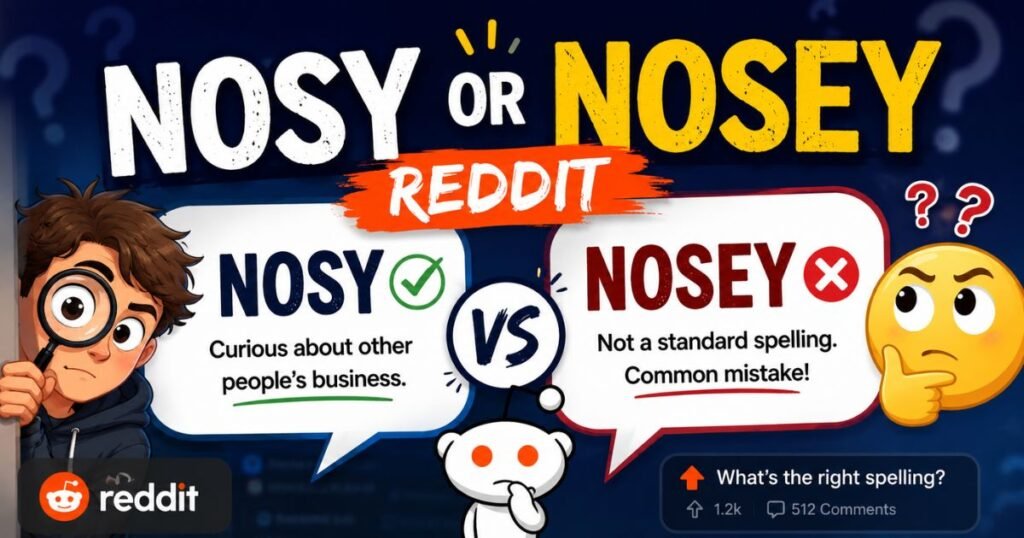
Online communities like Reddit often discuss small grammar debates like this one, and the “nosy vs nosey” question comes up fairly often in language and grammar forums. Most users tend to agree that “nosy” is the more common and accepted spelling in everyday use, especially among American users.
However, some users from the UK or Australia mention that “nosey” still feels natural to them and is not seen as wrong in their local context. This lines up with what dictionaries actually say too, since both spellings are recognized, but usage leans heavily toward “nosy” worldwide.
The general takeaway from these online discussions is simple. If you want to sound modern and widely understood, “nosy” is the safer bet across almost every platform and audience.
Nosy or Nosey in Real Life Usage
This word shows up far more often than people realize, in daily conversations, workplaces, and even news headlines. Understanding how it is used in real situations makes it easier to use correctly yourself.
Workplace usage: People often use “nosy” to describe a coworker who asks too many personal questions or tries to get involved in matters that are not their concern.
Neighborhood and family usage: This is one of the most common settings for the word, often used lightly or jokingly to describe someone who watches too closely over others’ daily lives.
Social media usage: The word is frequently used online to describe people who comment on or judge private posts, relationships, or photos that do not concern them.
Journalism and media usage: Reporters or tabloids are sometimes called “nosy” when they dig into private details of a public figure’s life beyond what is necessary for the story.
Nosy or nosey oxford dictionary
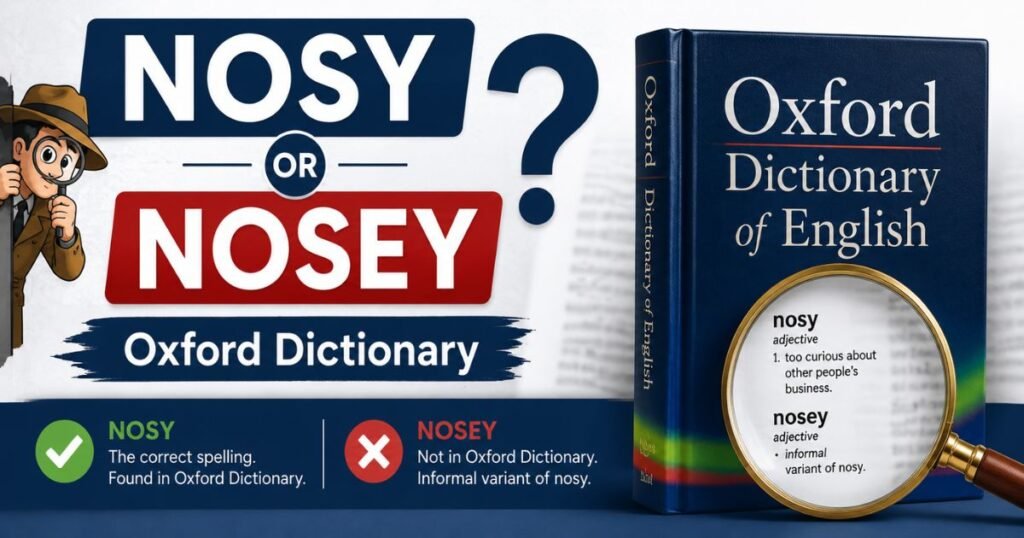
According to major dictionaries, including Oxford, “nosy” is listed as the primary and preferred spelling. “Nosey” appears as a secondary, accepted variant, mainly used in British English contexts.
This distinction matters because dictionaries generally list the most commonly used and grammatically consistent spelling first. Since “nosy” follows the standard English rule of dropping the silent “e” before adding “-y”, it fits naturally as the main entry, while “nosey” is kept as an alternative for regional or historical use.
For anyone writing content, essays, or professional documents, following the dictionary’s primary spelling is always the safest and most widely accepted choice.
British and American English Usage
Spelling differences between British and American English are common, and this word is a small but interesting example of that pattern. While many people assume “nosey” is strictly British and “nosy” is strictly American, the reality is a bit more relaxed than that.
| Region | Preferred Spelling | Notes |
| American English | Nosy | Standard in almost all writing and media |
| British English | Nosy or Nosey | Both are used, though nosy is now more common |
| Australian English | Nosy | Follows the American preference closely |
| Canadian English | Nosy | Mixed influence, but nosy is more frequent |
Even in British publications today, “nosy” appears more often than “nosey” in modern newspapers, books, and websites. This shows that the gap between the two regions is shrinking, and “nosy” is becoming the global standard across nearly all forms of English.
Conclusion
At the end of the day, the choice between “nosy” and “nosey” is not a major grammar crisis, but it is worth getting right. “Nosy” is the correct, modern, and widely accepted spelling that follows standard English rules, while “nosey” remains a valid but older variant mostly seen in British English. Using “nosy” will keep your writing clean, professional, and easy to understand no matter where your audience is from.
The next time you are unsure, just remember the simple trick: “nose” plus “-y” equals “nosy”, no extra letters needed. Keep this guide handy, and you will never have to second guess this tricky little word again.

Mubeen is a passionate writer who shares simple and practical English grammar, vocabulary, and writing tips at ScoopVisly.