

You’re typing a quick professional email. You hit send, then spot it. Did you write “bussiness” with two s’s?
That tiny slip happens to almost everyone. This guide gives you the answer fast, then explains why it’s so easy to get wrong.
Quick Answer
Business is the correct spelling. It has one “s” after the “u” and one “s” at the “ness” end. That’s two s’s total, but they sit apart.
Bussiness is a misspelling. So are bussines, buisness, and busness. None of them are accepted spelling in standard English.
Business or Bussiness: Which Spelling Is Correct?
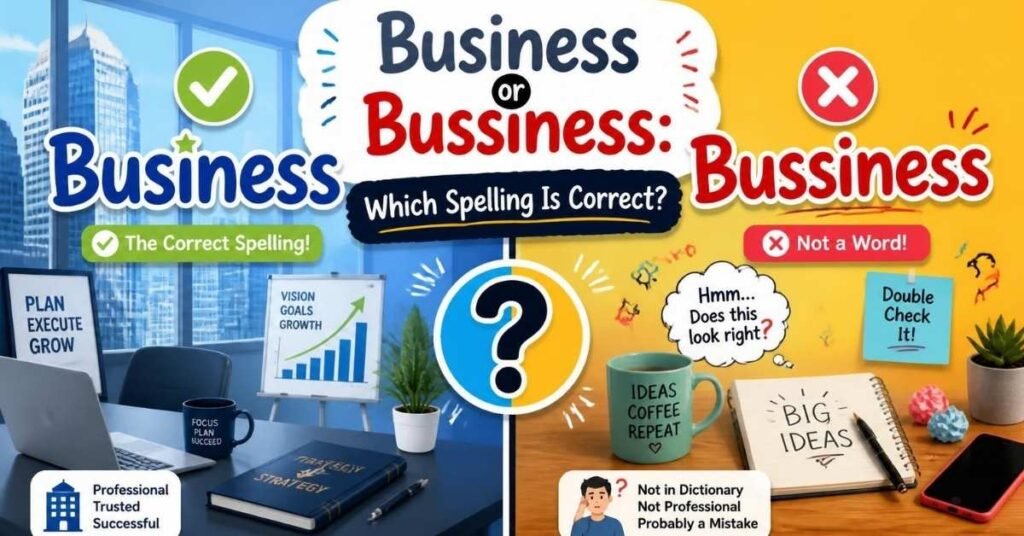
Only “business” is a real English word here. “Bussiness” is an incorrect word that shows up because of an extra s in the middle.
Dictionaries in American English and British English agree on this. You won’t find a region where “bussiness” is allowed. If you see it, treat it as a spelling mistake.
How to Spell Business? Is It Bussines or Bussiness?
Spell it b-u-s-i-n-e-s-s. Say it slowly: bus, i, ness. That’s the standard spelling and it never changes.
“Bussines” drops the last s. “Bussiness” adds an extra one in the middle. Both are common spelling errors, and both fail a proofreading check.
What’s the Difference Between Business and Bussiness?
There’s no difference in meaning, because “bussiness” isn’t a word. It’s simply “business” with a typo baked in.
Think of it like a common typo on your keyboard. The reader knows what you meant, but the spelling accuracy takes a hit. That matters when your credibility is on the line.
Which Is Correct, Busyness or Business?

Both are correct, but they mean different things. Busyness is the state of being busy. It’s what you feel when your calendar is packed and your phone won’t stop buzzing.
Business covers a company, commercial activity, or professional matters. So “the busyness of December” and “the business of selling cars” are two separate ideas. Mixing them up changes your meaning, not only your spelling.
Is It Spelt Buisness or Business?
It’s “business.” The form “buisness” swaps the “i” and the “s,” so the letter order goes wrong. It’s a classic case of switched letters.
Many people write it that way when they type fast. Your fingers know the word, but they land in the wrong order.
What’s the Difference Between Buisness and Business?
Again, “buisness” has no meaning of its own. It’s a misspelling of “business” and nothing more.
The interesting part is why people make this mistake. Three habits explain most of it.
The Word Sounds Different From Its Spelling
Say “business” out loud. Most people say BIZ-ness, with two beats. The “i” in the middle barely gets spoken.
That’s a spelling-pronunciation mismatch. Your ears hear “biz-ness,” so your brain skips the “i.” Then you guess where to put it, and “buisness” or “busness” appears.
English Spelling Is Not Always Predictable
English borrows from many sources, so its spelling patterns often break their own rules. “Business” is a good example of unintuitive spelling.
If every word matched its sound, we’d write “bizness.” We don’t. That gap between sound and letters trips up English learners and native speakers alike.
Repeated Letters Cause Typing Errors
Words with double letters or repeated letters invite mistakes. Your fingers want to repeat a key, or skip one.
“Business” has two s’s close together in the sound, but they’re split across the word. That’s why people add an extra s or lose one. It’s a typing error more than a knowledge gap.
Key Differences At A Glance
Here’s a quick snapshot you can scan in ten seconds.
| Word | Status | Notes |
| business | Correct | Standard spelling, noun |
| busyness | Correct | State of being busy |
| bussiness | Incorrect | Extra s after “bus” |
| bussines | Incorrect | Missing s at the end |
| buisness | Incorrect | Incorrect letter order |
| busness | Incorrect | Letter omission, missing “i” |
Keep this table in mind next time you proofread. One glance can save you from an awkward typo.
What Does “Business” Mean?
At its simplest, business means a company, organization, or enterprise that sells goods or services. Think of a corner bakery or a software firm.
It also means commercial activity, like trade and commerce. You might hear “we do business with that supplier” or “business is slow this week.”
The word stretches further, too. It can mean work, your profession, or personal concerns, as in “that’s none of your business.” It can even mean a matter at hand, like “let’s get down to business.”
Common compound terms include small business, online business, family business, and business owner. You’ll also see business plan, business services, and business management everywhere.
Why “Bussiness” Looks Wrong To Native Speakers
Native speakers have seen “business” thousands of times. The correct shape is stored in memory, so a wrong version feels off right away.
“Bussiness” looks heavy in the middle. That double letters pattern doesn’t match the familiar word. Your eye catches it even before you can explain why.
Here’s a small story. A friend of mine once ran a bakery in Dallas and ordered a banner that read “Open for Bussiness.” Three customers pointed it out on day one. It cost her a reprint and a bit of pride.
How To Remember The Correct Spelling
You don’t need to memorize a rulebook. A few spelling memory tricks do the job. Pick whichever sticks best for you.
Think Of “Busy”
Start with the root. Busy leads to business, because a business keeps people busy. Swap the “y” for an “i” and add “ness.”
So the path is busy → business. If you can spell “busy,” you already have most of the word.
Remember There Is Only One “S” After The “U”
After the “u,” you only get one “s” before the “i.” That’s the one s after u rule. It kills “bussiness” on the spot.
Then the ending is “ness,” with its own pair of s’s. Count them: “bus” has one, “ness” has two, for three s’s in total. That’s the correct spelling pattern.
Use Familiar Phrases
Phrases lodge in memory better than single words. Try business as usual, mind your own business, or open for business.
Say them while you picture the letters. Strictly business and mean business work well too. Repeating a phrase builds spelling practice without feeling like homework.
Common Mistakes People Make
Most errors fall into four buckets. Knowing them helps you spot your own habit. Then you can fix it for good.
bussiness
This is the most common error. It adds an extra s after “bus.” The word looks longer and stranger than it should.
Fix it by remembering “busy” first. Only one s sits between the “u” and the “i.”
buisness
This one flips the “i” and the “s.” It’s a pure case of incorrect letter order, usually from fast typing.
Slow down on the first four letters. Type b-u-s-i, then check before moving on.
busness
Here the “i” goes missing. It’s a letter omission, and it often happens because the middle sound is so soft.
Say “bus-i-ness” in three beats while you write it. Then you won’t skip the middle.
bussines
This version drops the last “s.” You end up with “ness” shortened to “nes.” It’s another missing s problem.
The ending is always “ness.” Think of words like “kindness” and “darkness,” which end the same way.
Correct And Incorrect Examples
Seeing real sentences makes the rule click. Here are a few of each kind. Read them aloud if you can.
Correct Examples
- She started a small business selling handmade candles.
- Our family business has served the town for 40 years.
- The shop is open for business every day at nine.
- He’s learning business management at night school.
- That topic isn’t your business, so mind your own business.
Incorrect Examples
- She started a small bussiness selling handmade candles.
- Our family buisness has served the town for 40 years.
- The shop is open for busness every day at nine.
- He’s learning bussines management at night school.
Notice how each wrong version still looks almost right. That’s exactly why these slip through.
Business In Professional Writing
In professional writing, spelling signals care. A typo in a client email or a job application can make a reader doubt your attention to detail. That’s unfair, but it’s real.
Be extra careful in email subject lines, resumes, and client proposals. These are the first things people see. Check your LinkedIn profile too, since a typo in your headline stays there for months.
The same goes for company names, branding, business websites, and marketing materials. Mistakes in ads cost money, because you can’t unprint a flyer. Clean, polished writing builds trust.
Why Spell-Check Doesn’t Always Save You
Spell-check software catches “bussiness” most of the time. It underlines it in red, and you fix it. That’s helpful, but it isn’t perfect.
It can’t tell “business” from “busyness” when both are real words. It also stays quiet if a company name is entered on purpose. So you still need a human eye on important documents.
Quick Proofreading Tips For Emails And Documents
Read your message out loud before you send it. Your ear catches things your eye skips. It takes thirty seconds.
Try reading from the bottom up, line by line. You’ll notice individual words instead of the flow. Also, wait five minutes on big messages and look again with fresh eyes.
For school papers, academic writing, and college assignments, keep a short list of your personal trouble words. Add “business” if it’s on there. Proofreading gets easier when you know your own habits.
Dictionary-Style Word Details
Here’s a compact reference for the word, set up like a dictionary entry. Use it as a quick lookup. It covers the dictionary definition and basic usage facts.
Verb
“Business” is not used as a verb in standard English today. You won’t say “I business every day.” If you need an action word, use “operate,” “trade,” or “work.”
Noun
As a noun, business has several senses. It means a company, commercial activity, a profession, or a matter of concern. It’s the sense you’ll use ninety nine percent of the time.
The pronunciation is BIZ-ness in natural spoken English. In careful or slow speech, some people say it with three beats. Both are understood.
Synonyms
Close synonyms include company, enterprise, trade, and commerce. For personal concerns, try “affair” or “concern.” For occupation, use profession or work.
Pick the one that fits your sentence. “Enterprise” sounds bigger and more formal than “company.”
Example Sentences
- Her online business grew fast during the spring.
- They’re discussing a business plan this afternoon.
- It’s strictly business, so skip the small talk.
- Out of business signs hung on three shop windows.
Word History
The word history of business is a fun one. It traces back to older English forms like “bisignis,” built from “bisig,” meaning busy, plus a suffix. So the link to busy is real, not a memory trick.
Over centuries, the pronunciation shift dropped the middle vowel sound. The historical spelling kept the “i,” which is why the etymology shows up in the letters even though your mouth skips it.
Phrases Containing
Many business-related phrases are everyday English. Here are some you’ll hear often:
- Business as usual: things carry on normally
- Monkey business: silly or suspicious behavior
- Mind your own business: stay out of it
- Open for business: ready to serve customers
- Out of business: closed for good
- Mean business: be serious and determined
- Strictly business: no personal talk
- Business meeting: a formal work gathering
Other Commonly Confused Spelling Pairs
If “business” trips you up, you’re in good company. English has many frequently confused words and frequently misspelled words. Here are a few close cousins to watch.
- Accommodate vs Accomodate
- Amateur vs Amatuer
- Absence vs Abscence
- Foreign vs Foriegn
- Definite vs Deffinite
- Tomorrow vs Tommorow
- Truly vs Truely
- Lose vs Loose
Each has a correct word and a tempting wrong one. The same tricks apply: break the word into chunks, tie it to a root, and say it out loud.
Conclusion
“Business” is the right spelling, every time. “Bussiness,” “bussines,” “buisness,” and “busness” are all common spelling mistakes you can avoid.Remember the chain: busy leads to business, one “s” after the “u,” and “ness” at the end. Say a phrase like “open for business” to lock it in.
Now it’s your turn. Which version has tripped you up the most? Drop a comment below, and share this guide with a friend who types fast.
FAQs
Is it business or bussiness?
It’s business. “Bussiness” is a common misspelling with an extra “s” in the middle.
How do you spell business correctly?
Spell it b-u-s-i-n-e-s-s. Think “busy” first, then add “ness.”
Is buisness a real word?
No. “Buisness” is a misspelling where the “i” and “s” swap places. The correct word is “business.”
What’s the difference between business and busyness?
Business means a company, commercial activity, or work matters. Busyness means the state of being busy.
Why do people spell business wrong?
The word sounds like “BIZ-ness,” so the middle “i” gets lost. Fast typing and double letters add to the confusion.
Is bussiness correct in British English?
No. British and American English both use “business.” No region accepts “bussiness.”
How can I remember the spelling of business?

Mubeen is a passionate writer who shares simple and practical English grammar, vocabulary, and writing tips at ScoopVisly.