

Ever stared at a sentence and wondered if it’s time frame or timeframe? You’re not alone, and yes, it can feel oddly stressful in a client email.Here’s the short version. Both are correct, and the open form time frame is the safer pick for formal writing.
The rest of this guide shows you when each one fits. You’ll also get quick rules, real examples, and a memory trick you can use today.
Quick Answer
Time frame (two words) and timeframe (one word) mean the same thing.
Both describe a period of time set aside for something.
Use time frame when you want the widest accepted spelling.
Use timeframe when your brand, product, or house style prefers the closed compound.
Pick one and stick with it.
Consistent usage matters more than which side you choose.
Time Frame or Timeframe

Think of it like “e-mail” and “email.”
Both forms lived side by side for years before one took over.
The same thing is happening here.
Time frame is the long-standing open compound, while timeframe keeps gaining ground online.
So which is “right”?
Neither is a typo, and that’s the honest answer.
What Does Time Frame Mean?
Time frame meaning is simple.
It’s a specific period during which something happens or must happen.
Say your landlord asks, “What’s your time frame for moving out?”
He wants a window, like the next 60 days.
Notice the phrase works as a compound noun.
You’ll often see it in project planning, hiring, and health advice.
What Does Timeframe Mean?
Timeframe definition matches the open form exactly.
It’s the same defined period, just written as one word.
A software team might write, “Select a timeframe for your report.”
That’s a closed form doing the exact same job.
You’ll spot it a lot in dashboard labels and software interfaces.
Shorter words fit tighter buttons, and designers love that.
Time Frame vs Timeframe: Is There Any Difference?
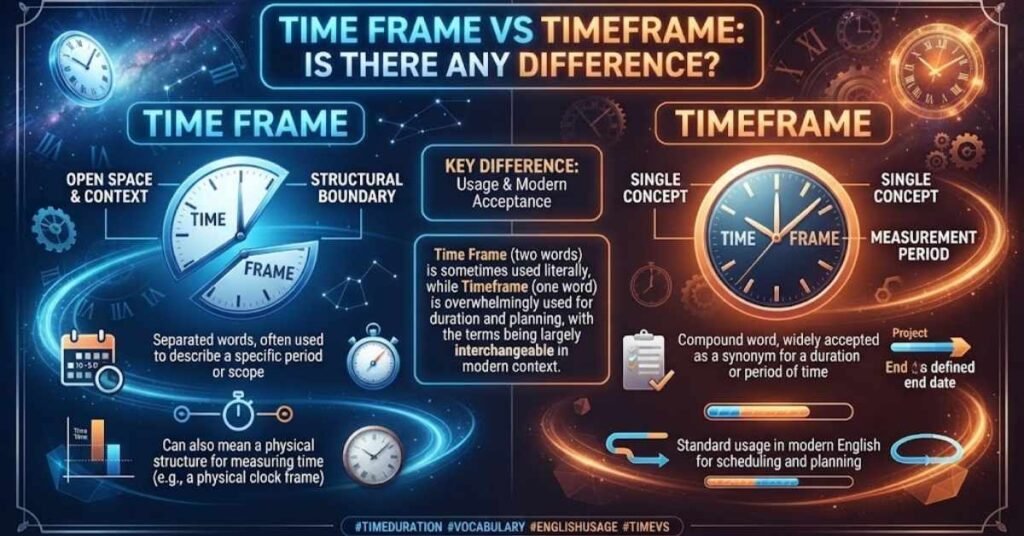
Meaning? None.
Grammar? None.
The difference is style, not substance.
It’s a matter of spelling choice and editorial preference.
Think of two coffee mugs with different handles.
Same coffee, same warmth, just a different grip.
Time Frame vs Timeframe in American English
In American English, both forms show up in print and online.
Time frame still leads in books, newspapers, and formal writing.
Tech companies lean toward timeframe.
That habit spreads fast because US English absorbs product language quickly.
If you write for a US audience, time frame feels the most neutral.
Nobody will raise an eyebrow.
Time Frame or Timeframe in British English
British English users tend to be a bit more traditional.
You’ll see time frame more often in UK news and government papers.
That said, timeframe appears in British business writing too.
It’s especially common in emails, decks, and product documentation.
Nothing here counts as an error.
It’s about which look your readers expect.
Time Frame or Timeframe in Major Dictionaries
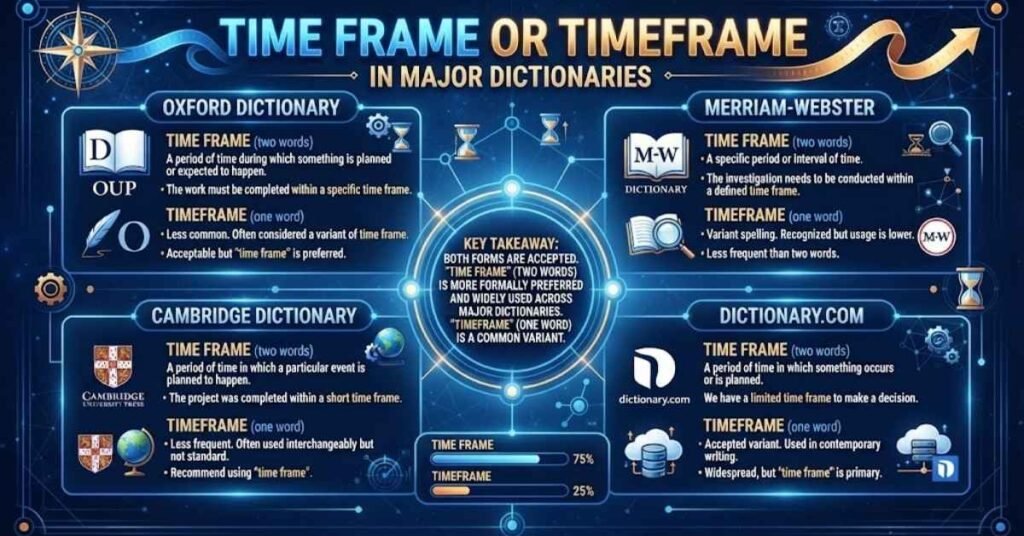
Major dictionaries list both versions.
Merriam-Webster and Cambridge Dictionary both recognize the term, with the open form usually leading.
Merriam-Webster’s historical usage notes place the phrase as far back as 1893.
That’s a long life for a word people still argue over.
Dictionary entries can change, so check the current page before you publish.
Two minutes of checking beats a week of corrections.
Time Frame or Timeframe in Style Guides
AP Style, Chicago style, and APA style don’t make a big deal of this word.
None of them treat one form as an outright mistake, as far as I’ve seen.
Corporate style guides and institutional style guides are different.
Many of them pick a winner so every document looks alike.
Publication-specific rules always beat general advice.
If your editor says “one word,” it’s one word.
Which Spelling Should You Use?
Here’s the rule I’d hand to a new writer.
Default to time frame, unless your style guide says otherwise.
Switch to timeframe when it matches your interface, brand voice, or existing documentation consistency.
Don’t flip back and forth inside one piece.
Ask yourself one question.
“What will my reader expect to see?”
Time Frame vs Timeframe in Business, Academic, and Everyday Writing
Where you write changes what looks natural.
Let’s walk through three common spots.
Time Frame vs Timeframe in Business Communication
Business communication leans practical.
In professional emails and investor reports, either form works if you stay consistent.
Picture a project manager writing, “Please confirm the delivery timeframe by Friday.”
Short, clear, and nobody stops to question the spelling.
For corporate communication shared outside your company, choose time frame.
It reads a touch more polished.
Time Frame vs Timeframe in Academic Writing
Academic writing rewards caution.
In research papers and university writing, time frame is the safer bet.
Journals often follow APA style or Chicago style.
Editors may also change your spelling to match the journal.
If you’re describing a research study or experiment, state the time frame clearly.
“Data were collected over a six-month time frame” tells the reader exactly what happened.
Time Frame vs Timeframe in Everyday Writing
Everyday writing is relaxed.
Texts, school assignments, and blog posts can go either way.
Your friend won’t grade your group chat.
Still, pick one and use it the same way each time.
News writing and journalism usually follow a house style.
That’s why you’ll see both in different newspapers.
Time Frame Grammar: Hyphens, Plurals, and Verb Forms
Now the grammar rules most people trip over.
Don’t worry, there are only four.
Each one takes about a minute to learn.
Then you’ll never second-guess them again.
Should Time Frame Be Hyphenated?
Usually, no.
You’d write “the time frame is tight,” not “time-frame.”
The hyphen rules change when the phrase becomes a number modifier.
Then the hyphen sits between the number and the unit, as in a six-month time frame.
You’ll see time-frame with a hyphen now and then.
It’s an old habit, and most modern guides skip it.
Why the Time Unit Stays Singular
Here’s a rule that confuses many writers.
When a number and a time unit modify a noun, the unit stays singular.
So write three-year time frame, not “three-years time frame.”
The same goes for a 30-day time frame, a 90-day time frame, and a 48-hour time frame.
Compare it with a normal sentence.
“The project lasts three years” is plural, but “a three-year project” is not.
What Is the Plural of Time Frame?
Easy one.
The plural forms are time frames and timeframes.
It’s a countable noun, so you can count it.
“We tested two time frames before choosing one” is perfectly fine.
Keep your plural in the same style as your singular.
Don’t write “time frame” in one line and “timeframes” in the next.
Can Time Frame Be Used as a Verb?
Not in standard use.
You won’t find “we time-framed the launch” in careful writing.
The verb forms people actually use are phrases.
For example, you set a time frame, establish a time frame, or propose a time frame.
You can also extend a time frame or work within a time frame.
Those phrases keep your writing natural and clear.
Common Mistakes With Time Frame and Timeframe
Let’s talk about what goes wrong.
These are the common mistakes I see most.
- Mixing forms in one document. You write “time frame” in the intro and “timeframe” in the conclusion.
- Pluralizing the unit. “A five-days time frame” should be “a five-day time frame.”
- Adding a stray hyphen. “Time-frame” looks dated in most business writing.
- Confusing it with a deadline. A window isn’t the same thing as a due date.
- Ignoring house style. Your editor’s rule wins every time.
Fix these five and you’re ahead of most writers.
Sound easy? It is.
Time Frame vs Timeline, Timespan, Timescale, Duration, and Deadline
These words look related, and they are.
They’re just not interchangeable.
Mixing them up can make a plan sound vague.
Let’s sort them out one by one.
Time Frame vs Timeline
A timeline shows events in chronological order.
A time frame is the window those events fit inside.
Picture a wedding.
The time frame is “June to August,” and the project timeline lists every task inside it.
You need both for solid project planning.
One gives the boundary, the other gives the steps.
Timeframe vs Timespan
A timespan measures the length between two points.
It’s more about “how long” than “when.”
“The timespan between the two studies was ten years.”
That sentence talks about length, not a planned window.
You can use timeframe when you’re setting a limit.
Use timespan when you’re describing what already happened.
Timeframe vs Timescale
Timescale shows up in science and long-range thinking.
It describes the scale at which something changes, like geological versus daily.
A biologist might discuss the timescale of evolution.
That’s very different from an estimated timeframe for a website launch.
If you’re planning tasks, skip timescale.
Stick with time frame or time window.
Timeframe vs Duration
Duration tells you how long something lasts.
It doesn’t say when it starts or ends.
“The meeting’s duration is 45 minutes.”
That answers “how long,” not “which window.”
Use timeframe when the dates or limits matter.
Use duration when only the length matters.
Time Frame vs Deadline
A deadline is one fixed point.
A time frame is a stretch that leads up to it.
Your boss might say, “The project deadline is May 30.”
You then plan your work inside a reasonable time frame before that date.
Never call a deadline a time frame.
That small slip can create real confusion in contracts and service level promises.
Related Terms and Common Variations
Writers use plenty of neighbors for this word.
Some are true time frame alternatives, and some aren’t quite.
Good stand-ins include time period, period of time, time window, interval, and schedule.
Timetable and completion window also work in the right context.
You’ll also spot phrases like short time frame, long time frame, and flexible timeframe.
Others include limited timeframe, target timeframe, and specified timeframe.
Time Frame and Timeframe in Modern Digital Writing
Screens changed how we spell.
Short, tight words win on buttons and menus.
That’s why timeframe feels at home in menu items, software filters, and user manuals.
Look at any analytics tool, and you’ll likely see “Custom timeframe” or “Reporting timeframe.”
SEO writing adds another twist.
People search both spellings, so smart writers use each naturally and keep search intent in mind.
Origin / Evolution of Time Frame and Timeframe
Language evolution rarely follows a straight line.
Two words often merge into one after decades of use.
Merriam-Webster evidence points to an early appearance of time frame in 1893.
The one-word version arrived later and grew as digital writing exploded.
This pattern is common with compound words.
Think “website,” “online,” and “email,” which all started in pieces or with hyphens.
How to Remember the Correct Spelling
Here’s a simple trick.
Think “frame the window.”
If you’re writing for people, keep the window open.
That’s your reminder to use the open compound, time frame.
If you’re labeling a button, close it tight.
That’s the closed compound, timeframe, for compact space.
Conclusion
Both spellings are right. Your job is to pick one and keep it the same throughout.Default to time frame for formal, academic, and client-facing work. Use timeframe when your brand or interface terminology calls for it.
Which one do you use at work? Drop your answer in the comments, and share this with the teammate who keeps asking.
FAQs
Is timeframe one word or two words?
Both are accepted. Timeframe is one word, and time frame is two.Most formal writing still prefers the two-word form. Check your style guide if you’re unsure.
Which is correct: “timeframe” or “time frame”?
Neither is wrong. They’re just two accepted spellings of the same term.Choose based on your audience andhouse style. Then stay consistent.
What does “time frame” mean?
It means a fixed period or window for something. Think of the “when” around an activity.For example, “a 30-day time frame” sets a clear limit. Simple as that.
What does “timeframe” mean?
It has the exact same meaning as the open form. It’s just the closed form version.You’ll see it a lot in software interfaces. It’s short, tidy, and easy to read.
Is “time frame” correct in formal writing?
Yes, and it’s usually the safer pick. It matches most traditional editorial standards.Academic and business English both accept it comfortably. When in doubt, go with two words.
Which spelling is more commonly used today?
Time frame still leads in print. Timeframe keeps growing online.Word frequency shifts over time. Check current usage if it matters for your project.
Why do dictionaries show both forms?
Dictionary variants reflect real usage. When many writers use a form, lexicographers record it.That’s how language development works. Dictionaries follow people, not the other way around.
How do I choose the correct form?
Start with your style guide. If none exists, use time frame for formal work.Then check your audience and platform. Keep the same spelling from top to bottom.

Mubeen is a passionate writer who shares simple and practical English grammar, vocabulary, and writing tips at ScoopVisly.