

You saw “stfu” in a text and froze for a second.Was it a joke? Was your friend mad at you? Or is this just how people talk online now?Here’s the short answer. STFU stands for “Shut The F*** Up.” It’s one of the most common pieces of internet slang used in text messages, group chats, and social media comments. It can be playful among close friends or genuinely rude depending on who says it and how.
This guide breaks down everything: the STFU full form, real chat examples, platform specific usage, and safer alternatives when you want the same energy without sounding harsh.
What Does STFU Mean in Text & Chat?
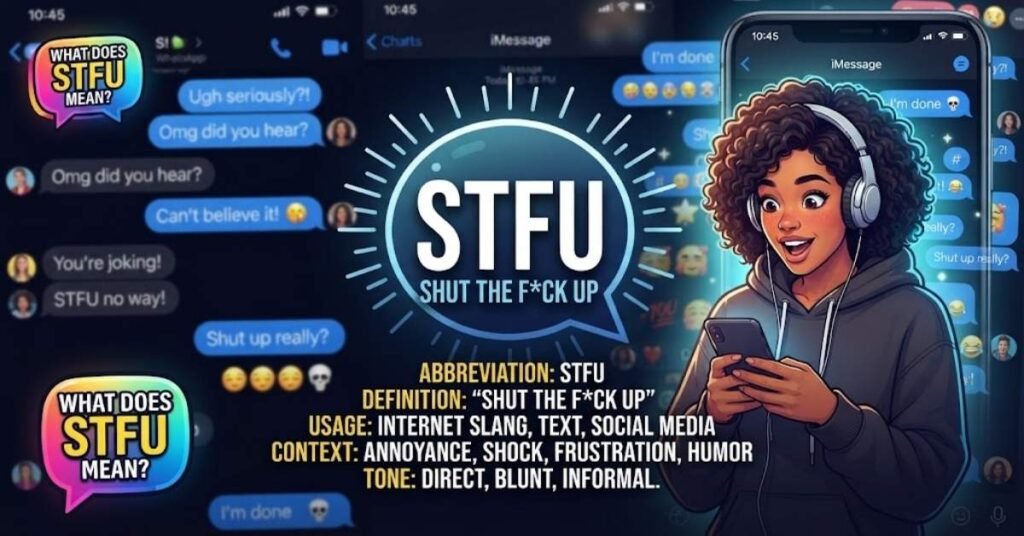
STFU meaning in text is simple on the surface. It tells someone to stop talking, usually in a blunt or forceful way.
But tone in texting changes everything. The same four letters can mean “you’re hilarious, stop” between best friends, or “I’m genuinely annoyed with you” in a heated argument. Context and the relationship between the two people decide which one it is.
That’s the tricky part about texting slang in general. Words carry no voice, no face, no body language. So STFU abbreviation gets read differently by different people, even in the exact same sentence.
Quick Chat Examples
- Friend: “I just got the concert tickets!” You: “STFU no way, for real?”
- Coworker venting: “STFU, that’s so unfair, I’m sorry.”
- Heated argument: “Just stfu already, I don’t want to hear it.”
Notice how the punctuation, caps, and situation shift the meaning each time.
Is STFU Appropriate for Everyone?
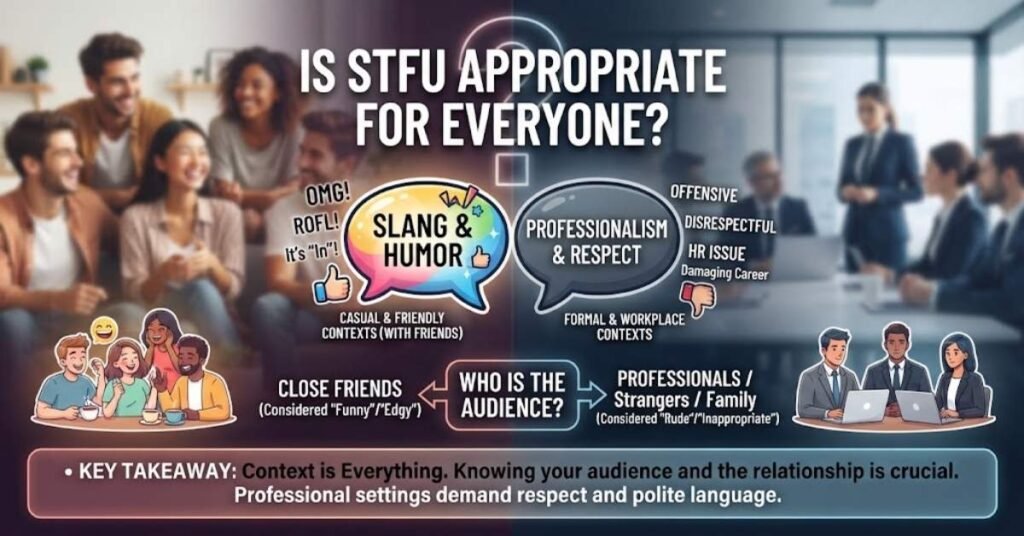
No, and this is where a lot of people get it wrong.
STFU slang works fine in casual conversations with close friends who already know your sense of humor. It does not belong in work emails, messages to clients, or chats with teachers and managers. Using it there can come across as disrespectful, even if you meant it as a joke.
Age and relationship also matter here. What’s normal banter between two twenty year olds on Discord could feel jarring coming from a stranger or a new coworker. If you’re unsure whether someone will laugh or feel insulted, that uncertainty is your answer. Skip it.
What Should You Say Instead of STFU?
Sometimes you want the same punch without the harshness. Good news, there are softer alternatives that still land.
Try phrases like “no way, seriously?” or “stopppp, are you kidding me?” for excited reactions. For a lighter way to ask someone to pause, “could you give me a second?” or “let’s keep it respectful” both work well in mixed company. These respectful alternatives keep the energy without risking offense.
- Playful excitement: “You’re kidding!” or “Seriously?”
- Asking for quiet respectfully: “Be quiet please” or “Can we pause for a moment?”
- Setting a boundary calmly: “I don’t like being spoken to that way.”
Full Form, Stands For & Short Meaning of STFU
The STFU full form is “Shut The F*** Up.” That’s what it stands for, no hidden trick behind it. It’s a blunt, no filter way of telling someone to stop talking.
It falls under the wider bucket of internet abbreviations, sitting alongside terms like LOL, BRB, and SMH. These short forms exist because typing fast matters more than typing formally when you’re mid conversation on your phone.
Short Meaning of STFU
In one line: it means “stop talking,” delivered with more force than a polite request. Whether that force reads as funny or offensive depends entirely on delivery.
Friendly vs Rude Usage
Friendly Usage
Among close friends, STFU often shows up as a reaction to surprising or exciting news. It’s less command and more exclamation, similar to saying “no way” but with extra punch.
Rude Usage
In arguments or when someone genuinely wants another person to stop, it becomes an actual insult. This version carries real aggressive language and can escalate a conversation quickly.
Why People Use Abbreviations Like STFU
Speed is the main driver. Digital conversations move fast, and typing full sentences slows things down. Abbreviations let people react in real time without breaking the flow of a chat.
There’s also a social layer to it. Using slang like this signals familiarity with internet culture and online behavior, almost like a shared language among people who grew up chatting online.
Origin, History & First Known Use of STFU
STFU didn’t appear out of nowhere. It grew out of a much older habit of shortening blunt phrases for faster typing.
Early Internet Culture
Back in the days of IRC chat rooms and early online forums, typing speed was everything. People shortened common phrases into acronyms so conversations could keep pace with real time chatting, and blunt expressions like this one fit right in.
Growth Through Memes & Social Media
As meme websites and social media platforms grew, so did the reach of terms like this. Meme comments sections became a breeding ground for casual, reaction based slang, and STFU rode that wave straight into mainstream online culture.
First Known Use
Language researchers and slang dictionaries trace casual internet acronyms like this back to online communities from the late 1990s and early 2000s, a period often called the early texting era of internet history. It spread through chatrooms before smartphones even existed, then carried over naturally once SMS texting became common.
How People Use STFU in Daily Conversations
This phrase shows up more often than people realize, and not always with bad intent.
Common Daily Uses
1. Shock or Excitement
“STFU, you got the job?!” This use has nothing to do with anger. It’s pure disbelief and excitement rolled into one reaction.
2. Joking With Friends
Between friends who trust each other, it becomes playful banter, almost a compliment in a weird way. Nobody involved actually wants the other person to stop talking.
3. Anger or Frustration
Sometimes it’s exactly what it sounds like. Someone is annoyed and wants the conversation or noise to stop immediately.
Where People Commonly Use It
You’ll spot it in group chats, gaming chats, Discord servers, and comment sections across nearly every major platform. It’s especially common among younger internet users who treat it as everyday chat slang rather than something shocking.
When You Should Avoid Using STFU
Skip it in professional conversations, school discussions, or any customer service chats. Even if you’re frustrated, there are calmer ways to express that without damaging a relationship or your reputation.
STFU Meaning Across WhatsApp, Instagram, TikTok & Snapchat
Each platform has its own rhythm, and STFU fits into that rhythm slightly differently everywhere.
On WhatsApp, it usually shows up in personal or group chats among people who already know each other well. It leans more toward the playful side here since most WhatsApp threads are private and informal.
On Instagram, you’ll see it in comments reacting to surprising posts, reels, or stories. It works as a quick, expressive reaction rather than a genuine command to stay silent.
TikTok
TikTok comment sections are full of this term, often stacked with emojis for extra emphasis. It’s practically shorthand for “I can’t believe this” in that space.
Snapchat
On Snapchat, usage tends to mirror close friendships since most conversations there happen between people who already talk daily. The tone is usually light and joking.
Important Note About Tone
Across every platform, punctuation and emojis change the reading. “stfu 😂” reads completely differently from “STFU.” typed alone with a period. Always check what surrounds the word before reacting to it.
Different Meanings of STFU in Other Fields
Outside of internet slang, this abbreviation occasionally pops up meaning something else entirely.
Possible Alternative Meanings
In niche or unrelated contexts, people have used it to mean “Special Task Force Unit,” “Start The Follow Up,” or “Stand Together For Unity.” These are rare and mostly limited to specific organizations or internal jargon.
Why Context Matters
If you saw this in a military document or a business memo, it almost certainly isn’t referring to internet slang. Context clues and the surrounding language context tell you which meaning applies.
Internet Slang Usually Wins
That said, in text messages, chat messages, and social media comments, the internet slang meaning wins nearly every single time. Unless you’re reading something clearly professional or technical, assume the common definition.
Common Confusions, Mistakes & Wrong Interpretations
People misread this term constantly, and it causes more miscommunication than you’d expect.
Common Mistakes
Thinking It Is Always Funny
Not every use is a joke. Some people type it while genuinely upset, and treating it as playful in that moment can make things worse.
Using It in Professional Chats
Sending this to a boss or client, even as a joke, can damage how you’re perceived. It’s simply not built for workplace communication.
Misreading Tone
Reading it as angry when it was meant as excitement, or the reverse, leads to unnecessary arguments. Always pause and consider the full conversation tone before reacting.
Another Common Confusion
Some newer internet users confuse it with similar sounding acronyms like GTFO or SMH, assuming they all mean the same thing. They don’t. Each carries its own shade of meaning and intensity.
Best Practice
When in doubt, read the last few messages before it. The surrounding conversation context almost always clears up the confusion.
Similar Terms, Alternatives & Related Slang
STFU doesn’t exist alone. It’s part of a much bigger family of text abbreviations.
Related Slang Terms
Terms like LOL (laugh out loud), BRB (be right back), IDK (I don’t know), IDC (I don’t care), SMH (shaking my head), GTFO (get the [expletive] out), OMG (oh my god), and TTYL (talk to you later) all serve similar quick reaction purposes in online messaging.
Softer Alternatives to STFU
If you want the impact without the sting, try “alright, relax,” “let’s keep it respectful,” or “okay, I’ll stop.” These work especially well in mixed groups or professional etiquette situations.
Examples
- Instead of an angry STFU: “I don’t like being spoken to that way.”
- Instead of a joking STFU: “Stopppp, no way!”
Examples of STFU in Real Chat Situations
Seeing it in action makes the meaning click faster than any definition.
Funny Reactions
“STFU, you actually did that? I’m dying.” This is pure amusement, nothing hostile about it.
Shocked Responses
“Wait, stfu, they got engaged?!” Shock and disbelief, often followed by a dozen question marks.
Angry Usage
“Can you just stfu for one second, I’m trying to think.” Here, frustration is the driving emotion.
Gaming Chat
In competitive matches, especially within gaming communities, you’ll hear “stfu” thrown around during intense moments, sometimes joking, sometimes not, depending on how the match is going.
Friendly Group Chat
“stfu bestie you always do this 😂” This is affectionate teasing, common in tight knit friendly conversations.
How to Reply When Someone Says STFU
Your response should match the situation, not just the words on the screen.
If They Are Joking
Laugh along or reply with something equally playful. Matching their energy usually keeps things light and fun.
If They Sound Angry
Stay calm and ask what’s actually bothering them. Reacting with more aggression rarely helps, and it usually escalates a small issue into a bigger one.
If You Feel Uncomfortable
You’re allowed to say so directly. Something like “I don’t like being spoken to that way” sets a clear, respectful boundary.
Smart Online Communication Tips
- Pause before reacting emotionally to a single word.
- Look at recent messages for tone clues.
- Ask directly if you’re unsure what someone meant.
Is STFU Still Popular? Trends & Online Usage
Yes, and it doesn’t look like it’s slowing down anytime soon.
Why It Is Still Trending
Viral slang tends to stick around when it’s flexible enough to fit multiple situations, and this term checks that box perfectly. It works for shock, humor, and frustration, which keeps it relevant across different moods and conversations.
Popular Platforms
It remains especially common on Twitter/X, Reddit, Discord, and TikTok, where fast, reactive comments dominate the culture. Mainstream internet slang tends to concentrate on exactly these kinds of platforms.
Shift in Meaning
Compared to its early days, the term now leans more toward humor and disbelief than genuine hostility. Language evolution naturally softens harsh phrases over time as more people adopt them casually.
Will It Stay Popular?
Given how deeply it’s embedded in modern slang and everyday online messaging, it’s likely to stay relevant for years, even as new trending slang comes and goes around it.
Conclusion
STFU carries more nuance than its blunt full form suggests. Among friends, it’s often just an expressive reaction, a stand in for “no way” or “I can’t believe it.” In tense moments or professional spaces, it turns into something you’d want to avoid entirely.Reading the room, or in this case, reading the chat, matters more than memorizing a single definition.
Pay attention to tone, platform, and relationship before you type it, or before you react to someone else typing it. That’s really the whole trick to using internet slang well.Got a favorite way you use it, or a story where it went wrong? Drop it in the comments and share this with a friend who still gets confused by texting slang.
FAQs
What does STFU stand for in texting?
It stands for “Shut The F*** Up,” a blunt way of telling someone to stop talking, though tone usually softens the meaning in casual chats.
Is STFU rude?
It can be, depending on context. Among friends joking around, it’s usually harmless. In arguments or professional settings, it reads as disrespectful.
What does “stfu 😂” mean?
Adding a laughing emoji almost always signals playful disbelief rather than genuine anger, similar to saying “no way” in shock.
Is STFU bad to say to friends?
Not necessarily, as long as your friend group already uses this kind of language casually and understands it as a joke rather than an insult.
What apps use STFU the most?
It shows up heavily on TikTok, Instagram, Discord, Reddit, and Twitter/X, mostly in comment sections and fast paced group chats.
Can STFU mean something else?
Rarely, yes. In specific professional or organizational contexts it has been used for phrases like “Special Task Force Unit,” though this is uncommon compared to its internet slang meaning.

Mubeen is a passionate writer who shares simple and practical English grammar, vocabulary, and writing tips at ScoopVisly.