

You got a text with “JSP” in it. Now you’re stuck wondering what it means.Is it a joke? A jab? Something serious? That confusion is exactly why so many people search for JSP meaning in text every single day.Here’s the short answer. JSP usually means “Just Saying, Period” or “Just Playing” in casual texting.
But it can also mean “Je ne sais pas” (French for “I don’t know”) or even refer to JavaServer Pages in tech circles. The right meaning depends entirely on who sent it and where.Let’s break down every context so you never have to guess again.
JSP Meaning & Definition
At its core, JSP abbreviation stands for a handful of things, and texting is where it gets messy. In everyday texting slang, JSP most commonly means “Just Saying, Period.” People use it to drop an opinion and shut the conversation down at the same time.
Sometimes it flips into “Just Playing.” Someone teases you, then throws in JSP so you know they’re not being mean. It softens the blow. Think of it as a digital wink.
Outside of casual chat, the JSP full form can mean something completely different. In tech, it’s JavaServer Pages. In French texting, it’s “Je ne sais pas.” Context is everything here, and we’ll get into each one.
JSP Background & History

Slang like this didn’t just appear overnight. It grew out of early 2000s internet shorthand, back when character limits on SMS forced people to shorten everything. Fast typing habits became the norm, and abbreviations like JSP, IDK, and TBH filled that gap.
Chatrooms and early internet forums played a huge role too. People needed quick ways to react without typing full sentences. Chatroom language rewarded speed over grammar, and JSP fit right in as a snappy way to end a thought.
Fast forward to now, and this kind of digital language hasn’t slowed down. If anything, social platforms made it spread faster. What started as SMS shorthand now shows up in comment sections, group chats, and even gaming lobbies.
Usage in Different Contexts
Context changes everything with JSP. In a group chat among friends, it often reads as playful. Drop it after a wild claim, and everyone knows you’re joking around, not picking a fight.
In more serious or professional communication, JSP rarely belongs at all. If it shows up in a work email, it’s almost certainly not slang. It’s likely referring to something technical or an internal document name, which we’ll cover further down.
Then there’s the French angle. If a French speaker or bilingual friend texts “JSP,” they might genuinely mean “Je ne sais pas,” or “I don’t know.” No sarcasm, no jokes, just a shrug in text form. This is a great example of why context-based meaning matters so much with short abbreviations.
Meaning in Chat, WhatsApp, Instagram, TikTok
Every app has its own flavor of slang, and JSP adapts depending on where it lands. On WhatsApp, it usually pops up in group chats among friends or family, often as a lighthearted way to state an opinion and move on.
On Instagram, you’ll spot it in Instagram comments and Instagram DMs. Someone drops a bold take under a photo, adds JSP, and basically says “that’s my opinion, deal with it.” It’s common under disappearing stories too, where the tone is naturally more casual.
TikTok takes it even further. In TikTok comments, JSP often pairs with humor or exaggerated jokes. Someone makes an outrageous claim about a trend, tags it JSP, and the whole comment section understands it’s for laughs. Emojis and punctuation usually ride along to make the tone crystal clear.
Meaning in Physics, Medical, and Aircraft Terminology
Here’s where things get interesting. Outside of texting, JSP shows up in totally unrelated fields, and mixing these up causes real confusion.
In aviation terminology, JSP can refer to Joint Strike Project, tied to certain aircraft documentation. It’s a formal term used in reports, not something you’d casually text a friend.
Medical terminology has its own version too, sometimes tied to clinical trial naming conventions. And in Government terminology and Military terminology, JSP frequently stands for Joint Service Publication, a term deeply rooted in UK defense documentation. None of these have anything to do with the slang version, but Google search results often blend them together, which is exactly the kind of confusion this article aims to clear up.
JSP in Coding and Technology
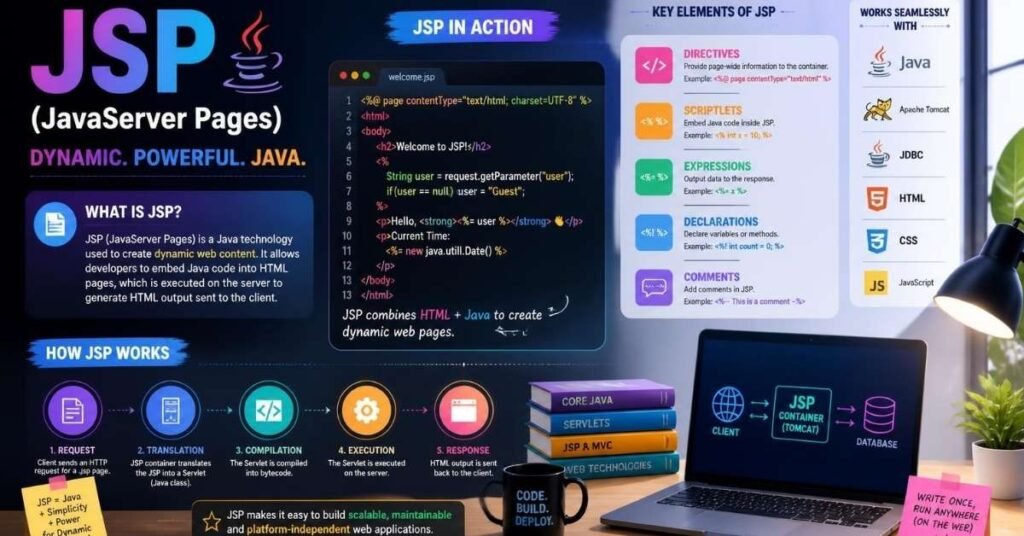
If you’ve spent time in technology forums or studied web development, JSP means something else entirely. JavaServer Pages is a server-side technology built by Sun Microsystems, used to create dynamic websites.
This version of JSP lets developers embed Java code directly into HTML pages. It was a major part of early Java web technology, and many legacy systems still run on it. If you’re in coding forums asking about JSP, you’re almost certainly asking about this, not the texting slang.
This is one of the biggest JSP misconceptions online. People searching for the texting meaning sometimes land on pages about JSP technology in Information Technology, and it leaves them more confused than before. Knowing which world you’re in, chat or code, saves a lot of headache.
Common Misconceptions
A lot of JSP myths float around simply because the abbreviation is overloaded. One common mix-up is JSP vs JS, where people confuse the texting term with JavaScript shorthand. They’re not related at all.
Another misconception is assuming JSP always means the same thing across every platform. It doesn’t. What reads as playful on TikTok might come off as blunt or dismissive somewhere else. Tone interpretation genuinely depends on the platform and the people involved.
Some also assume JSP is a newer term invented by Gen Z. In reality, its slang roots stretch back further, even if Gen Z slang trends have kept it alive and evolving in fresh directions.
Similar Terms & Alternatives
JSP doesn’t exist alone. It sits alongside a whole family of abbreviation meanings that serve similar purposes. Just Saying on its own carries a lighter tone without the added “Period” for emphasis.
Then you’ve got IMO (In My Opinion) and IMHO (In My Humble Opinion), both softer ways to share a take. TBH (To Be Honest) leans more toward honesty than opinion. FYI (For Your Information) is purely informational, no opinion attached at all.
Don’t forget JK (Just Kidding) and IDK (I Don’t Know), which overlap with JSP’s playful and French meanings respectively. Knowing these slang alternatives helps you pick the right one when you’re texting, instead of leaning on JSP for everything.
How to Respond to It
So someone sends you JSP. What now? If it reads as an opinion, a simple acknowledgment works fine. Something like “fair point” or “noted” keeps the conversation etiquette intact without escalating anything.
If it’s clearly playful, match the energy. A laughing emoji or a playful response back tells them you got the joke. This is where online replies thrive on tone matching rather than overthinking things.
If you’re unsure, just ask. “Wait, are you joking or serious?” is a completely normal thing to send. Nobody expects you to be a mind reader, and clarifying keeps the casual replies natural instead of awkward.
Differences from Similar Words
It helps to line JSP up against its cousins directly. JSP tends to carry more finality than “Just Saying” alone, almost like a mic drop. IMO and IMHO, by contrast, invite pushback or discussion.
TBH focuses on honesty rather than opinion. If someone says “TBH, I didn’t like the movie,” they’re being upfront, not necessarily ending the topic. JSP, on the other hand, often signals “this is my stance, take it or leave it.”
This abbreviation comparison matters because picking the wrong one changes how your message lands. Using JSP when you meant TBH might come across sharper than intended, and that small mismatch can shift the whole conversation tone.
Relevance in Online Conversations & Dating Apps
Dating apps have their own texting culture, and JSP fits right in. Someone drops a bold statement about their type or a pet peeve, then adds JSP so it reads confident rather than aggressive. It’s a small but effective tone softener.
In flirting online, playful jabs are common, and JSP often shows up attached to teasing messages. It keeps things light while still letting someone state a real preference. This is very different from a formal setting, where the same words would feel out of place.
Online communities, especially in gaming chats, use JSP similarly during trash talk. It’s part of the fun, not a genuine insult. Understanding this relationship context helps you avoid misreading a joke as a real jab.
A Quick Note on Reading Tone Correctly
Reading tone through text alone is genuinely hard. There’s no face, no voice, just words on a screen. That’s why emotional context and communication cues like emojis, punctuation, and even reply speed matter so much.
If JSP comes with a laughing emoji, it’s almost certainly a joke. If it’s dry, no punctuation, sent after a tense conversation, it probably carries a firm opinion behind it. Your texting behavior history with that person also plays a role. A close friend joking around reads differently than a stranger typing the same words.
When in doubt, don’t assume the worst. A quick clarifying question beats a misunderstanding every time, especially in relaxed atmosphere group chats where jokes fly fast.
JSP Usage in 2026
Slang doesn’t stay still, and JSP usage in 2026 looks a bit different from a few years back. It’s still common among younger users, but plenty of adults using slang have picked it up too, especially across messaging apps and social media communication.
What’s changed is how it blends with modern slang trends. It now often pairs with newer expressions and reaction memes, showing up in digital conversations far beyond simple texting. This kind of slang evolution is normal. Words rarely disappear, they just adapt to whatever platform is popular that year.
Expect JSP to stick around a while longer. Internet culture tends to recycle and remix old terms rather than dropping them completely, and JSP has proven flexible enough to survive across contexts.
Conclusion
JSP isn’t one thing. It’s several things wearing the same three letters. In everyday texting language, it usually means “Just Saying, Period” or “Just Playing.” In French, it’s “Je ne sais pas.” In tech, it’s JavaServer Pages. In government and defense papers, it’s Joint Service Publication.The trick is reading the room.
Who sent it? Where? What’s the conversation been like so far? Once you factor those in, JSP stops being confusing and starts making sense almost instantly.Got a JSP story of your own, a mix-up or a moment it saved you from an awkward reply? Drop it in the comments. And if this cleared things up, share it with a friend who’s still confused.
FAQs
What does JSP mean in a text message?
It usually means “Just Saying, Period” or “Just Playing,” depending on the tone of the conversation. Check the context before assuming which one applies.
Is JSP rude to use?
Not typically. It can sound blunt if used dry, but among friends it’s usually playful rather than rude.
Does JSP mean the same thing on every platform?
No. WhatsApp, Instagram, and TikTok each carry slightly different vibes, even though the core meaning stays similar.
Can JSP be used in professional emails?
Generally, no. It doesn’t fit professional email etiquette and could confuse a formal reader.
What does JSP mean in coding?
In web programming, JSP stands for JavaServer Pages, a technology for building server pages and dynamic web applications.
Is JSP still used in 2026?
Yes, it remains part of casual language trends, especially in texting and social media comment sections.
How do I know if someone is joking when they use JSP?
Look at message intent, accompanying emojis, and your history with that person. When it’s still unclear, just ask directly.

Mubeen is a passionate writer who shares simple and practical English grammar, vocabulary, and writing tips at ScoopVisly.